




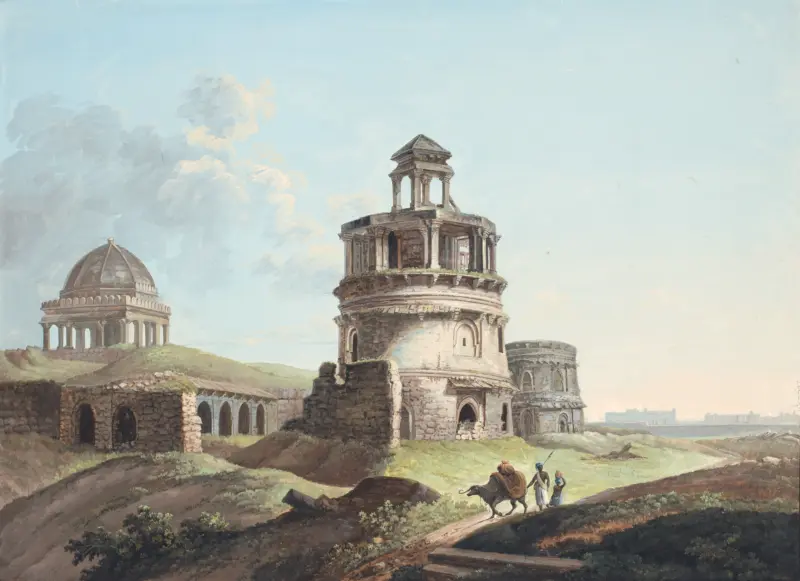

The seven years that Thomas and William Daniell spent in India in the late 18th century set the bar for the future of landscape painting in India so high, even brilliant artists from across the world couldn't drag the spotlight onto themselves.
Tracing the evolution of the picturesque aesthetic in India in the post-Daniells era, 'The Indian Picturesque: Landscape Painting 1800-1850', an exhibition at DAG in New Delhi, brings together, for the first time, British and Indian landscape paintings from the early 19th century to examine their artistic interconnections and shared visual vocabulary.
It highlights how artists across cultural contexts shaped a distinctive vision of the subcontinent. Curated by Giles Tillotson, SVP, DAG, the exhibition is on view till May 2.
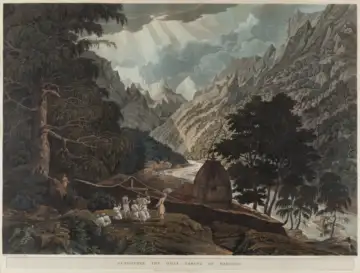
James Baillie Fraser. Gungotree, the Holy Shrine of Mahadeo. Engraving and aquatint, tinted with watercolour on paper, 1820.
With a wide spectrum of artistic practices, from the large-format aquatints of Henry Salt and James Baillie Fraser - inspired by the commercial success of the Daniells - to the intimate rural landscapes of George Chinnery, whose influence extended to numerous amateur artists across Bengal, the show examines the rise of illustrated travelogues and print culture. It expanded the reach of picturesque imagery and shaped public imagination about India both within and beyond the subcontinent. While oil paintings capture atmospheric rural scenes and monumental vistas, often reflecting European academic techniques, watercolours and drawings reveal the immediacy of sketching practices, especially among Company artists and amateur travellers.
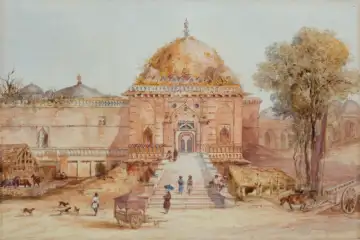
Claudius Richard, William Harris. Front View of the Ruined Mosque, the Jumah Musjid (Mandu). Watercolour and graphite on paper, 1852.
Aquatints and engravings demonstrate the commercial success of illustrated publications, enabling wider circulation of picturesque imagery, while lithographs and travelogues combine text and image to expand the genre of visual narrative. Ceramics and decorative objects illustrate how picturesque motifs entered popular visual culture, particularly in Britain.
Complementing the exhibition is a publication that brings together new scholarship by leading experts and situates the project within broader intellectual and historical contexts.
The essays explore the evolution of the picturesque in India from colonial to contemporary perspectives, the role of amateur sketching networks, and the exchanges between British and Indian practitioners that defined the period's visual culture.