




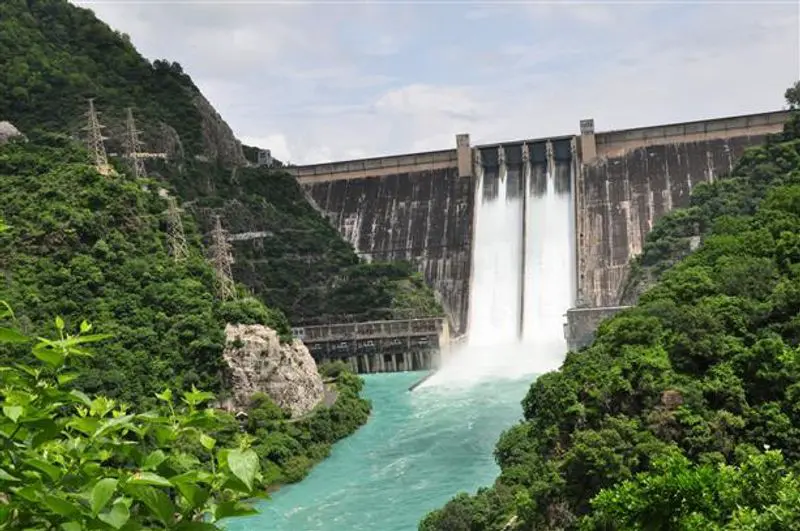

For half-a-century, Bhakra Beas Management Board (BBMB) has been a vital lifeline for north-western India, managing the waters of crucial rivers, operating giant dams and generating hydro-electricity.
The board is commemorating its 50th anniversary in Chandigarh on May 15, with Union Power Minister Manohar Lal scheduled to preside over the functions.
The board manages two key dams, Bhakra on the Sutlej and Pong on the Beas, both situated in Himachal Pradesh, along with several other power houses downstream. The total installed capacity of BBMB projects is 2,936.73 megawatts (MW) and the dams have an irrigation potential of 5.46 million hectares of land, facilitating an average annual water supply of about 34,537 million cubic meters (MCM). The dams also play a crucial role in flood control.
The genesis of BBMB lies in the Indus Waters Treaty of 1960 between India and Pakistan for sharing the water resources of six rivers of north India that flowed into Pakistan. Under this pact, the waters of the three eastern rivers - Ravi, Beas and Sutlej - were allocated exclusively to India, while the waters of the Indus, Jhelum and Chenab were allocated to Pakistan. This paved the way for large-scale development of these river systems to harness their potential for irrigation and power generation.
Bhakra Management Board (BMB) was set up by the Ministry of Power under provisions of the Punjab Reorganisation Act, 1966 for the administration, maintenance and operation of the Bhakra-Nangal project, a joint venture of the states of Rajasthan and Punjab and its successor states of Haryana and Himachal Pradesh. The Bhakra-Nangal project was formally handed over to BMB in October 1967.
The Bhakra-Nangal project had been conceptualised as far back as 1923. The construction of the Bhakra dam started in 1948 and it was opened in 1963, with then prime minister Jawaharlal Nehru describing it as a modern temple of resurgent India.
Bhakra Construction Board (BCB) was constituted under the Act for the execution of Beas project, comprising the Pong and Pandoh dams, and on completion it was transferred to BMB. The construction of the Pong dam, an earthen embankment, had started in 1961 and completed in 1974.
Consequently, BMB was renamed Bhakra Beas Management Board (BBMB) with effect from May 15, 1976, marking its expanded mandate to manage both Sutlej and Beas river systems.
BBMB is a statutory body under the Ministry of Power, with its responsibilities including regulation of water supply from the Sutlej, Ravi and Beas rivers, regulation and supply of power from the BBMB projects, maintenance and operation of the dams, reservoirs and power stations and explore the potential for developing new hydro projects.
Recently, it has forayed into solar power generation and is also pursuing 'pumped storage plants' a kind of hydro power generation system where excess of idle capacity of the major dam is used to pump water to a secondary reservoir at a higher level, the release of which can produce power.
States benefiting from BBMB in terms of electricity, irrigation and drinking water include Punjab, Haryana, Rajasthan, Himachal Pradesh, Delhi and Chandigarh. Water is allocated to the states according to a fixed formula and regular meetings are held between partner states to work out any changes in demand and supply.
BBMB, which comprises about 12,000 employees, including 700 officers, is headed by a full-time chairman appointed by the Central Government. The board consists of a full-time member (Power) and member (Irrigation), who are on the permanent staff of the board responsible for day to day functioning of these domains, two members nominated by the Central Government and a representative each from member states, generally a senior bureaucrat.
In April, the Centre had tweaked the appointment rules for the chairman and the two full-time members, who as a matter of practice were drawn from Punjab and Haryana. The new rules specified that members can be selected from across the country, which led to Punjab raising objections.