




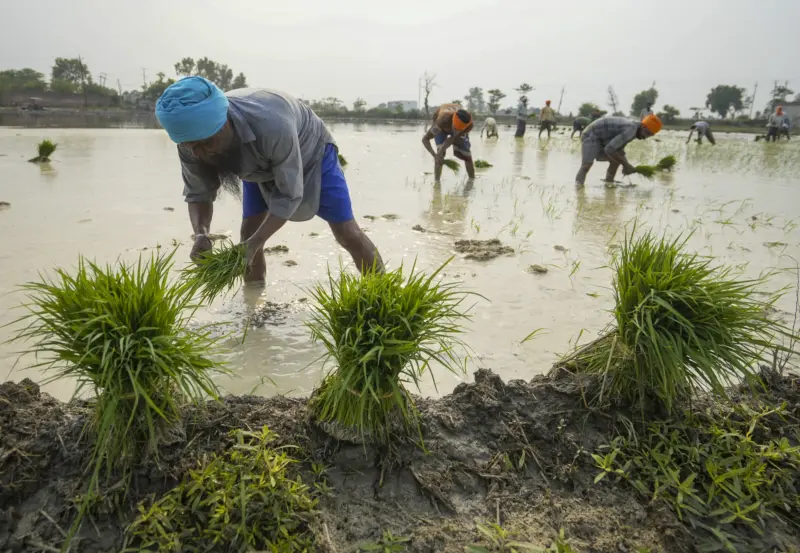

With the Paddy season schedule announced, starting June 1, Punjab's electricity demand is projected to increase by six per cent and reach a record level of over 1,8000 MW. Every paddy season, over 13.94 lakh tubewells pump out gallons of water to irrigate fields, a majority of these borewells are located in the districts with overexploited water table.
Despite repeated reminders and advice by experts, Punjab continues to allow paddy sowing to the start of June as against the proposed date by the end of June - when the monsoon is round the corner. This is the last paddy season of the incumbent government, before the state goes to polls early next year, so the government would want to ensure fool-proof power arrangements.
According to experts in the power sector, the maximum power demand during the coming paddy season is expected to cross 18,000 MW while it was above 17,200 MW during the last paddy season of 2025. Ahead of the crucial Vidhan Sabha elections, this is the last paddy season of the incumbent government and like last year, the zone-wise cultivation of the paddy crop will start from June 1 and the government would hope to meet the highest power demand in the history of the state.
Punjab paddy season begins from June 1 and paddy cultivation covers over 30 lakh hectares and as per weather predictions this year, the number of heat wave days will be more as compared to last year and the monsoon will be below normal of last 10 years' average. The Punjab State Power Corporation Limited (PSPCL) is gearing up for an eight-hour power supply to tube wells amid not so favourable conditions.
Even in April this year, the maximum power demand crossed 12,000 MW, an increase of 800 MW over last April demand.
"In Punjab, the PSPCL internal power supply is around 6,500 MW and it may draw more than 10,500 MW from the grid by way of power purchase, banking arrangements between 3,000 to 3,500 MW, thus making a total of about 17,000 MW. Also short term arrangements in banking, 4,800 MW share of state in centre sector and BBMB plants and purchase of cheap solar power during day time are likely to help the PSPCL meet the peak demand," said an engineer privy to the developments.
Short term power purchases during the coming paddy season will be more than 2,000 million units. The agriculture supply alone may touch 16,000 MU this year. "In Punjab, normally the maximum power demand occurs in the second fortnight of June after complete Punjab tube wells get an eight-hour power supply," said another PSPCL insider.
Tube wells at play
Every tube well pumps out 30.24 lakh litres of water per week with an average eight hours of power supply. This means that around 14 lakh tube wells pump out 4,385 billion litres of water per week.
A recent report submitted to the National Green Tribunal by an expert committee suggests that if paddy transplantation is delayed by a week, the state can meet the demand for water of its 3 crore population for more than 3.5 years.
Ludhiana has maximum tubewells (1.17 lakh), followed by Gurdaspur (99,581), Amritsar (93,946) and Sangrur (93,669). These districts have shown a steepest decline in water table. Farmers in Barnala and Sangrur have been extracting water from the maximum depth by using 17 BHP motors.