
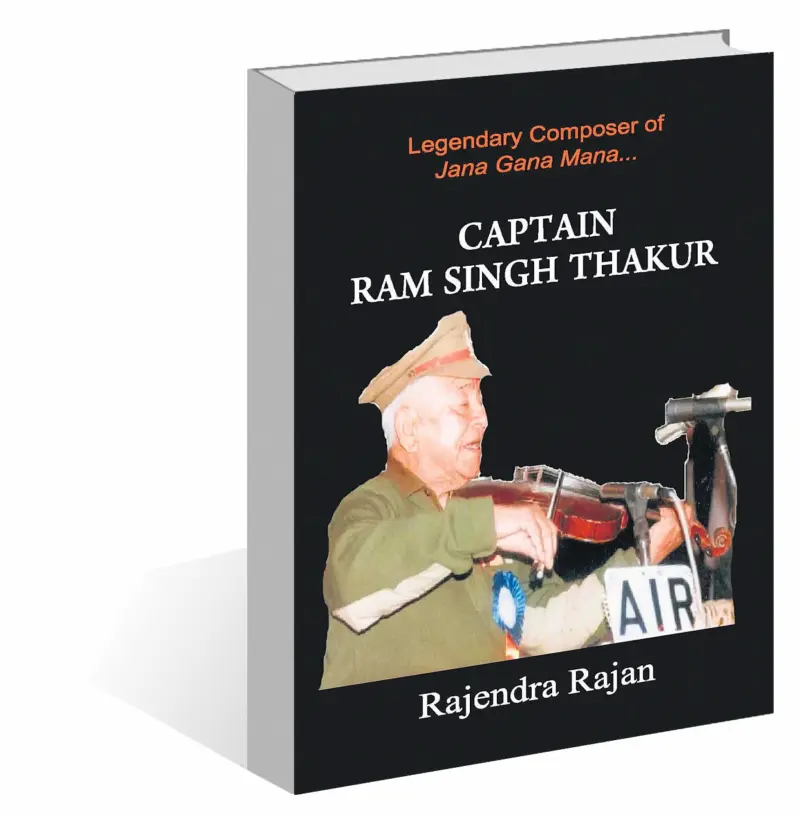

Rajender Rajan's book on Captain Ram Singh Thakur talks about a significant yet understated contribution in India's forgotten nationalist histories.
It's a tribute to the overlooked composer behind the tune of 'Jana Gana Mana' and attempts to restore him to his rightful place in the nation's collective memory.
The chapters take the reader on a historical journey, beginning with the formation of the Indian Independence League in 1920 under Rash Behari Bose to the rise of the Indian National Army under Subhas Chandra Bose in 1942, and post-Independence India.
Within this turbulent nationalist milieu emerges Ram Singh Thakur, born in Bhagsu Khaniara near Dharamsala in Himachal Pradesh, whose life represents a blend of music, military service and patriotic fervour.
The book draws upon interviews of Ram Singh from the Nehru Memorial Museum, memoirs of his son Ramesh Thakur and media reports, weaving an account that is both documentary and personal - his enlistment in the 2nd Gorkha Rifles in 1927, his later association with the INA, and his long service in the Provincial Armed Constabulary (PAC), Lucknow.
Ram Singh's musical inclinations, nurtured under the influence of his maternal grandfather Nathu Chand and further refined through training under British musicians like Hadson and Danish, reveal a fascinating confluence of indigenous and western traditions.
The text foregrounds his versatility as a composer equally at ease with bhajans, Sufi music, qawwalis, Gurbani and Christmas carols. His contribution in creating musical compositions of iconic patriotic songs such as 'Kadam Kadam Badhaye Ja', 'Shubh Sukh Chain', and 'Sare Jahan Se Achha' situates him as a vital but neglected figure of history.
It was Netaji who inspired him to set music and simplify the highly Sanskritised 'Jana Gana Mana' to a simpler martial tune.
The engaging aspects of the book are Ram Singh's association with Netaji, who honoured him with a gold medal for shaping a martial, musical 'Jana Gana Mana' capable of inspiring soldiers. Under Jawaharlal Nehru, an All India INA Orchestra was also formed to support bereaved families of INA soldiers, as a part of state recognition.
Ram Singh's later life in post-Independence India is marked by bureaucratic neglect, emotional distress, and even the indignity of performing at private ceremonies. His poignant assertion, "I am Nepalee but I am an Indian Gorkha," encapsulates his pride in demonstrating his belongingness to India.
Some chapters reflect upon a subtle controversial aspect where Tagore is credited with the lyrics of the national anthem but Ram Singh's role in shaping its martial tune remains marginal in mainstream historiography.
Despite its archival richness, the book falters in execution. The repetition of details and an overemphasis on facts render sections monotonous. The typographical errors disrupt the reading experience, diminishing the aesthetic and intellectual grace of the text.
This work remains an informative read for those interested in subaltern histories and the recovery of marginalised voices. It resists any romantic glorification of the past and offers a plain and unsettling reminder of how nations remember and forget their heroes.
- The reviewer teaches in Government College, Kullu