




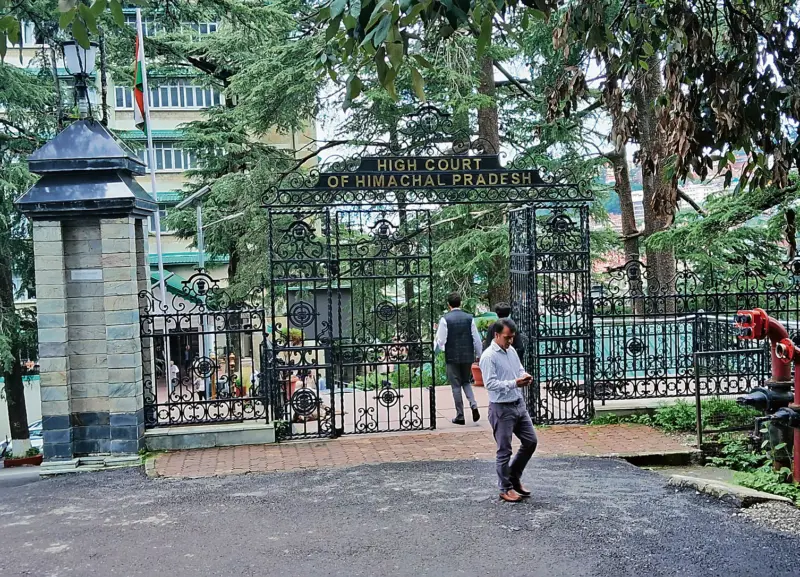

The Himachal Pradesh High Court has barred Shanan Hydroelectric Project from carrying out de-silting operations at the Barot hydroelectric site before March 1 every year - effectively covering the crucial breeding season.
The Bench also ordered scientific monitoring of sediment discharge, and directed Rs 12 lakh compensation for restoring trout populations, while cautioning that "economic consideration will not prevail over the environmental rights".
"It is on the basis of the admissions, we found that in spite of the recommendations made during the lean season, de-silting was being carried out. Respondent-Shanan Hydroelectric Project has, thus, carried out the de-silting solely for the economic gain as such of the project," the Bench of Chief Justice GS Sandhawalia and Justice Bipin Chander Negi observed.
The matter was placed before the Bench after the high court took suo motu cognizance of a letter addressed to the Chief Justice stating that silt discharge from Barot Dam in Mandi district of Himachal Pradesh had affected water purity level, leading to casualty of the marine life in the water
"The present case is about the rainbow trout and brown trout fish being caught in the sandstorm of silt and not being allowed to breath and breed," the Bench asserted, before issuing a series of mandatory directions.
The Bench ordered that the respondent "shall not do any de-silting on the site in question before March 1 of every year." The direction assumes significance as trout breeding is a notified closed season from November to February under the Himachal Pradesh Fisheries Act.
During the de-silting process, efforts would be made to install sensors below the scour outlet and at least at two to three downstream locations to record data on Total Suspended Solids (TSS) discharge and maintain proper monitoring.
The Department of Fisheries would inspect the release of at least 15 per cent of the minimum discharge, as directed by the National Green Tribunal (NGT), during the lean period and the project would not hoard water.
The state would make efforts to constitute a River Monitoring Committee, to be chaired by the Deputy Commissioner, along with senior officers from the Fisheries and Electricity Departments and a representative of the project proponent. The committee would advise on the manner and timing of de-silting, including whether it should be carried out during the day, and recommend restrictions for other projects in areas where trout fish abound and breed.
Keeping in view the damage caused and the need for replenishment of riverine life, the court directed the project proponent to deposit Rs 12 lakh with the Department of Fisheries, which would stock the river with brown trout and rainbow trout in a graded manner over the coming years using the funds. The department would also be at liberty to utilise the amount for further enhancement of aquatic life in the river, subject to furnishing details of utilization. Eventually, the utilisation certificate would be submitted at the level of the Assistant Director (Fisheries).
'Living in a Perpetual Sandstorm'
In its detailed order, the Bench observed apparently the project authorities in 2024-25 had undertaken de-silting in the lean and breeding season from November to February without any effective monitoring, thereby causing heavy turbidity and serious ecological harm. The Bench added it appeared from the records that this was done notwithstanding earlier directions in a related matter, complaints to the Pollution Control Board and other authorities by locals, and newspaper reports
"The undertaking given as such by the respondent that it would be done in a scientific manner in the Uhl river apparently has been blatantly violated," the Bench observed. Referring to expert findings, the court further noted that silt caused turbid aquatic environment, which was like living in a perpetual sandstorm. "The fish obtain oxygen by filtering water through their gills, a task made harder in turbid waters," it was added.
Survival of the fish
The Bench asserted it was of the considered opinion that necessary directions were required to be issued to the project proponent to ensure survival of trout fish in the Barot dam and the two rivers-Uhl and Lambhadagh. "The interests of the generation capacity of the unit has to be as such that are to be safely balanced with the marine life and at the cost of the de-silting as such of the project, the respondent cannot take defence," the Bench observed.
Admonishing the project authorities, the court observed it was for them to have consistently de-silted the reservoir over a period of time. It was on account of their own negligence that they led the silt as such to accumulate over the period of years and not made any attempt as such to de-silt earlier. In a "knee-jerk reaction" over a period of one month as such to desilt has affected the marine life downstream apart from the fact that the TSS levels have gone up out of control from the permissible limits…"
Polluter pays, ecology first
Invoking the "polluter pays" principle and constitutional duty under Article 51-A(g), the court asserted that protection of rivers and aquatic life was a fundamental obligation. It ruled that environmental compensation was justified given the admitted violations and ecological damage.
The matter has been listed for further monitoring on July 31, 2026, with directions for filing of a compliance affidavit - signaling continued judicial oversight over the ecological restoration.
When the high court reached back 150 years
Diving deep into legal history while hearing the river-related matter, the Bench invoked a rule laid down over a century and a half ago to deal with a present-day environmental breach. The Bench quoted the celebrated "Rylands versus Fletcher" case of (1868) - a landmark English tort law case establishing the doctrine of strict liability for abnormally dangerous activities.
The Bench observed that the Supreme Court, in a case dealing with pollution caused by chemical industries in Rajasthan, had found that toxic untreated waste was allowed to flow freely, harming people living nearby. Relying on the rule in "Rylands v Fletcher", the Apex Court held that if an industry kept hazardous material on its land and it escaped, it was fully responsible for the damage - regardless of intent.
Since the industry was operating for profit and failed to take proper steps to control the pollution, the Supreme Court made it pay heavily - imposing Rs 37.385 crore as costs along with compound interest. The Bench placed this principle in the constitutional context as well, noting that Article 51-A(g) casts a fundamental duty on every citizen to "protect and improve the natural environment including forests, lakes, rivers and wildlife, and to have compassion for living creatures."
It was on this foundation that the court held "remedial environmental compensation has to be paid by the project proponent who is responsible for the discharge of the silt from its dam waters"