




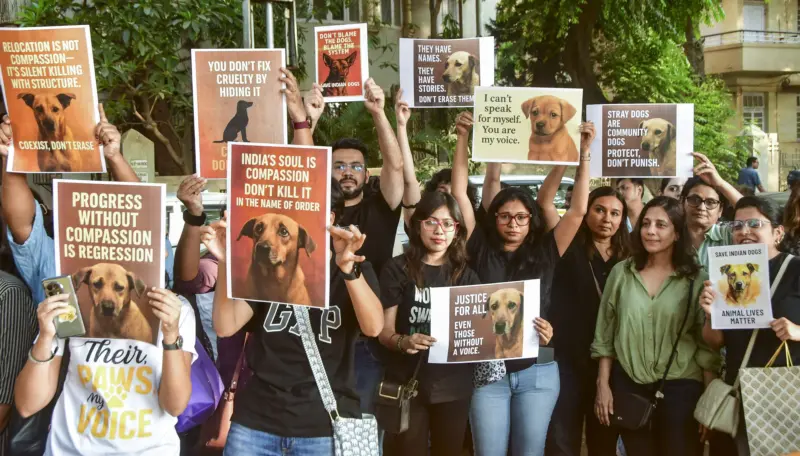

IN July 2025, the Supreme Court took suo motu cognisance of the stray dog menace in the country and instituted a case: 'City Hounded by Strays, Kids Pay Price.' In November 2025, in furtherance of its constitutional mandate to uphold constitutional principles, especially the fundamental right to life under Article 21 of the Constitution, the apex court gave exhaustive directions for the permanent removal of stray dogs from institutional areas, including schools/colleges, hospitals, highways, airports, rail/bus stations.
The court additionally prohibited the release of aggressive/biting stray dogs back onto the streets, and the unregulated feeding of stray dogs in public places.
These directions reversed several provisions of the Animal Birth Control Rules, 2023 (ABC rules), which require the release of stray dogs back to wherever they were picked up from after sterilisation. Predictably, a tsunami of petitions was filed by stray dog activists/NGOs, bizarrely fighting for the “rights" of stray dogs.
To provide context, the ABC rules, which require the sterilisation and release of stray dogs onto the streets, have been a national policy since 2001. These rules were amended in 2023, and arguably made worse, with the allowance of feeding stray dogs in public places, ostensibly to keep them fed and, therefore, supposedly less likely to bite people, and a blanket ban on the removal of stray dogs even if they attacked or killed citizens.
Authored by acclaimed dancer and animal welfare activist Rukmini Devi Arundale, the Prevention of Cruelty to Animals Act, 1960, (PCA Act) is an ‘animal welfare’ legislation as opposed to an ‘animal rights’ one.
The PCA Act does not give rights to animals but, instead, protects them from “unnecessary suffering" and not 'necessary' suffering for the upholding of human rights. It, therefore, allows the humane usage and killing of animals for food, cultural and religious rights and medical research. Most importantly, the PCA Act already recognises the negative impacts of stray dogs on society and their own suffering as homeless dogs and allows for their humane euthanasia.
Conversely, the ABC rules violate their own parent PCA Act by promoting dog homelessness. Over the last 25 years, the ABC policy hijacked public health and safety in the name of “animal rights", a concept alien to the Indian Constitution. They also weaponised Article 51A(g) - an undefined, unenforceable duty to show ‘compassion towards living creatures’, against the weakest and most vulnerable in society, placing their safety and rights below the so-called rights of stray dogs. Proponents of the ABC rules squarely blame the ‘evil humanity’ for all stray attacks on themselves.
As a side note, perhaps the stained legacy of ‘compassion’ via Article 51A(g), inserted into the Constitution via the 42nd Amendment during the Emergency, that also severely curtailed the powers of the apex court and freedoms of citizens, has forever left it utterly hypocritical and irrevocably meaningless.
The ABC policy functions on several false notions and a deeply flawed understanding of dog behaviour and ecology. If a full stomach alone were enough to prevent dogs from attacking people, no pet would ever attack anyone. Dogs are domestic, companion animals, meant to be under 100% human supervision and control. That is why even the most well-fed, well-cared-for and well-loved pets are required to be leashed in public.
In its May 19, 2026 judgment, the apex court reinforced and justified its directions and explicitly permitted euthanasia of rabid and dangerous stray dogs wherever necessary, stating “…the magnitude of the problem and the resultant threat posed to public safety has assumed deeply disturbing proportions… that reflect a continuing and widespread pattern of attacks resulting in severe physical injury, psychological trauma and, in several cases, loss of human life."
The court has also timely addressed the severe, resultant human-dog conflict currently unfolding on the ground. It stated that allowing the current situation to continue “…may lead to a regression towards a state where the Darwinian theory of evolution, namely, the survival of the fittest would effectively govern civic life and public spaces" and that “the Constitution of India does not envisage a society where children, elderly persons and vulnerable citizens are compelled to survive at the mercy of physical strength, chance or circumstance owing to the failure of the State machinery to discharge its constitutional and statutory obligations."
Additionally, the apex court has made it clear that any educational institution that allows the maintenance and feeding of stray dogs inside its premises must furnish an undertaking that in the event of any incident of stray dog bite occurring on the campus, they shall be liable to face tortious liability for the injury caused to anybody, stating, “The assertion of rights or interests in favour of such animals cannot operate in isolation, divorced from the corresponding responsibility to safeguard human life and safety."
Perhaps the most significant aspect of the Supreme Court judgment is the fact that it has rightly reframed the stray dog matter as an issue of public health, safety and Article 21.
Over the last decade, the ABC rules have become a tool in the hands of the urban elite indulging in their hobby of “saving stray dogs" from a distance, while remaining completely detached from the dangerous, grotesque consequences on the ground. The Supreme Court judgment is a welcome respite for lakhs of distressed and affected Indians caught up in a vicious cycle of stray dog attacks, harassment by animal rights activists and lifelong physical and psychological trauma.
It is imperative that the high courts now fast-track existing challenges to the ABC policy that are before them. This, along with the implementation of existing laws for the protection of both people and homeless dogs, will go a long way in re-establishing the cherished bond between man and man’s best friend.
HFPA had filed an Interlocutory Application in the suo motu in support of the SC’s directions