





Ask students what they remember most about their physics class in school, and it's mostly the dread. The circuit that never connected right.
The reading that never matched the textbook.
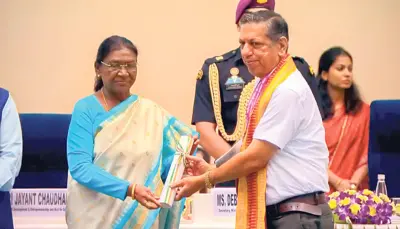
Now, what if there was a teacher who understood all this - and realised that the problem wasn't in the subject. It was how it was being taught. Dinesh Kumar, a physics teacher at Government Victoria Girls Senior Secondary School, Patiala, is that teacher, and the reason his students may never have to fear physics again, and perhaps also why the President of India conferred upon him the National Teachers' Award 2026, one of the highest honours for educators in the country on Teachers' Day.
And what he did to earn it might just be one of the more inventive ideas to come out of a government school classroom in recent years.
Dinesh Kumar built an entire virtual physics laboratory from scratch, letting every student run practicals on a screen, using his own programming skills.
"If there's no physics lab or lab operator in school, you can't just skip that part - you have to somehow teach your students about lab work, an essential part of the subject," he says. "So I made this virtual lab, which needed zero funding - no equipment, no connections, and the code is entirely my own."
Dinesh holds a PhD in physics and has an MSc in computer science - he simply put his degrees to work, spending around four years building the laboratory without any help.
But this virtual lab is only part of his story. Dinesh has also created 100 other teaching learning materials - small, hands-on activities designed to make tricky topics easy, covering concepts like angular momentum, interference, and diffraction. Some of these were built entirely by him; others, he built together with his students.
His work extends well beyond classroom: 18 of his modules have been published by the State Council of Educational Research and Training (SCERT), his lectures feature on the Diksha portal (India's national digital platform for school education) under the PM eVIDYA initiative, and he has 35 research papers published in national and international journals.
The results speak for themselves. Today, 57 of his former students are studying in top medical and engineering colleges across the country - several have gone on to become doctors, many others are working with MNCs. Many of his students have scored a perfect 100/100 in physics, with several featuring on the Punjab board's toppers' list.
For students from families that can't afford the fees such colleges demand, Dinesh has built a bridge of his own. One such student, Kanishka, comes from a modest financial background - and last year, secured admission to a top NIRF-ranked institute, where she is now pursuing computer science engineering.
"Dinesh sir told me about the Bharti Airtel Scholarship scheme and guided me through the entire process," Kanishka says. "I studied physics under him in Classes XI and XII, and what stood out was how clearly and patiently he explained things - he always made sure we actually understood a concept, not just memorised it. He was approachable whenever I had doubts. Beyond academics too, he's always encouraged me to recognise and make the most of the opportunities that come my way," she adds.
Kanishka's story mirrors what all his students say Dinesh brings to the classroom. For the school's leadership team, the picture looks no different. His school principal, Rajesh Garg, says, "I have had the opportunity to work with many dedicated teachers, but Dinesh truly stands apart. He understands that teaching is not merely about completing the syllabus, but about identifying the potential in every child. His virtual lab has made a remarkable difference to our students - concepts that were once difficult to grasp theoretically can now be experienced and explored virtually."
A clear change is visible, he adds; "they've become more curious, more engaged, more confident".
What does this National Award mean to him? Dinesh says, "When I saw my name for the National Award, I was overjoyed. But my real joy came when more than 50 of my former students - people I taught who are now well-settled in their careers - called to congratulate me." There is, of course, another side to Dinesh's story, the one his wife, Archana Behl, sees at home, long after the school day is over.
Archana, who is also a school teacher, says, "I teach humanities, he teaches physics. Both are completely different fields. But when I see him working so hard, I try my level best to stand by him in whatever way I can. He barely rests before 1 am or 2 am, always going out of the way for his students, trying to find different ways and means to help them. Even when he isn't keeping well, even when his body needs rest, he still shows up for them. And honestly, I get inspired by him."
This isn't Dinesh's first honour either. He received the state award in 2020, was named Punjab Teacher of the Year in 2022, and won the National Best Science Teacher award in 2023 from the Raman Science and Technology Foundation, alongside recognitions from several social welfare societies over the years.
And he isn't stopping here. As a state resource person for SCERT, Dinesh has already demonstrated his virtual lab at science seminars and institutions like Khalsa College for Women, Amritsar, and has plans to take it to schools across the state. He's also currently developing a Competency Enhancement Plan (CEP) for SCERT, built around six core learning skills - knowledge, understanding, application, analysis, evaluation, and creation.
Dinesh Kumar has never measured his work by the accolades. A true guru's finest work begins where the classroom ends - in the lives his students go on to build for themselves. For the teacher from Patiala, that is where his story truly belongs.