
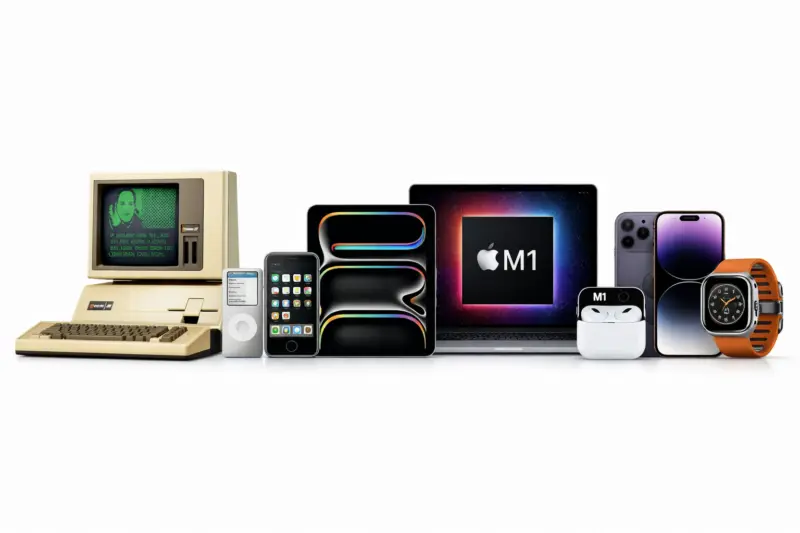

On April 1, Apple Inc. turned 50. In tech years, that's practically ancient. And yet, Apple remains the yardstick. Not always the biggest, not always the first, but almost always the one that others end up chasing.
Apple's real story isn't about survival, it's about influence. For five decades, Apple hasn't just competed in the tech industry, it has repeatedly reset the direction of it. And perhaps the clearest proof? Its rivals, from Microsoft to Samsung Electronics to Google, have often found themselves reacting to Apple's moves.
Challenging IBM, Microsoft
In the late 1970s, Apple II helped popularise personal computing. But it was the 1984 launch of the Macintosh that truly disrupted the industry with its graphical user interface (GUI). At the time, IBM dominated computing, while Microsoft Windows was still evolving.
Apple's GUI forced Microsoft to accelerate development of Windows, which adopted similar visual navigation concepts. The mouse-driven interface, once revolutionary, became standard across all PCs. Apple didn't win the market share battle then, but it decisively won the idea war.
Music industry shake-up
Before 2001, Sony and others dominated portable music through walkmans and discman players, defining how people listened on the go. Then came the iPod and iTunes. Apple built an ecosystem where users could buy, organise and carry music seamlessly, with an interface that felt intuitive and effortless. Sony, despite owning vast music catalogues, failed to integrate hardware and software effectively.
Within a few years, the iPod controlled over 70 per cent of the digital music player market and reshaped listening habits globally. Its competitors weren't just beaten, they were made irrelevant.
Touchscreen takeover
In 2007, the iPhone arrived, and changed everything. Before that, Nokia ruled global handset sales and BlackBerry dominated business communication with physical keyboards. Apple removed the keyboard entirely. Within five years, both Nokia and BlackBerry saw a dramatic decline in relevance.
Meanwhile, Samsung emerged as Apple's biggest rival, adopting large touchscreens, app ecosystems and premium design language, many of which mirrored Apple's approach. Even Google reshaped Android after the iPhone launch, pivoting from keyboard-centric designs to touchscreen-first smartphones.
Birth of the marketplace
The 2008 launch of the Apple App Store created a new economic model. Developers could build apps, users could download them instantly and Apple took a cut. Today, this model is universal. Google Play, Microsoft Store, every platform adopted the same framework. The global app economy, now worth hundreds of billions of dollars, traces its roots back to Apple's blueprint.
Birth of the marketplace
Over to tablets
When Apple introduced the iPad in 2010, critics dismissed it as "just a big phone". Yet within a year, competitors, from Samsung to Amazon, launched their own tablets. The category quickly exploded, with devices finding use in homes, classrooms and offices alike. Tablets became mainstream for media consumption, education and business. Apple didn't invent tablets, but it made them work, setting benchmarks for usability and performance.
Beyond Intel, Qualcomm
Apple's move to in-house silicon, starting with A-series chips and later M-series for Macs, shifted the balance of power. Traditionally, companies relied on Intel and Qualcomm. Apple broke that dependency. The result? Industry-leading performance per watt. Now, competitors like Samsung and Google are investing heavily in custom-made chips. Even Microsoft is exploring similar strategies. Once again, Apple moved first and others followed.
Still setting the pace
Apple's greatest strength isn't being first, it's being definitive. It enters categories late, studies them, then rewrites the rules so convincingly that competitors have no choice but to adapt. From IBM to Nokia to Samsung to Google, the names change, but the pattern doesn't. At 50, Apple isn't just part of the tech race. It is still setting the pace.
To mark the milestone, CEO Tim Cook rang the opening bell at NASDAQ, a fitting symbol for a company that has
influenced not just products, but entire markets. As Cook said during the anniversary, "Apple has always believed in challenging the status quo… and the best innovations are still ahead of us."
Mocked, then copied
Apple's bold decisions often become industry norms
Removing the headphone jack (iPhone 7): Later followed by Samsung, Google and other major smartphone makers
Eliminating physical keyboards: Gradually became the universal standard across smartphones of all big brands
Dropping optical drives in laptops: Became standard practice across ultrabooks & regular laptops
Embracing thin, minimalist design: Widely adopted across premium devices
Time and again, competitors mocked Apple publicly, only to adopt similar changes quietly later.