





A boy who was not allowed to watch films until he was 15 is now taking his own film to the London Film Festival. The journey from Dayalpur, a small village in Faridabad, to the prestigious BFI London Film Festival may sound improbable, even to Ankur Hooda himself.
His latest docu-drama, 'The Calf Doll', made in his ancestral village on a modest budget and without institutional backing, has been selected for screening at the festival. But for Hooda, the journey to London is less about an arrival than about a long, uncertain search - one that began with books, took an unexpected turn away from medicine and eventually brought him back to the rural world he had once been kept away from.
Hooda spent the first 14 years of his life in Dayalpur, where an atmosphere of violence and crime meant he was rarely allowed to venture out. He grew up among teachers and professors. His first real encounter with the world beyond his immediate surroundings came through literature. "My mother once brought home a car full of discarded books from an old school library, including the complete works of Premchand and Chekhov. These shaped how I began to understand rural spaces and human relationships," recalls Hooda.
Cinema came later, and when it did, it arrived with force. "At 15, I watched my first film in its entirety, 'Anhey Gorhey Da Daan' by Gurvinder Singh. It opened up a new medium of expression," says Hooda. He was already writing short stories and poetry, but was preparing for the medical entrance test. Over the next two years, he watched nearly 500 films. By the time school ended, his path had changed completely. "I knew I had to pursue this art," he says.
Finding his way as a filmmaker, however, meant learning to resist conventional filmmaking. "The biggest challenge, for me, has always been figuring out the 'why' before thinking about the 'how' of dealing with cinema," says Hooda. The filmmaker has spent many nights wrestling with that question, and still does not have a definitive answer. Instead, he has come to value uncertainty, instinct and discovery as essential parts of filmmaking.
A major turning point came when he abandoned his first feature just two days before its shoot. The film had become so predetermined that Hooda felt there was little left to discover. "If I already knew exactly what I was going to see, then I was only reproducing something I had imagined earlier," he says. He shelved it and returned to his village, spending the next seven months detached from cinema.
"The failure forced me to ask what I really wanted from filmmaking, and why I needed to make films at all," he admits.
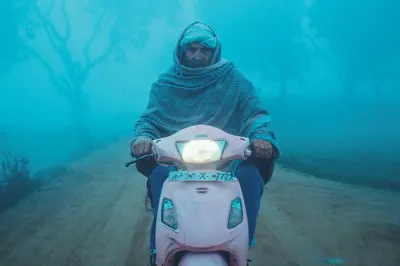
This consciousness found its way into 'The Calf Doll'. Its story began on a winter afternoon when Hooda saw his grandfather sitting alone at a farmhouse, looking at a neighbour's cows after reluctantly selling his own herd. "There was something very ordinary about it, but also something existential that I couldn't explain," Hooda recalls. Having grown up watching his grandfather, a teacher who remained a farmer at heart, live alongside cattle, Hooda saw their disappearance as something larger than the loss of animals. "It helped me to explore the crumbling rural ways of life around me," he says.
The resulting film occupies the space between documentary and fiction. Hooda's grandparents and villagers play themselves, while professional actors portray fictional characters. "Pure documentary can sometimes be limited by what reality gives you, while fiction can be limited by what you have already imagined. I was interested in the space where the two could challenge each other," says Hooda.
On the film being selected for screening in London, he says, "Learning that our bootstrapped Haryanvi indie has made it to this prestigious film festival was tough to process. But to see it travel from a small village in Haryana to BFI feels not just surreal, but deeply moving."
Yet the recognition has not changed the challenges facing independent filmmakers. "Filmmakers from smaller cities and towns have realised that no one is going to give them an opportunity, so they are finding their own resources and creating alternative ways of working," he says. Yet he is wary of calling the ecosystem truly open. According to Hooda, "Festivals can provide a route for independent Indian cinema to reach audiences abroad. But what about indie movies that can't make it to the festival circuit? There is no support or infrastructure for such films," he adds.
However, that lack of conventional support has also created unexpected freedom for Hooda. "What began as a limitation became a way of discovering how I actually wanted to make films," he smiles.
Hooda also hopes to develop the 'Dayalpur Trilogy', exploring industrial displacement, migration and urban loneliness in Haryana. "These projects may move further towards magical realism, bringing the folk traditions, myths, humour and stories of Haryana into conversation with a modernised landscape," he adds.
His larger ambition is to discover Haryana's visual culture through cinema. Its oral traditions are rich and distinct; its visual language is something he is still searching for. Perhaps, that is why London feels less like a destination than another step in the journey.