




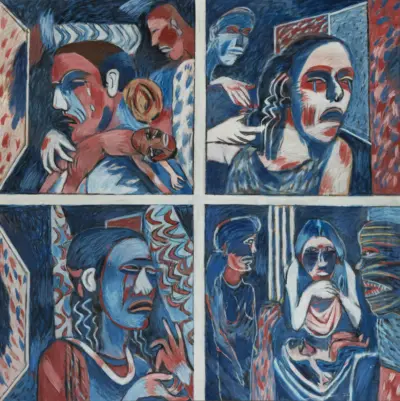

Artist Gulammohammed Sheikh still remembers his first day at the Faculty of Fine Arts. "It was awe-inspiring. I had not visited a big city like Baroda, coming from a small town like Surendranagar.
I couldn't imagine that there could be a college where everyone and everything was devoted to art and just art."
It would take Sheikh several years to realise that painting was to become his vocation. With the studios open 24 hours, he recalls "working furiously day and night to find my own idiom". Many such stories were to emerge from the Faculty of Fine Arts (FFA) at MS University in the years that followed. Together, they would shape a remarkable chapter in the history of modern Indian art. A seminal new exhibition at DAG offers a glimpse into that extraordinary legacy.
'Freedom to Form: Baroda Modern' traces the origins and the enduring legacy of the FFA, which came up at the MS University in 1950, positioning Baroda as a critical site for understanding the development of artistic practice in post-Independence India.
The show, in New Delhi, brings together nearly 200 paintings, sculptures, prints, photographs and mixed-media works alongside rare archival material. The accompanying scholarly publication features commissioned essays by Priya Maholay-Jaradi, Kathleen L Wyma, Sandhya Bordewekar, Kanupriya Sharma and Gayatri Sinha.
1950 - in fact the decade it ushered in - was an important point in modern Indian art. The FFA came up at a time when the Progressive Artists' Group had begun to disband, with several members shifting abroad. Following Tagore's demise, Santiniketan was reeling under institutional uncertainty; in Mumbai, the JJ School of Art was trying to shed its colonial legacy. It was at this moment that the FFA was founded, its birth rooted in the progressive cultural vision of Maharaja Sayajirao Gaekwad III, whose patronage of the arts, crafts and education fostered an indigenous modernity decades before the establishment of the university.
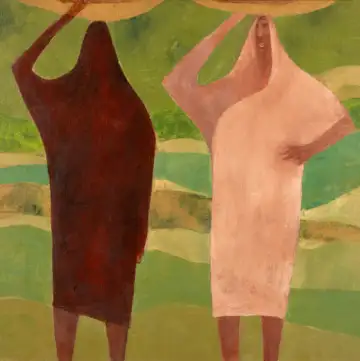
Haku Shah (1934-2019), Untitled, Oil on canvas.
An exalted faculty and equally talented legions of students were to emerge out of the city, fusion of traditional idiom and modernist ideas being the hallmark of their art.
After finishing his studies at Santiniketan, KG Subramanyan had spent some time at a refugee rehabilitation camp in Punjab in 1949 and taken up odd jobs in Delhi when he got an offer to join a new arts school coming up in Baroda. Sankho Chaudhuri, his contemporary at Santiniketan, was already there, establishing the department of sculpture. Along with NS Bendre, Markand Bhatt and VR Amberkar, they were to lay the foundation of Independent India's first art school.
If MSU Vice-Chancellor Hansa Mehta was instrumental in setting up of the college, the teachers shaped the curriculum. As Bordewekar points out in her essay on KG, while FFA represented the inclusiveness and informality associated with Kala Bhavana, this was reinforced with a more structured studio programme and supportive discursive studios, "including the administrative independence to plan its courses, revise them when needed and assess student performance through its own devices…"
Comparing FFA with JJ and Santiniketan, art historian and curator R Siva Kumar says each of these colleges was shaped by the moment and context of its founding. "JJ was founded during the colonial period and was designed to address the social needs and aesthetic sensibilities of colonial India. Santiniketan, on the other hand, was started in the midst of the anti-colonial movement in Bengal and embodied Rabindranath's vision of culturally rooted modernism. The Baroda art college was founded in post-Independent India and reflected the aspirations of a new India that wanted to be part of the world. Like Santiniketan, it was also part of a university and placed art practice within the sphere of a larger intellectual pursuit. While it had close connections with both Bombay and Santiniketan through its first teachers, it did not carry the burden of either colonial taste or anti-colonialism. That helped Baroda become an art college of special eminence between 1960 and the 1980s."
This freedom is where the show derives its name, and character. Ashish Anand, CEO and MD, DAG, says the freedom in 'Freedom to Form' is, above all, the freedom to build a new model of art education at a moment when India itself was being reimagined. "Unlike the colonial art schools of Calcutta, Bombay and Madras, which had inherited established academic systems, Baroda had the opportunity to create its own pedagogical framework. But that did not mean turning away from the past or from international modernism. Rather, Baroda's freedom lay in being able to bring different traditions into dialogue: European modernism alongside Indian art histories, folk and craft practices alongside the fine arts, and formal experimentation alongside questions of everyday life and society. The teachers helped establish an environment in which students were encouraged to discover an individual language rather than conform to a prescribed style. It made the art school itself a laboratory for modernism."
The FFA did well, and it did so quickly, curatorial lead Kanupriya Sharma points out in her essay. The first exhibition of students' work at Bombay within the first few years showed to the world what Baroda was doing, says Sharma, adding that it spurred conversations about the need to develop and update art education curricula all over India. In due course of time, the college was to spawn a myriad of learners who would define modernism, making the world sit up and take notice.
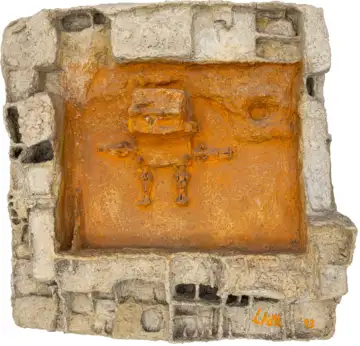
Latika Katt (1948-2025), Sati, Papier-mâché and mixed media with bamboo armature, 1993.
It was the environment the college offered that made Baroda what it was: studios open 24×7, teachers' homes welcoming students at any hour of the day, students joining teachers on commissioned projects, the art melas assimilating the "cosmopolitan island" of FFA with the rural background around.
Kanupriya says the pedagogical culture was unusually porous. "Teaching extended beyond formal classroom instruction into studios, homes, discussions, study tours and encounters with living traditions. Subramanyan, for instance, challenged the conventional hierarchy between fine art and craft, bringing processes such as terracotta, mural-making, toy-making and textile-related practices into the field of modern artistic enquiry."
Equally important, she says, was the continuity between generations. "Students such as Jyoti Bhatt and Gulammohammed Sheikh eventually became teachers themselves, transmitting and transforming what they had inherited. The Faculty thus became a self-renewing intellectual community in which artists taught artists, students became teachers, and pedagogies themselves became part of the artistic legacy. That is why the exhibition treats the institution not merely as a backdrop to the artists' careers, but as an active force in shaping them."
The exhibition showcases works by Bendre, Chaudhuri, Subramanyan, Sheikh, Mrinalini Mukherjee, Bhatt, Jeram Patel, Himmat Shah, Nilima Sheikh, Vivan Sundaram, besides many others, mapping the journey of successive generations whose practices collectively shaped the Baroda Modern.
For Anand, plurality is one of Baroda's defining characteristics. The possibilities that the first generation of artists and administrators offered were taken into very different directions by the next generations. "Jyoti Bhatt transformed printmaking and photographic practice while developing an extensive engagement with folk and vernacular visual cultures. Gulammohammed Sheikh developed a distinctive narrative figuration that brought together history, literature, politics and multiple pictorial traditions. Bhupen Khakhar radically expanded the possibilities of figuration through his engagement with everyday life, sexuality and the personal. Artists such as Jeram Patel, Himmat Shah and Ratan Parimoo pursued very different approaches to abstraction, material and form, while Nasreen Mohamedi developed a highly distinctive language of geometric abstraction and perception. The later generations demonstrate how far the Faculty's influence could extend beyond any single definition of the Baroda School," he says.
"What ultimately defined Baroda was not a common style but a common permission to find one's own form. That is perhaps the most important trajectory the exhibition seeks to reveal." And that is what made Baroda Modern a celebration of a new uninhibited India.
(On view till Oct 3)