





WHEN I was in school, there was a lot of stress on being "perfect". In the morning, when we entered the campus, a teacher would check our uniform and shoes.
The uniform had to be perfectly ironed and the shoes polished to a shine. When we were quizzed in class, our answers had to exactly match the text. When we played any sport, we had to be in perfect form. Any lapse in this perfection would lead to a mark on our record, which publicly shamed us for the rest of the academic year.
The principal would often tell us, "Practice makes perfect", to encourage us to avoid mistakes. There was no room for error. It was drilled into us that being perfect was to reach the pinnacle of success. Across civilisations, achieving perfection has been the overarching goal, whether in art, architecture or literature.
Recently I found, contrary to what I learnt in school: perfection is being looked down upon. Rather, it has become a bane. The better your work is, the more likely you are to be accused of using artificial intelligence (AI).
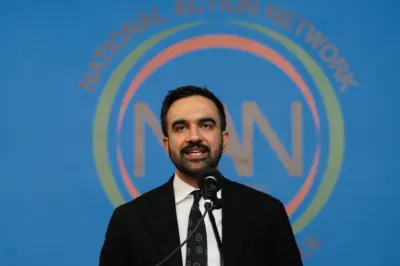
A case in point is a recent series of videos by the New York City Mayor, Zohran Mamdani, in which he speaks in Mandarin, Bengali and Spanish while promoting a government initiative. However, people quickly started questioning the authenticity of the videos and accused him of using AI to generate the foreign language bits. He was mocked and criticised because his videos were too "perfect". It had to be AI-generated - this was the natural reaction of many viewers.
Activities such as writing an article, composing a song or making a video are now fraught with risk. We face the dilemma that if our work is too good, then we might be accused of using AI. So, do we intentionally create something substandard? How do we prove that our work contains the "human element"?
Mamdani came up with a creative solution. In response to the AI accusations, his media team released a "blooper" clip which captured several moments of him struggling with the pronunciation of the foreign words or forgetting them mid-sentence. Off camera, some people can be heard pointing out his mistakes and advising him. He is visibly frustrated but keeps encouraging himself every time.
In this clip, Mamdani is clearly very human. He is making mistakes; he is joking; he even recalls his time learning Mandarin at school. It is fun to watch his efforts, which seem to have silenced his critics. Only a clip of his mistakes could establish that his videos were not AI-generated. Ironically, the only way remaining to demonstrate our "humanity" is to mess up. A phrase I learnt at school comes to mind: "To err is human".
The writer is a Chandigarh-based contributor