
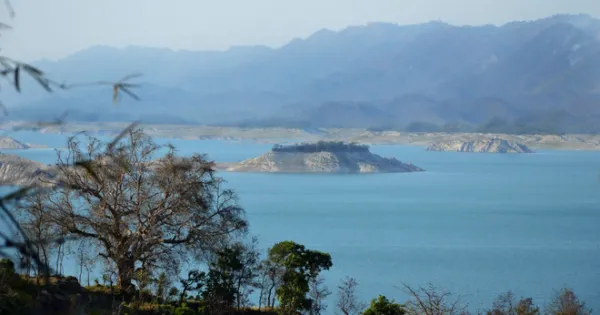

Amidst a forecast of below-normal monsoon this year, the water level in crucial reservoirs in northern India is noticeably above normal at the start of summers, which could help mitigate the impact of lower rainfall.
The current storage level at three reservoirs in Himachal Pradesh is 39 per cent above normal, while in Punjab's sole reservoir it is 58 per cent above normal for this time of the year, according to data released by the Central Water Commission (CWC). In Rajasthan, which has seven reservoirs and depends heavily on water from rivers flowing through Himachal Pradesh and Punjab, storage is 31 per cent above normal.
Private forecaster Skymet predicted earlier this month that India's 2026 monsoon will be below normal at 94 per cent of the long period average (LPA), due to developing El Nino conditions, which is unusual warming of surface waters in the central and eastern tropical Pacific Ocean.
While rains in June are expected to be near-normal at 101 per cent of the LPA, rainfall is expected to weaken in August and September, impacting the agricultural sector and power generation. Water released from the dams for drinking and agricultural purposes is shared by Punjab, Haryana, Himachal Pradesh, Rajasthan and Delhi in accordance with mutually decided formulas depending upon availability and demands.
The filling season for reservoirs in the northern region is from mid-April to September. While snow melt in summers is the primary source for some reservoirs, others are dependent on rains. In winters, when there is no snow melt and little rain, inflows into reservoirs are very low.
At Bhakra Dam, which lies on the Sutlej in Himachal Pradesh, the current storage is about 2.32 billion cubic meters (BCM) against the full capacity of 6.23 BCM, which is 37.17 per cent of its total capacity. It was 19.14 per cent last year with the past 10-year average being 26.40 per cent.
The storage at Pong Dam on the Beas in Himachal Pradesh is 2.32 BCM against the full capacity of 6.16 BCM, which is 37.72 per cent of its total capacity. It was 12.29 per cent last year, with the past 10-year average being 27.35 per cent.
At Kol Dam, which lies upstream of Bhakra and has a miniscule storage capacity as compared to the other dams, the current level is 0.069 BCM against the top level of 0.089 BCM accounting for 77.35 percent. It was 80.35 per cent last year with the past 10-year average being 62.54 per cent.
Thein Dam on the Ravi in Punjab is currently 61.69 per cent full, with the storage being 1.45 BCM against the total capacity of 2.34 BCM. It was 17.58 percent last year with the past 10-year average being 38.93 per cent, according to CWC data.
While Bhakra and Pong dams are operated by the Bhakra Beas Management Board (BBMB), Kol Dam is controlled by the National Thermal Power Corporation. Thein Dam is owned by the Punjab Irrigation Department.
The combined hydel power generation of the dams in Himachal Pradesh is 2,577 MW and their irrigation potential is 676 thousand hectares. Thein has a hydel capacity of 600 MW and an irrigation potential of 348 thousand hectares. The seven reservoirs monitored by CWC in Rajasthan have an irrigation potential of 476 thousand hectares and two dams among them can generate 312 MW. This makes them critical infrastructure assets.