






Scientists are raising concerns about a possible "mega" El Niño event developing in 2026-2027, which could rank among the most powerful in recorded history and potentially rival the devastating 1877-78 El Niño.
Also read: India dominates world's hottest cities list; Delhi, Rajasthan not among top 20
Meteorologist Ryan Maue has warned that warming ocean temperatures, possibly exceeding 2.5°C above normal, combined with ongoing climate change could intensify the event significantly. He noted that experts monitoring climate models are increasingly alarmed by recent projections.
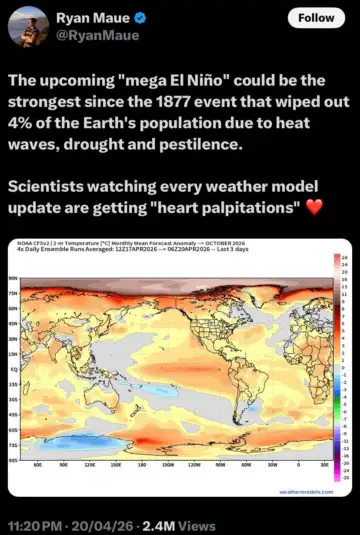
The 1877-78 El Niño triggered extreme droughts and famine across multiple regions, contributing to widespread mortality estimated at up to 4 per cent of the global population at the time.
If a similarly strong event develops, scientists warn it could bring severe consequences worldwide. These include intense heatwaves, prolonged droughts, and major disruptions to agriculture, particularly in vulnerable regions such as India.
At the same time, some areas, like parts of the southern United States could experience heavy rainfall and flooding.
Experts also caution that modern climate change, driven by rising greenhouse gas levels, may amplify the severity of such an event, making its impacts more extreme than those seen in the past.
Overall, a "mega El Niño" could lead to significant global challenges, including food shortages, economic strain and widespread weather disruptions.
El Niño is a natural climate pattern that happens when the surface waters in the central and eastern Pacific Ocean become unusually warm. This warming shifts global weather patterns.
What El Niño typically causes
Heavier rainfall and floods in some regions (e.g., parts of South America, southern US)
Droughts and heatwaves in others (e.g., Australia, parts of Asia, including Indian)
Disruptions to agriculture, fisheries, and global food supply
So what "mega El Niño" means
When people say "mega El Niño," they usually mean:
A very strong or extreme El Niño event
With much higher-than-normal ocean temperatures
And more intense global weather impacts than typical events
Scientists can predict El Niño conditions months in advance, but the exact strength is uncertain.