




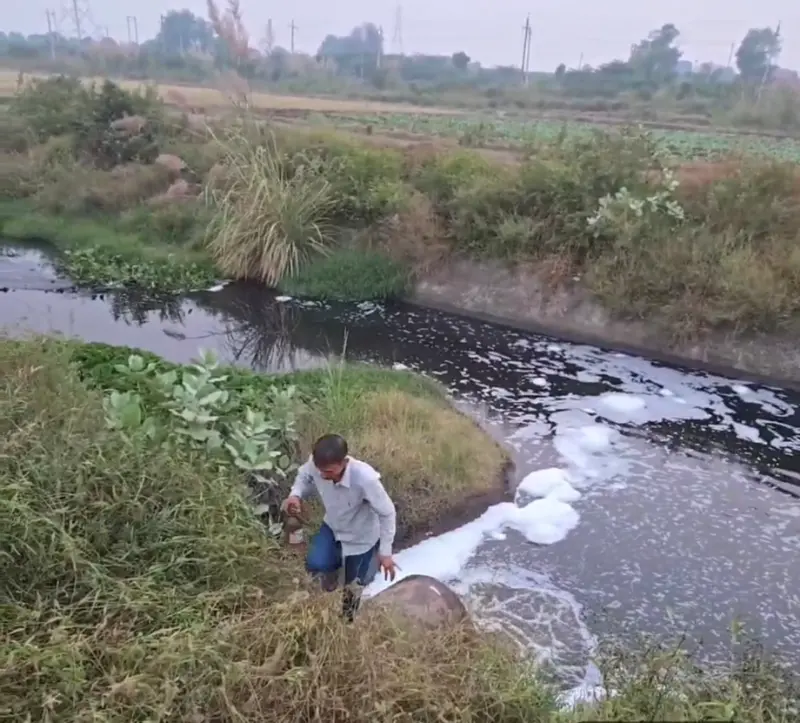

The Yamuna, a natural boundary between Haryana and Uttar Pradesh, is always in the limelight due to its pollution load. The Yamuna water quality deteriorates sharply as it passes through urban and industrial clusters.
After the BJP formed the government in Delhi, both Haryana and Delhi administration claimed to have adopted a more coordinated approach towards reducing pollution load in the river. The meetings of the River Rejuvenation Committee (RRC) are being held monthly to review the progress reports regarding upgrading the quality of the water falling into The Yamuna. Recently, Yogesh Kumar, Member Secretary, Haryana State Pollution Control Board (HSPCB) also held a meeting with members of the Special Environment Surveillance Task Force (SESTF) of Sonepat district, in which officials of all stakeholder departments also participated.
From where does the River Yamuna flows into Haryana?
The Yamuna covers a distance of nearly 320 km in Haryana. The river enters the state in Yamunanagar district with relatively clean, blue-hued water and then passes through Karnal, Panipat and Sonepat before entering Delhi. After flowing through the national capital, the Yamuna re-enters Haryana in Faridabad and Palwal districts and eventually flows into Uttar Pradesh near Kosi in Mathura district.
How much untreated effluents goes into the Yamuna in Sonepat?
According to the recent reports prepared by the HSPCB, the Drain No. 6 travels through Panipat and Sonepat districts and carries the effluents of Samalkha and Sonepat towns and joins Yamuna in Delhi territory through Najafgarh drain downstream of Wazirabad barrage. It carries a total 153 million litres effluent a day (MLD), out of which 103 MLD is treated and 50 MLD is untreated. The average BOD value in the drain is 106 mg/l. It also carries wastewater of 25 discharge points of villages/institutions/ residential areas located on the side of the drain and estimated discharge of these 25 points is 18.21 MLD.
What was the main focus of the meeting and who participated?
A meeting of the RRC was organised under the chairmanship of the Member Secretary, HSPCB, with the members of SESTF and the officials of the HSIIDC, HSVP, Irrigation Department, Panchayat Department and Municipal Corporation (MC). The meeting focused on strengthening inter-departmental coordination and ensure strict implementation of environmental protection measures to improve the water quality of the river. The Member Secretary issued clear directions to all departments, and emphasised on time-bound and result-oriented action to reduce pollution load of the river.
What directions did the Member Secretary, HSPCB, issue to the stakeholder departments?
Yogesh Kumar, Member Secretary, HSPCB, directed the HSIIDC officials to install CCTV cameras at all entry and exit gates of industrial areas and establish a dedicated control room for round-the-clock monitoring for tracing the movement of vehicles carrying unpermitted fuel and untreated effluent. All industrial estates of the HSIIDC were further instructed to ensure that no untreated effluent should be discharged into Drain No: 6 from any of the source and take immediate coercive and preventive measures wherever required.
The Member Secretary further directed the HSIIDC and the MC, Sonepat, officials to lift their legacy solid waste from the area and channelise the same to M/s JBM Waste to Energy Plant, located at Murthal to ensure its scientific disposal.
The Member Secretary has directed that enforcement should be strengthened and special drives to check and curb the movement of illegal tankers involved in unauthorised transport and discharge of untreated effluents should be initiated by capturing illegal tankers. The joint exercise should be conducted by the RTA, Traffic Police and Local HSPCB office and initiate strict action against the violating industry and owner of the tanker.
Additional directions were also passed to the Irrigation Department regarding fencing on bridges available on the river and drains. He said there should be regular cleaning of the drains to avoid recurrence of pollution and dumping of solid waste by the commuters should also be prevented.
The Member Secretary also directed the stakeholders to work on war scale to tap or treat untreated discharge points falling into drain No, 6 by installing the STPs. This would be done to stop the discharge of untreated effluent into River Yamuna from the jurisdiction of Sonepat district.