
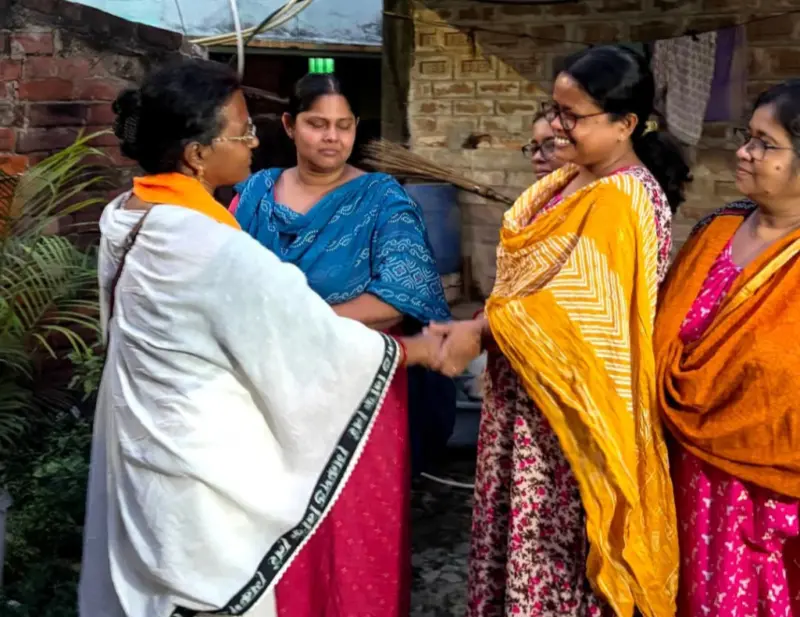

Sodpur/Panihati: In most elections, parties try to impose an issue on the voters. In Panihati, the issue arrived before the campaign did, through a body, a state in revolt, and a wound that has not closed.
Nearly two years after the rape and murder of a young doctor from the area at R.G. Kar Medical College and Hospital on August 9, 2024, Panihati remains the constituency where the demand for justice has not been reduced to memory, ritual or television debate. Here, the largest citizens' movement Bengal has seen in recent years still breathes through ward meetings, doctors' gatherings, street-corner discussions and electoral arguments. In this election, Panihati has grown from an assembly seat on the northern edge of Kolkata into the political afterlife of the incident we have grown to call 'R.G. Kar.'
 Panihati this time is not merely voting amid anti-incumbency, welfare calculations or the familiar Trinamool Congress-Bharatiya Janata Party polarisation. The constituency, once a stronghold of industrial labour and Left politics, has in the last decade been remade by factory closures, precarious urbanisation, municipal decay and the rise of a restless middle-class politics. Then came R.G. Kar, and with it a citizens' uprising that cut across party loyalties.
The BJP has tried to convert that moral force into electoral capital by fielding Ratna Debnath, the mother of the slain doctor, as its candidate. The decision has made Panihati one of the most emotionally charged battlegrounds in the state.
Debnath's candidature gives the BJP an issue no conventional campaign could have manufactured: grief sharpened into accusation, and accusation turned into a demand for votes. Senior leaders Smriti Irani and Biplab Deb had accompanied her for her nomination filing.
Campaigning in Ward No. 6, Ratna Debnath said, "I am seeking justice. If justice is delivered for my daughter's murder and the culprits are punished, it will be a victory for all those who protested. One family rules Panihati, and I am asking for votes to free people from their oppression."
By "family", Debnath was referring to the TMC network around former MLA Nirmal Ghosh, who did not get the ticket this time amid allegations that include the destruction of evidence in the R.G. Kar investigation. His reported presence at the R.G. Kar Hospital on the day of the crime, and the allegedly hurried cremation of the victim in his presence have come under question from the victims' parents and colleagues in the past.
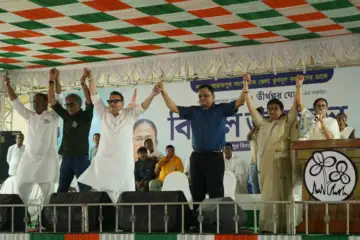
TMC leaders at Panihati with Tirthankar Ghosh. Photo: By arrangement.
This time the TMC has fielded his son Tirthankar Ghosh. The candidature has sharpened the opposition's charge that Panihati remains under the grip of one political family. It has also kept the R.G. Kar case tied to the constituency's local power structure.
Nirmal Ghosh has defended himself by saying that he went to the hospital out of "social responsibility" because the victim was from his constituency and justified the cremation by citing crowd management and the family's wishes. "The opposition can do nothing except slander, and slander has no answer. People love us, which is why we win whenever there is an election," he told The Wire.
Asked about the R.G. Kar issue, Tirthankar Ghosh said, "I will not comment on matters that are sub judice."
The victim's father told The Wire, "We thought it over and realised that in this country only the influential and powerful get justice. One family rules Panihati, and we are asking for votes against them."
Across the constituency are signs that Ratna Debnath's candidature has struck an emotional chord. Tarun Das, a local businessman said, "A woman who has lost her child is asking for votes. We also have children. Though I supported TMC in the last election, this time I am thinking of giving my vote to the mother."
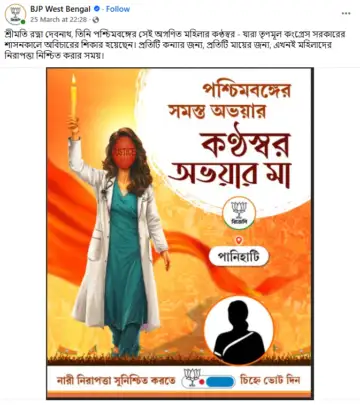
BJP's announcement of Ratna Debnath's candidature.
Yet Panihati's political story is more complicated than grief turning directly into votes. The same citizens' movement that made justice the defining issue of the election has not moved in one political direction. Many who were part of the agitation continue to reject both Trinamool's handling of the case and the BJP's attempt to appropriate the movement.
A local and an activist of the R.G. Kar movement, Payel Das drew that distinction sharply. "Lakhs of women came onto the streets and occupied the night in protest. There is no question of supporting the BJP, which insulted them. The BJP should first answer why the CBI is not conducting a proper investigation, as alleged by the deceased's mother," she said.
Even in the middle of the campaign, the movement continues to seek expression outside party platforms. On April 9, doctors and members of civil society gathered again at nearby Sodpur.
A senior doctor associated with the Justice For R.G. Kar movement, Tomanash Chowdhury, said, "The Supreme Court has again directed the CBI on reopening the investigation. This is a success of the citizens' movement."
The CPI(M), sensing room among politicised youth and sections of the urban middle class, has fielded Kalatan Dasgupta, a young leader whose public profile rose sharply during the R.G. Kar protests. Dasgupta was among the first to reach the hospital after the body was found, and blocked the vehicle that meant to carry away the remains. He became one of the early organisers of the protests that later grew into the statewide movement. In September 2024, he was arrested by West Bengal police after an audio clip released by TMC was cited to allege a conspiracy to attack protesting junior doctors and discredit the state government. The Calcutta high court later granted him bail and restrained the authorities from taking further coercive action without the court's permission. The Left has since turned that arrest into part of its political case, presenting Dasgupta as a leader targeted during the movement rather than discredited by it.
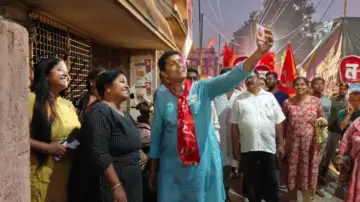
Kalatan Dasgupta at Panihati. Photo: By arrangement.
Speaking to The Wire Dasgupta said, "We are still protesting to demand justice for the brutal crime of a woman doctor being raped and murdered in a government hospital. Whether she or her family supported any party or politics is not the main issue. Alongside that, there are demands to control pollution in Panihati, ensure adequate drinking water, and protect government schools and health centres."
But Panihati is not voting on R.G. Kar alone. It is also voting on the exhausted infrastructure of a crowded suburb that has long outgrown the systems meant to serve it. Waterlogging in monsoon remains one of the constituency's most persistent grievances, turning neighbourhoods into stagnant basins and exposing the failure of an ageing drainage network.
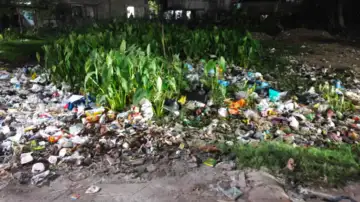
Garbage dumped at Panihati. Photo: By arrangement.
Those civic failures are central to the constituency's mood, even though these are not the municipal polls. Residents speak of pollution, rotting garbage, poor drainage and collapsing public infrastructure.
Sanitation, too, has become a political embarrassment. A March 2026 intervention in the Calcutta high court over garbage dumping beside Panihati Playground put the municipality under renewed scrutiny after allegations that biomedical and household waste was being openly piled up near a major public space and residential buildings. To many middle-class residents, the sight of used syringes, blood-stained waste and rotting debris beside a historic playground has come to stand in for the wider disorder of civic life under local rule.
Jiban Basu, a resident of the Sodepur Station area, said, "Panihati is now among the most polluted cities in the country. Whether you look at Nilganj Road or the Sodepur-Madhyamgram Road, the garbage dumps on the roads show what kind of civic services exist here. And although this municipality has long been under the ruling party's monopoly, the chief minister herself has repeatedly criticised its functioning."
The constituency's healthcare burden tells a similar story. Panihati State General Hospital remains an essential but overstretched public institution, facing the familiar pressures of doctor shortages, long waiting hours and inadequate infrastructure. In the background lies another long-term threat of arsenic contamination in groundwater, a reminder that Panihati's crisis is not just political, but environmental and structural.
TMC, however, remains structurally strong. In the 2021 assembly election, it won 49.61% of the vote in Panihati, with the BJP at 34.63% and the Left-Congress alliance at 12%. In the Lok Sabha cycle, Trinamool's vote in the segment declined to 41.86%, while the BJP remained at 34.62% and the Left rose to 20.87%, suggesting a competitive three-cornered fight.
The constituency had 231,656 voters in the pre-draft roll. The electorate now stands at 189,263, meaning 42,393 names have been deleted, a reduction of 18.30%. In an already tense constituency, that sharp contraction adds another layer of scrutiny to the electoral process.
Panihati matters because it shows what happens when a citizens' movement does not end with the protest. Here, R.G. Kar has entered electoral politics without being contained by any party.
The BJP is trying to turn grief into votes, the Left is trying to turn protest into principled opposition, and TMC is trying to hold together welfare loyalty under moral pressure. This constituency in the North 24 Parganas is where Bengal's biggest citizens' movement in recent memory remains alive, contested and politically unfinished.