





A recent analysis by Keji Mao in The Wire underlines the shift in US strategy towards China and its knock-on consequences for Indian diplomacy.
It provides a sharp, policy-oriented analysis that might well need to be aired among the India strategic community.
Mao's networks suggest a policy-oriented scholar embedded in China's elite institutions as well as at the Harvard-Yenching Institute. He is part of networks built even before, but especially following, China's 'opening up' after the death of Mao, which several of my colleagues and I have researched over the past several years.
It is important to bear in mind that policy analysis, like other kinds of knowledge, is always conditioned by the strategic community or elite networks of power that one is part of.
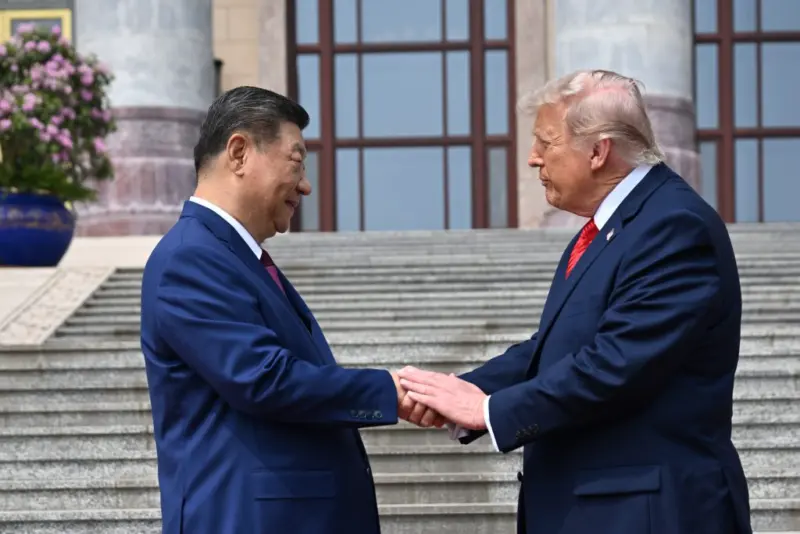
In this article, however, we provide a broader context for the Sino-US relations made visible through the recent summit between US President Donald Trump and Chinese President Xi Jinping. The current analysis provides the broader context of the transnational class and elite relations that effectively 'land' in policymaking terms in the analysis and prescriptions offered by Mao.
It overlaps with Mao's conclusions, even if there are serious reservations about the nature of India's self-proclaimed historic 'strategic autonomy' or 'non-alignment'.
The balance of power between China and the US
The recent summit between China and the US undoubtedly raises major questions about the nature as well as past, current and future directions of the Sino-US relations - the most strategically significant relationship in world politics today. Is it moving toward inevitable conflict, as some argue, and to which President Xi alluded when he mentioned the Thucydides Trap? Or is it moving towards some sort of liberal benign cooperation?
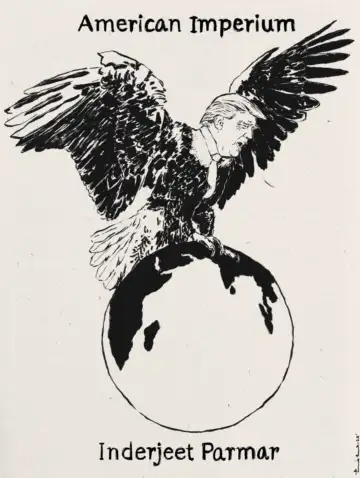
Illustration: Pariplab Chakraborty.
The evidence presents a mixture of conflicts, tensions, competition, and economic interpenetration. We argue here that it is an elite-driven relationship rooted in a fragile but functioning transnational class alliance, which neither realists nor liberals can actually account for. The dynamic between China and the US is far better captured however by a Gramscian-Kautskyian approach, which highlights elite power, class alliances and interdependence/interpenetration between capitalist nations.
The balance of power between China and the US, which tilted towards the US from the early 1980s until around 2008, has clearly shifted. Uneven development is an iron law of global politics. Compared to Trump's 2017 visit, the leverage available to the US over China has clearly weakened.
In fact, looking back at 2012, we now seem to be back to something resembling a, little less optimistic version of Xi's formulation, that the US and China were building a "new type of great power relationship".
In 2026, the two leaders agreed to frame bilateral ties as a “constructive China-US relationship of strategic stability,” intended to guide relations over the next three years and beyond. This framework comprises four dimensions: positive stability with cooperation as norm, sound stability with moderated competition, constant stability with manageable differences, and lasting stability with prospects for peace. These four dimensions are interconnected rather than separate. The Taiwan issue remains an important factor affecting the overall stability of China-US relations, which in turn significantly shapes the scope for economic cooperation.
Bilateral pageantry
Summits are complex phenomena combining performance, grand declarations, backroom deals, words of warning. They are also frequently a barometer of the balance of power. The periodic Trump-Xi summits - most notably the lavish 2017 Beijing extravaganza and its 2026 reprise - offer more than mere bilateral pageantry. They reveal the inner workings of a transnational ruling class dynamic, one that Antonio Gramsci might recognise as the construction of a fragile transnational historic bloc, and Karl Kautsky as a contemporary mutation of ultra-imperialism.
Far from the zero-sum clash of civilisations peddled in populist rhetoric, these encounters facilitate selective accommodation between fractions of US and Chinese capital, with President Trump's personal coterie of donors, cronies, and family occupying a pivotal, if transactional, node. Trump has almost managed to make the US ruling class' interests align with his personal interests as well as that of his cronies'.
Dominant classes rule not merely through coercion but by constructing consent via organic intellectuals, institutions, and ideological projects that universalise their narrow interests. They sell their narrow elite interests as national interest, and even as in the world's best interests. Kautsky's ultra-imperialism, meanwhile, envisioned advanced capitalist powers forming cartel-like international agreements to jointly exploit the world's peoples, sidelining costly and disruptive inter-imperialist war for organised super-exploitation.
Applied to US-China relations, we see neither full confrontation nor liberal convergence, but a tense, elite-managed modus vivendi. Summits serve as rituals where material concessions - commitment to buy each other's products, open up markets, increase investments, and stabilise supply chains - cement this bloc, even as geopolitical friction persists.
The 2017 summit
The 2017 Beijing summit, with its headline $250 billion+ in announced commercial deals and Memoranda of Understanding, was a case in point. Boeing aircraft purchases (hundreds of planes worth tens of billions), Qualcomm chip agreements ($12 billion), energy pacts, and involvement from GE, Caterpillar, Goldman Sachs, and others were not random wins for "America." They extended longstanding corporate relationships while signalling to US capital fractions - especially in aviation, tech, and finance - that the Trump administration could deliver access despite "America First" sloganeering for popular consumption. The workers get a psychological wage; corporations reap something far more substantial.
Key Trump allies and donors featured prominently in 2017. Stephen Schwarzman of Blackstone, a major Trump backer with deep China ties, through initiatives like the Schwarzman Scholars programme, was an advisor. These were largely extensions of existing ties or letters of intent, many of which saw limited materialisation amid the subsequent trade war.
Yet, the optics consolidated a domestic bloc: Trump's base (framed around jobs in aerospace and agriculture) alongside donor-class interests. Critics noted parallel benefits to the Trump Organization, including claims of trademark approvals in China around this period. The pattern? Personalised elite diplomacy masking structural class accommodation.
The 2020 Phase One deal, emerging from Trump-Xi interactions, locked in Chinese commitments for $200 billion in additional US goods. Agriculture and energy sectors gained, benefiting broad US exporters - including Trump-aligned farm states and energy interests. Implementation fell short (around 60% of targets), underscoring the non-binding, pragmatic, and performative character of these pacts. They stabilised elite relations without resolving deeper contradictions: technology transfer, IP, or China's state-capitalism model.
The 2026 summit: Crony convergence in Beijing
The recent Beijing summit (May 2026) sharpens the lens. Trump arrived with a glittering CEO delegation - Tesla's Elon Musk, Nvidia's Jensen Huang, Apple's Tim Cook, BlackRock's Larry Fink, Boeing executives, and Blackstone's Schwarzman - many with documented Trump-world ties or donations.
Eric Trump attended in a personal capacity. Announcements included 200 Boeing aircraft sales (with potential for more, echoing 2017), $17 billion+ per year sales in agricultural products (2026-2028), rare earths/minerals supply assurances, and new bilateral trade/investment boards.
Nvidia benefited from reported approvals for chip sales, with Huang's presence and Trump's disclosed stock holdings raising conflict-of-interest concerns. These are extensions of pre-existing relationships - Boeing-China aviation ties span decades - repackaged as Trump victories. The Trump family axis gained once again, over and above transparently new Trump Organisation deals in China. Schwarzman and Fink-types secure forums for ongoing financial access.
From a Gramscian-Kautskyian vantage point, this is the logic: US hegemonic fractions (tech-finance-manufacturing) and Chinese counterparts (state-linked enterprises) co-produce a "new type of great power relationship." It incorporates willing elite segments into a transnational bloc that prioritises accumulation over systemic rupture.
Trump's disruptor persona, which mainstream media obsess over, masks a deeper continuity - using state power to broker deals for his network while ideological polarisation over tariffs or China's security threats disciplines the wider polity and extracts concessions. Ordinary US workers/farmers see selective export boosts; Chinese labour bears the costs of further integration in such chains and investments.
Hegemony operates through this unequal but mutual elite accommodation. That's the topline and the bottom line. Summits provide the theatre for corporate deal-making in the Sino-US relationship - devoid of ideological competition and the interests of ordinary people - fired by power grabs and jockeying for position.
Where is India's place in this drama? Maybe the clever money should be on aspiring for strategic autonomy.
Inderjeet Parmar is a professor of international politics and associate dean of research in the School of Policy and Global Affairs at City St George's, University of London, a Fellow of the Academy of Social Sciences, and writes the American Imperium column at The Wire. He is an International Fellow at the ROADS Initiative think tank, Islamabad, on the board of the Miami Institute for the Social Sciences, USA, and on the advisory board of INCT-INEU, Brazil, its leading association for study of the United States. Author of several books including Foundations of the American Century, he is currently writing a book on the history, politics and crises of the US foreign policy establishment.
Ferran Perez Mena is Assistant Professor of the International Relations of East Asia at Durham University. His research focuses on transnational elite networks and elite studies in world politics, China-West transnational elite networks, and China in the Global South. He is the author of numerous articles and a book, Contender States and Modern Chinese International Thought (2024).
Bamo Nouri is a Visiting Lecturer at City St George's, University of London, an independent investigative journalist and writer with interests in American foreign policy and the international and domestic politics of West Asia.