
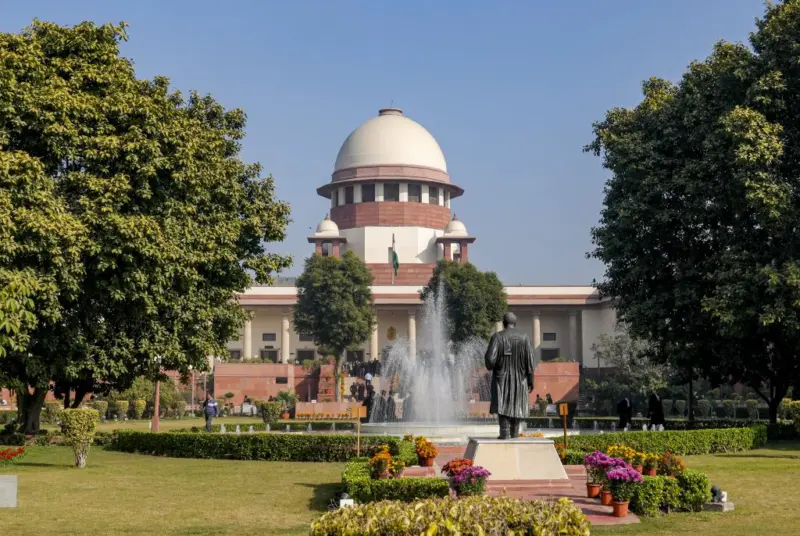

The recent intervention by the Supreme Court of India into a Class 8 social science textbook produced by National Council of Educational Research and Training (NCERT) marks a significant departure from established constitutional practice.
Acting on its own motion, the Court has not merely expressed concern or sought clarification. It has imposed a blanket prohibition on the textbook, initiated coercive proceedings, and issued punitive directions against individuals associated with its preparation. The scale and immediacy of these actions require careful legal and institutional scrutiny.
What is at stake in the present controversy is not a textbook, nor a single chapter, nor even the reputation of the higher judiciary. It is something structurally deeper: whether democratic institutions in India can be studied, critiqued, and taught as living, evolving entities - or whether they must be insulated from scrutiny in the name of preserving authority.
At the core of the issue is the treatment of a section dealing with challenges within the judiciary, including references to corruption. The court appears to have taken the position that such discussion - especially in material intended for young students - amounts to an attack on institutional integrity. This position is difficult to sustain within the framework of constitutional democracy.
A democratic Constitution does not rest on the infallibility of its institutions. It rests on their accountability. The Indian judiciary itself has repeatedly affirmed that transparency, criticism, and public reasoning are essential to maintaining legitimacy. From judicial pronouncements on freedom of speech to its own articulation of constitutional morality, the court has historically recognised that institutional dignity is not preserved through silence but through openness to scrutiny.
Educational curricula reflect this understanding. Across disciplines, school textbooks routinely examine the legislature and the executive not only in terms of their functions, but also their failures. Corruption, inefficiency, and misuse of power are not treated as aberrations beyond discussion; they are presented as structural challenges that democratic societies must confront. To exclude the judiciary from such analysis is to place it outside the democratic framework it is meant to serve.
The role of bodies like NCERT is precisely to translate complex institutional realities into pedagogically appropriate material. Textbook development follows a structured process involving expert committees, peer review, and alignment with broader curricular frameworks such as the National Curriculum Framework. Courts, by contrast, are not designed to adjudicate on academic content in the absence of clear illegality. When a court substitutes its own reading of a text for that of subject experts, it risks entering a domain where it lacks both institutional competence and democratic mandate.
The right to be heard was bypassed
Equally troubling is the manner in which the intervention has unfolded. Foundational principles of natural justice -particularly the right to be heard - appear to have been bypassed. Individuals associated with the textbook were not afforded an opportunity to explain the context, sources, or pedagogical intent of the material before adverse conclusions were drawn. Instead, determinations regarding motive and credibility were made at the threshold stage, followed by directions carrying severe professional consequences.
Such actions raise serious constitutional questions. The right to reputation, recognised as part of the right to life under Article 21, cannot be curtailed without due process. Academic freedom, though not explicitly enumerated, flows from the guarantee of free expression under Article 19(1)(a). The Supreme Court has, in multiple decisions, cautioned against prior restraint and the suppression of ideas merely because they are uncomfortable or critical. To invoke contempt jurisdiction in the context of textbook content-absent a clear and present threat to the administration of justice - extends that power into uncertain and potentially expansive territory.
The doctrine of contempt, particularly in its 'scandalising the court' form, has long been debated within Indian jurisprudence. Its origins lie in a monarchical conception of authority, where criticism of the sovereign was equated with a threat to order. Modern constitutionalism, however, demands a narrower and more precise application. Criticism of institutions, including the judiciary, cannot be conflated with contempt unless it demonstrably obstructs justice. To treat pedagogical discussion of institutional challenges as contempt risks converting a protective doctrine into a punitive one.
It is also necessary to consider the broader implications for education. If textbooks are to avoid any reference to institutional shortcomings, they cease to be instruments of critical learning. Students are then presented with a static, idealised version of governance that bears little resemblance to lived reality. This not only undermines educational integrity but also weakens democratic citizenship. A citizenry that is not encouraged to question is ill-equipped to participate meaningfully in public life.
The concern that young students are 'impressionable' cannot justify the removal of complexity from their education. On the contrary, it is precisely at this stage that foundational habits of critical thinking must be cultivated. Carefully framed discussions of institutional challenges do not erode respect; they deepen understanding. They allow students to appreciate both the strengths and the vulnerabilities of the systems that govern them.
There is, moreover, an internal inconsistency in insulating the judiciary from the standards applied to other branches of government. If corruption and accountability can be discussed in relation to the executive and legislature, there is no principled basis for excluding the judiciary. Doing so creates an asymmetry that is difficult to reconcile with the idea of constitutional equality among institutions.
None of this is to suggest that textbooks should be careless or sensationalist. Accuracy, balance, and contextualisation are essential. But these are matters for academic evaluation, not judicial prohibition. If errors exist, they can be corrected through established processes of review and revision. If concerns arise, they can be addressed through dialogue between educational authorities and the judiciary. What is at issue here is not the possibility of error, but the method of response.
It is within this context that the Court's language during the April 6 hearing assumes particular significance. The use of a term such as "blacklisted academics" to describe contributors to a school textbook is not merely intemperate, it is deeply revealing. The phrase carries unmistakable colonial and authoritarian connotations, historically associated with regimes that sought to exclude dissenting intellectuals from public life.
Its invocation by a constitutional court is both disproportionate and institutionally inappropriate. It signals not a reasoned disagreement with academic content, but a punitive impulse to delegitimise and exclude. Such terminology has no place in a constitutional democracy committed to reason, plurality, and the autonomy of knowledge production.
The present episode signals a shift towards a more interventionist judicial posture in domains traditionally outside its purview. Such shifts, if left unexamined, can alter the balance between institutions in ways that are difficult to reverse. The legitimacy of the judiciary depends not only on its constitutional authority but also on public confidence in its restraint. When that restraint is perceived to diminish, the consequences extend beyond any single case.
A constitutional court does not strengthen itself by shielding its image from critique. It does so by demonstrating confidence in the robustness of its role, by allowing space for informed discussion, and by adhering scrupulously to the principles it has itself articulated. The test of institutional maturity is not the absence of criticism, but the capacity to engage with it.
At this juncture, an additional concern must be squarely acknowledged. While the Court may seek to prevent students from encountering structured, contextualised discussions of corruption or misuse of power within the judiciary through textbooks, it cannot insulate them from the wider public domain. Students today are not confined to curricular material. They are exposed, often in fragmented and sensational forms to news reports, social media narratives, and public controversies.
When newspapers carry reports of large sums of unaccounted cash being recovered from the residence of a sitting judge, or of such cash being destroyed under suspicious circumstances, these accounts enter public consciousness without the benefit of context, institutional explanation, or critical framing.
In such a scenario, the absence of balanced, pedagogically grounded discussion within textbooks does not protect the judiciary's image. It produces the opposite effect. Young minds, encountering isolated and often alarming information without analytical tools, are far more likely to develop distorted, uninformed, or cynical views about the institution. A carefully written textbook that situates such issues within broader frameworks of accountability, reform, and institutional safeguards would mitigate precisely this risk. Suppression of discussion, by contrast, cedes the terrain of understanding to rumour, speculation, and partial truths.
A site for a larger discussion
It is in this context that initiatives such as the Campaign for Judicial Accountability and Reforms (CJAR) must be understood. Far from seeking to diminish the judiciary, such efforts have consistently attempted to strengthen it by foregrounding accountability, transparency, and public trust. The objective has never been to erode institutional credibility, but to deepen it - by insisting that the judiciary, like all organs of the state, remains open to scrutiny and responsive to democratic expectations. To conflate such engagement with hostility is to misunderstand the very basis of institutional legitimacy in a constitutional democracy.
The controversy over a school textbook thus becomes a site for a larger reflection. It asks whether India's constitutional order will continue to embrace openness, plurality, and critical inquiry, or whether it will move towards a more controlled and defensive conception of institutional authority. The answer will shape not only the future of education, but the character of the Republic itself.
From the standpoint of law, pedagogy, and democratic principle, the path forward is clear. Educational bodies must retain the autonomy to develop curricula that reflect the complexities of governance. Courts must exercise restraint, intervening only where there is clear violation of law. And the space for reasoned, evidence-based discussion of all institutions - including the judiciary - must remain protected.
Anything less would mark a departure from the constitutional promise that institutions exist not above the people, but in service of them.
MJ Vijayan is a writer, research scholar, and founding member of the Campaign for Judicial Accountability & Reforms (CJAR).