




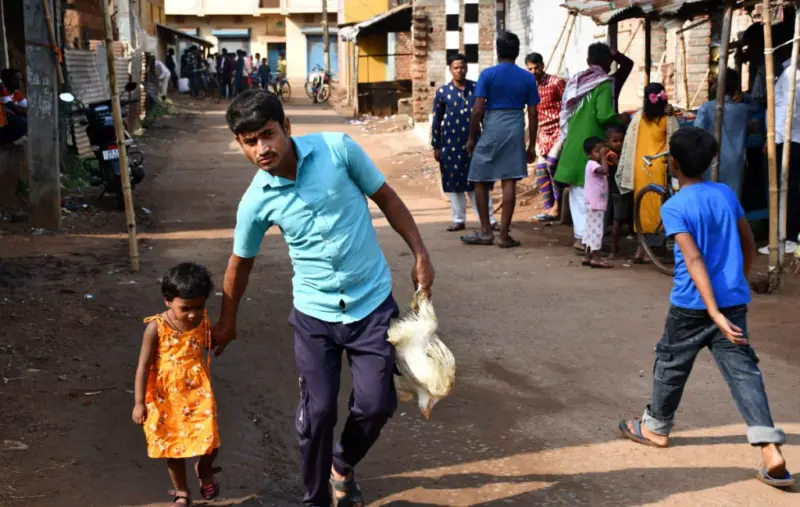

Punisol (Bengal): Overshadowed by anxiety, this year's Eid al Adha, popularly known as Bakrid, in West Bengal saw an atmosphere of melancholy.
In place of celebration, the festival brought to the fore a key question that the new Bharatiya Janata Party government has introduced to the culture of the state - are Muslim festivities not a significant part of Bengal's traditional fabric?
Bengal's chief minister, Suvendu Adhikari, wrote a terse message on the occasion on social media, saying, "Greetings to all those who are celebrating Eid-ul-Adha. Wishing you & your families peace and prosperity." He later visited the ISKCON Chandradaya Temple in Mayapur of Nadia district, to perform cow worship on the day, in an act reflective of his personal brand of political messaging.
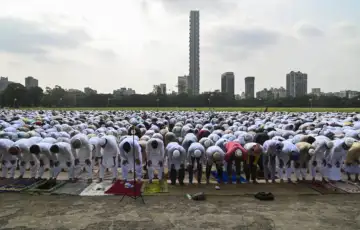
People offer prayers on the occasion of Eid al-Adha at Brigade Parade Ground, in Kolkata, Thursday, May 28, 2026. Photo: PTI.
In Bengal capital Kolkata, the largest Eid congregation was held at the Brigade Parade Ground instead of the iconic Red Road venue. But the real picture of a different kind of Eid was visible in Bengal's villages.
On May 28, this reporter visited several Muslim-majority villages to note how Bakrid celebrations were taking place. What emerged from nearly every locality was the role of silence. Residents spoke in hushed tones with a sense of resignation.
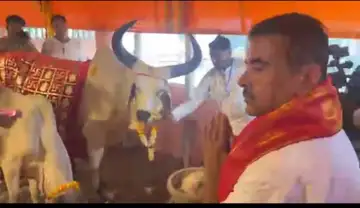
Suvendu Adhikari during rituals at a temple on May 28. Photo: Video screengrab/By arrangement.
For Muslims in Bengal, as elsewhere, the act of sacrifice at Eid is the heart of the ritual. The spirit of selflessness, where one must let go of what is most cherished, manifests in the sacrifice of cattle, goats, camels, and sheep which are raised with care for months.
This year, however, sacrifices were absent from the ritual in many places. The guidelines and restrictions surrounding animal sacrifice under the present BJP-led state government have created a climate of hesitation regarding slaughter during Eid.
In compliance with government directives, many families refrained from sacrificing cows altogether. In some places, people performed qurbani with goats or sheep instead.
It was not only the Muslim community that voiced anguish. Members of the Hindu community, too, openly expressed their distress over the impact of the BJP government's regulations surrounding the buying and selling of animals. Many said in unequivocal terms that these restrictions had pushed ordinary people involved in livestock trade and related livelihoods into severe hardship.
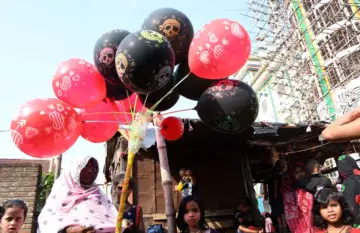
An old woman sells toys at Upordanga area of Punisol. Photo: Madhu Sudan Chatterjee.
Across communities, there was a shared sense that the centuries-old social and cultural fabric had been deeply disturbed, leaving behind a feeling of alienation on what should have been a day of spiritual significance and communal harmony.
A village in Bengal
A village with one of the largest Muslim populations in Bengal is Punisol in the Onda block of Bankura district. Nearly 90,000 people live in this village, the majority of them poor daily-wage workers struggling to sustain their families through hard physical labour.
During the Special Intensive Revision (SIR) verification phase, around 8,500 names out of nearly 26,000 Muslim voters had been placed removed. Armed with a report on The Wire, villagers had fought relentlessly to reclaim and secure their names in the electoral rolls. Eventually, all but a few were restored in what was a clear sign of a democratic success.
But this joy was short-lived.
"We were summoned to the Onda police station and clearly told that under no circumstances would cow sacrifice be allowed," said village youth Mofihul Rahaman. "We even asked whether camels could be sacrificed instead, but the police told us that camels are protected animals and therefore cannot be used for qurbani. We were told that goats, sheep, and dumba could be sacrificed. We obeyed the police administration's instructions. Not a single cow was sacrificed in this village this year."
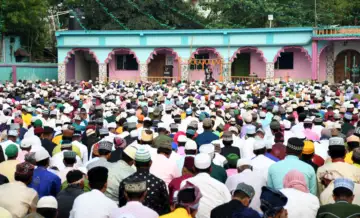
Eid prayers at Punisol, Bankura. Photo: Madhu Sudan Chatterjee.
After Eid prayers in the Keshabpur area of this village, elderly villagers and farmers Azad Khan, Kalamdar Ali, and Anwar Ali were worried.
"We had been raising cows for qurbani for months," Khan said. "Where are those animals supposed to go now?"
The villagers have wondered why they were stopped despite there being no explicit government order banning cow sacrifice during Eid al-Adha.
"If there is no official prohibition, then why did the police prevent us?" Kalamdar Ali asked. "The government guidelines said certificates from the panchayat pradhan and a veterinary doctor would be required for animal sacrifice. But the government never created any proper system for obtaining those documents. Without building any infrastructure or making arrangements, these directives were imposed unilaterally, leaving ordinary people confused and helpless," he said.
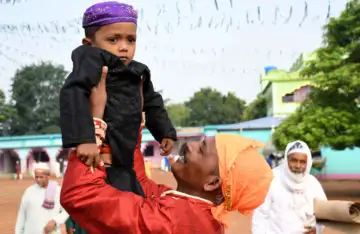
Eid celebrations at Punisol, Bankuar. Photo: Madhu Sudan Chatterjee.
Villagers explained that meat from sacrifice is traditionally divided into three parts - one is kept by the family offering the sacrifice, while the remaining two parts are distributed among relatives, neighbours, and poor families. This practice, they said, is observed across Bengal every year and forms an essential part of the spirit of Eid al Adha, symbolising sharing and social solidarity.
But this year, that tradition was broken in many homes. Relatives did not visit as they usually would during the festival, and countless poor families were deprived of the rare opportunity to receive nutritious protein-rich food.
Shamsuddin Khan recalled that last year, Punisol village had witnessed the sacrifice of nearly 100 cows and around 50 goats. "This year," he said sadly, "only 12 goats were sacrificed."
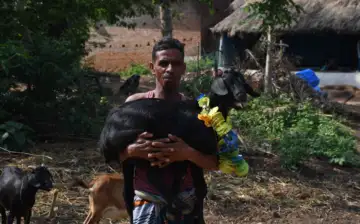
Maisur Ali Mallik takes a goat for sacrifice at Punisol village in Bankura. Photo: Madhu Sudan Chatterjee.
He pointed out the economic burden ordinary families now face. "A single goat costs around Rs 8,000 and yields barely eight kilograms of meat. How can poor people afford such prices? Just imagine how the cost of goat meat will rise now."
Resident Angur Molla said the social atmosphere of the festival had changed dramatically. "Earlier, no one in our village would eat chicken on the day," he said, "but this year, we saw several chicken shops doing brisk business in the village itself."
The impact was felt beyond the Muslim community as well. In neighbouring Ratanpur village, farmers Badal Ghose and Kartik Ghose, both involved in the local dairy business, described the severe crisis faced by cattle-rearing Hindu families.
"We survive by selling milk," they said. "But a cow cannot produce milk forever. We used to sell old cattle and buy new milch cows to continue our livelihood. This year, we could neither sell nor buy cattle. Where are we supposed to go now?"
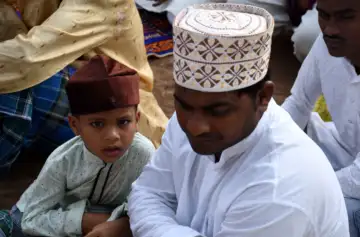
Eid prayers at Punisol, Bankura. Photo: Madhu Sudan Chatterjee.
They warned that many farmers might soon be left with no option but to abandon cattle on the roads.
"We Hindu cattle rearers are suffering the most," they said. "We do not know whom the government is really trying to protect."
The reactions heard in Punisol and the neighbouring villages of Bankura district on the day of Eid al Adha were not isolated voices - they reflected a much wider picture unfolding across Bengal.
Lakhs of Hindu and Muslim cattle rearers across Bengal had been completely unprepared for the 'certificate' clause even a month ago. Many had purchased cattle on loans, hoping to recover their investments during the festival season. Today, they find themselves unable to sell their animals.
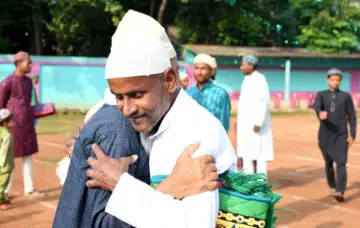
Eid celebrations at Punisol, Bankuar. Photo: Madhu Sudan Chatterjee.
The rural economy of Bengal survives largely on agriculture and livestock rearing. For many farmers, cattle rearing is inseparable from farming itself. At a time when agricultural produce already fetches little value, this sudden blow to the livestock economy has pushed rural families into deeper insecurity.
"We will not be able to survive this shock," said elderly farmer Sheikh Alhilal from Jagulipara village under Golsi police station in Paschim Bardhaman district.
The impact was equally visible in Murshidabad district, home to the largest Muslim population in the state. In areas such as Bhagwangola, Lalgola, Samserganj, and Raninagar, not a single cow was reportedly sacrificed on Thursday.
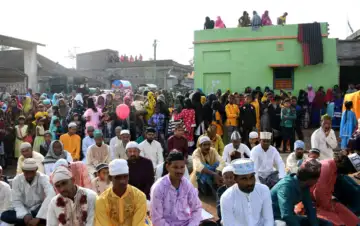
Eid prayers at Punisol, Bankura. Photo: Madhu Sudan Chatterjee.
"People observed Bakri Eid on Thursday under an overwhelming atmosphere of fear," said Asif Faruk, a social activist from Bhagwangola, Murshidabad. "At times, it felt as though we were living in a country where we no longer had freedom."
Speaking on the issue, Professor Saidul Haque, a resident of Golsi and state president of the Awaaj organisation, told The Wire, "Neither before independence nor in the decades after it have people faced such obstacles surrounding Bakri Eid. For the first time, the present BJP-led Bengal government has approached the festival through a communal Hindutva lens. The consequences have not affected Muslims alone - Hindus too have been pushed into severe distress. Rural Bengal's economy has suffered a direct blow."
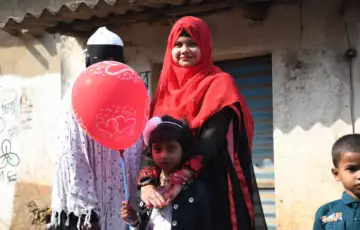
Eid celebrations at Punisol, Bankuar. Photo: Madhu Sudan Chatterjee.
He warned that the long-term effects could be far-reaching. "Milk production will decline, and the tannery industry will also face serious damage," he said, pointing to the interconnected nature of Bengal's livestock economy.