




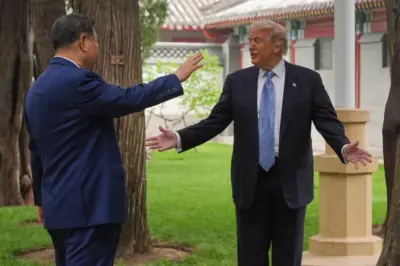

Those who are dismissing the Trump visit to Beijing as symbolic, without any special substance in terms of outcomes, are missing the woods for the trees.
Looked at closely, however, the visit marks the beginning of yet another reset in the US-China relations and its results will unfold over the next couple of months and years.
Illustration: Pariplab Chakraborty.
Most media reports suggest that Trump left with little to show for his talks with Xi, but its importance is in setting the stage for a shift in US-China ties towards a less confrontationist future, a not inconsiderable achievement in this period of high geopolitical tension.
Given the decade-long contention between China and the US, Beijing was clear from the outset that it was seeking a strategic shift, rather than some immediate transaction. It also wanted to show that it was now dealing with the US as a near peer, confident of defending its interests.
In Beijing, the US and China approached the summit from two, not necessarily opposing directions. In keeping with his style Trump looked to promote American investment and exports to China.
To this end he lined up the top bosses of the US high-tech and finance world-Jensen Huang of Nvidia, Elon Musk, Tim Cook of Apple, Christiano Amon of Qualcomm, Sanjay Mehrotra of Micron, Larry Fink of Blackrock, David Solomon of Goldman Sachs, Jane Fraser of Citigroup and Stephen Schwarzman of Blackstone.
The substantive portion, as reflected in US and PRC readouts, revealed the issues each side sought to highlight. Read side-by-side the two readouts almost described two different meetings. But neither side has contradicted the other's characterisation.
Key points in the US included: Chinese investment in the US; fentanyl; shared understanding on Strait of Hormuz; joint opposition to Iran possessing nuclear weapon; and PRC purchases of US oil to reduce dependence on Strait.
Key points in PRC readout included: Geopolitical framing around transformations in the international system; principles surrounding the establishment of US-PRC "constructive strategic stability;" bilateral communications channels; and a stark warning on Taiwan.
The decade gone by
In the last ten years, the US and China have been involved in a complex duel whose result led to Trump's Beijing visit. It began with Trump blowing up the old paradigm of the US-China relationship based on the concept of engagement, if not friendship.
Trump declared that China was now a strategic competitor and in line with this he imposed 25% tariffs on Chinese imports. The US blacklisted Huawei and tightened export controls on emerging technologies to prevent them from reaching China.
The succeeding Biden Administration doubled down on the Trump policies and new tariff hikes were added aimed at clean energy, healthcare and advanced manufacturing. Rules were upgraded to restrict export of semiconductors to China, as well as a ban on US or green card holders from supporting Chinese semiconductor fab facilities. The Chips and Science Act and the Inflation Reduction Acts were passed to promote the US semiconductor industry, as well as EVs, batteries and solar infrastructure.
Things came to a head in 2025, the first year of the second Trump Administration that specifically targeted China with massive tariffs reaching 145%. China did not back down, and it raised its own tariffs on US products. The showdown came when the US introduced its foreign direct product rules to stop global companies from selling technologies to affiliates of Chinese companies.
The Chinese retaliated by choking off the foundation of the semiconductor supply chain by imposing licensing and bans on gallium, germanium and antimony needed to make next generation chips and other advanced electronic products.
All this came at the head of a decade of effort by China to enhance its self reliance and industrial capacity. This led to China dominating the clean-technology pipeline controlling 75% of global lithium-ion manufacturing, and nearly 80% of solar module production. China also became a major producer of Electrical Vehicles in the world.
In addition, it elevated its marine manufacturing capacity to make next-ten LNG carriers, deep-sea equipment, It became the leading country for high-speed rail and the world's most advanced ultra-high voltage electricity grids. China made major advances in robotics, especially domestic industrial robots.
These developments led to Trump taking another look at China and seeking to make a new deal with it. In October 2025, Xi Jinping and Trump met in Busan and decided on a tariff truce by scaling them back for a year and to take up discussions for a wider reset, a process that was begun in Beijing last week.
China's new framework for the relationship
At the Beijing summit, China put forward a new frame for the relationship: the "constructive China-US relationship of strategic stability" ,in essence, one that emphasises cooperation, managed competition and stability.
A day later Wang Yi explained it in great detail and even declared it was a "political consensus" between the two leaders, stressing it was "not merely a slogan" but a "goal." This framework required "respecting each other's core interests" and governance models.
The setting for this new strategic formulation arose from Xi's worry at the outset of the visit as to whether China and the US could avoid the Thucydides Trap "and create a new paradigm of major country relations." Clearly the effort by China is to set guardrails to prevent the relations from crashing.
Five Reasons Why Trump's China Visit Should Worry New Delhi
In some ways this was not very different from XI's 2015 "new model of great power relations" which the US rejected because it implied a US acceptance of Chinese regional hegemony.
Taiwan: In Beijing, where XI Jinping warned against the "mishandling" of the Taiwan issue, Trump said that the two sides had discussed arms sales in great detail and that he had not yet decided on the $14 billion arms sales to Taipei. He also indicated publicly that he is open to walking away from the Six Assurances, saying "1982 is a long way away."
Notably, he said Xi asked him point blank if he'd defend Taiwan, and Trump declined to tell him. A walk-back from any of the Six Assurances, especially those related to arms sales would be a signal to Taipei that US commitments are negotiable. The Chinese want the US to change its stance from "does not support" to "opposes" Taiwan independence.
Tariffs: Trump said tariffs didn't come up on either day. Trump said, "We didn't discuss tariffs. They're paying tariffs, substantial tariffs. But we didn't discuss tariffs….It wasn't brought up." But Wang Yi said the two sides are currently discussing "reciprocal tariff reductions" at the working level. The Busan truce expires in October 2026.
Purchases: There seems to be a gap here. US Trade Representative Jamison Greer said the two sides agreed on "double-digit billions" of agricultural sales, and Trump repeated 150-200 Boeing aircraft, which was below expectations of the 500 aircraft order that Boeing had been negotiating.
But Wang Yi only confirmed the new Board of Trade and Board of Investment in his readout. On the other items, he said only that "the working teams on both sides are currently consulting on specific details."
Iran: Trump said he didn't ask Xi for help or pressure him: "I'm not asking for any favours, because when you ask for favours you have to give favours in return….I didn't ask him to put pressure. But I think he will."
He said he might "make a decision over the next few days" when it comes to lifting sanctions on Chinese refiners of Iranian oil. He suggested again China will buy more US crude. The US readout suggested that there was agreement between the two sides on the nuclear issue and the reopening of the Straits of Hormuz.
AI chips: Trump indicated they did came up, and the US seems poised to sell more of the Nvidia H200, but Trump also said Xi wants to make his own chips. China has made substantial advances in chip fabrication, but it is not yet close to be self-sufficient in top-of-the-line semiconductors. China remains dependent on western lithography equipment for leading edge chips.
Decline: Trump seemed miffed by statements Xi made like "great changes unseen in a century" and "Thucydides Trap" that indicate Beijing believes the US is in decline. Trump said that Xi clarified he was talking about the Biden era, not the Trump era, which seems unlikely (and at odds with China's own Party documents).
"He [Xi] made a statement. It might not have been from him, maybe somebody, but he talked about the decline. But he said today, and he said it very publicly that the US was declining for the last four years, and what President Trump has done in the last fifteen or sixteen months is a miracle. He said we have the hottest country anywhere in the world. But he said under Joe Biden we had a declining, a seriously declining, country. People were pouring in from all over the world. He said what President Trump has done has been a virtual miracle."
Between Trade and Tension: Trump's China Visit in an Unstable World
US allies, especially Japan and South Korea, have been looking at the summit with some anxiety. Any suggestion that the US is softening on Taiwan raises the uncomfortable issue of the US commitments under the US-Japan Security Treaty. Other allies like Australia and even European partners will be concerned as to whether US-China reset comes at the cost of the united allied pressure on trade and technology issues.
In the coming months we need to watch out for developments that will tell us that the reset is indeed underway. One will be the issue of whether the Busan agreement on lower tariffs is confirmed, strategic mineral export licenses eased, no new Chinese entities added to export restriction list, and whether the two sides can shape a working-level trade framework with timelines. Another will be a cancellation of Taiwan arms sales.
There is the possibility that actual decisions remain in abeyance even while summit level meetings continue without any working-level follow up. Or that a setback in the mid-terms lead to Congressional legislation to constrain Trump's diplomacy. This would lead to managed co-existence rather than genuine reset.
Manoj Joshi is a distinguished fellow with the Observer Research Foundation in Delhi.
This piece was first published on The India Cable - a premium newsletter from The Wire - and has been updated and republished here. To subscribe to The India Cable, click here.