




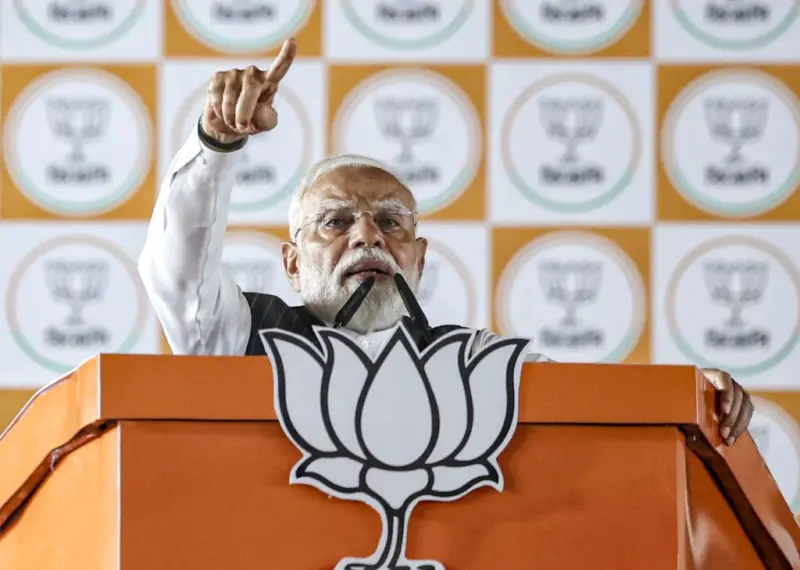

Prime Minister Narendra Modi addressed the nation on April 18 following the defeat of the Constitution (131st Amendment) Bill, 2026. The Bill was solely designed for the delimitation of Lok Sabha constituencies, increasing the number of seats from 543 to 850, while deviously linking it to 33% reservation for women in the Lok Sabha and state assemblies, based on 2011 census figures.
It was utterly shocking that he used vile language to vilify opposition parties, especially the Congress, for voting against the Bill that could not secure the constitutionally mandated two thirds majority of the House.
The solemnity and sanctity associated with the address of the prime minister to the nation was breached with impunity by Modi when he made acrimonious remarks against opposition parties, displayed rabid partisanship and undermined the grace and gravitas of the office that he holds.
Among other things, Modi said that the Congress and other opposition parties - the DMK, TMC and Samajwadi Party - committed an act of “foeticide" by 'defeating the women's quota bill' and warned that they would suffer sazaa (retribution) for their sin. It must be noted that the women's reservation Bill has already been passed in 2023.
"They stand as criminals against the nation’s Constitution. They stand as criminals against the country’s women,” he bitterly remarked and apologised to women for failing to pass the Bill.
He mentioned the Congress party 59 times while making such outrageous remarks. The prime minister’s address was inconsistent with the constitutional morality associated with his office and the role of opposition parties in our parliamentary democracy - that of thoroughly examining the contents of Bills, enriching their legislative intent through debates and discussions, and participating in the voting process.
The opposition parties attacked Modi for his scornful remarks which, according to them, undermined the sanctity of the prime minister’s address and converted it into a political speech. The speech was also in violation of the model code of conduct as election campaigns are underway in West Bengal and Tamil Nadu.
What happened in 1989
In 1989, the historic Constitution (64th and 65th Amendment) Bills - moved by Prime Minister Rajiv Gandhi's government - to provide 33% reservation for women in panchayats were defeated in the Rajya Sabha as those legislations could not secure the support of two thirds of majority of the members of the House.
BJP leader L.K. Advani while speaking on those Bills on August 16, 1989 agreed with the broad principle of decentralisation of power to Panchayats but described the Bills as nothing but "hypocritical, insincere…. pure election gimmickry.." and suggested referring those Bills to a select committee of the House for examination and report.
Other opposition party leaders voted against it on the ground that it would disturb the basic structure of the Constitution, which declares India to be a Union of States and not a Union of States, panchayats and other local self government bodies.
Gandhi defended those Bills on the ground that reservations for women would ensure that the panchayats and nagarpalikas undertaking planning exercises would adequately reflect the concerns of the weaker sections of society.
"These two Bills," he added, "would make democracy a solemn and ineluctable constitutional obligation on all concerned". Describing the Constitutional Amendment as a solemn and long term pledge, he was of the opinion that the consequences of the Constitution Amendments would far outlast its immediate relevance.
While those Bills could not be passed in the Rajya Sabha 1989 because the Congress did not have majority in the House and BJP along with opposition parties opposed it, in 1991, Prime Minister Narasinha Rao's government moved them as Constitution (Seventy Second and Seventy Third Amendment) Bills to reserve 33% of seats for women in the democratically elected institutions at the level of panchayat and nagarpalika.
Eventually, these were passed by both the Houses of Parliament as much of the opposition to the Bills had been softened due to threadbare discussion of its several provisions by the Joint Committee of both the Houses. After the passage and enactment of these Bills, these were known as the Constitution (Seventy Third and Seventy Fourth Amendment) Act.
The salutary point worth noting is that when the 1989 Bills were defeated, then prime minister Rajiv Gandhi did not address the nation and launch a no holds barred attack on the opposition.
When the Narasimha Rao government moved those two bills in 1991, they were referred to the Joint Committee of both Houses for examination of their provisions. As a result, a consensus was reached on those legislations.
Lowering the standard of public discourse
Fast forward to 2026, we see how Prime Minister Modi and his government have acted in sharp contrast to Rajiv Gandhi and Narasimha Rao. The Modi regime dismissed the repeated pleas of some of the opposition parties to refer (One Hundred and Thirty-First Amendment) Bill, 2026 to a joint or select committee or even a Standing Committee for scrutiny and examination.
Instead of a deliberative and consultative legislative process involving opposition parties, the government preferred to push the Bill unilaterally. When it was defeated, Modi, instead of graciously accepting the outcome, addressed the nation and used unacceptable language to target the opposition.
Such acts have lowered the level of public discourse and eroded people’s trust in the office of the Prime Minister and its present occupant. This expanding pattern of institutional erosion harms the country and imperils the Constitution, which must be safeguarded.
S.N. Sahu served as Officer on Special Duty to President of India K.R. Narayanan.