
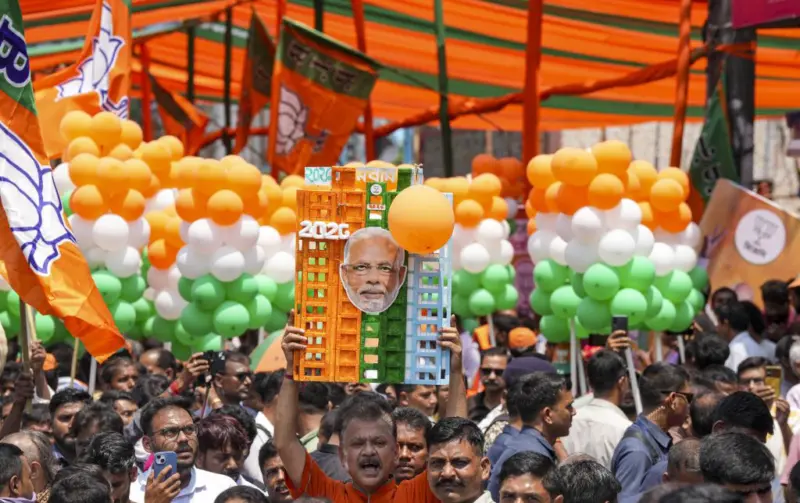

In the early years after the Independence, election posters were rare and handwritten on white paper or old newspapers. In our area, single-colour printed posters, petromax and loud speakers began appearing much after the first general election in 1952.
As a school boy, this writer used to walk miles to attend such rallies just for the glamour. Multi-colour litho-printed posters made in Sivakashi began appearing in Kerala some time around 1955. In 1982, when a poster with S. Bangarappa's picture appeared on Delhi walls, the Congress leadership asked him to pull it down. Those days, Congress posters had party symbols and Indira Gandhi's picture. Not any other leaders'.
 After Gandhi romped back to power, at some time around 1982, the Congress began distributing centralised posters in Hindi and English. Once the parliamentary board decided on ticket, the incumbent goes to an MP's Bungalow on Krishna Menon Marg and collect half of the allotted election fund and make arrangement to sent posters and other campaign materials to the constituency.
The centralised poster distribution was discontinued soon after. A little after the mid-80s, elections became more colourful and noisy. Cassettes and CDs blared out noisy songs and skits, most of them parodies of popular Bollywood songs. Vehicles fitted with loudspeakers went round the crowded streets.
The modernisation of the election was first initiated by what we derisively called Rajiv Gandhi's backroom boys. They had hired Rediffusion to design Congress election posters and handouts and media advertisements. Before this, all such work was done by office staff at Congress office on Jantar Mantar Road.
Ironically, those who had initially looked down on Rajiv Gandhi's wiz kids of 1984 were the first to adopt the modern technology for election campaign. A few years after the 'computer boys' - another term for the Rajiv aides - experiments, BJP as well as Congress competed in the use of campaign cassettes and CDs during the elections. Songs, slogans and skits blared out from vehicles fitted with high decibel music system.
As media reporters, we have been witness to the sweeping transformation in the entire gamut of elections: from candidate selection, publicity, modernisation of electoral machinery, concept and conduct of the rallies, prediction of results and reporting by media. In the process, conducting elections became made exorbitantly expensive for the fund-starved opposition.
Consider candidate selection. Until early 1960s, it candidates were chosen at the state level and announced at district rallies. A copy of the list was sent to the Congress headquarters by post. As a college student, this writer had listened to former minister K. Karunakaran declaring the Congress candidates at a public meeting. He introduced each one of them to the audience.
During the Syndicate days, candidates were fixed mostly at informal meetings by the bosses in their respective states. Those like Atulya Bose, Morarji Desai, S.K. Patil and C.B. Gupta were so domineering that they themselves chose the nominees. Late journalist P.P. Pande had narrated how C.B. Gupta had at an informal bahas at circuit house fixed the candidate for the assembly polls.
When Gupta asked a local leader to become candidate, the latter proposed his senior's name. Then a third person was finally chosen as per the suggestion made by the second person. Rajendra Sharma, a Rashtriya Swayamsevak Sangh pracharak deputed to the BJP during the Vajpayee days had described a similar reluctance by party workers to function as MPs or MLAS. Senior party workers shied away from legislative work.
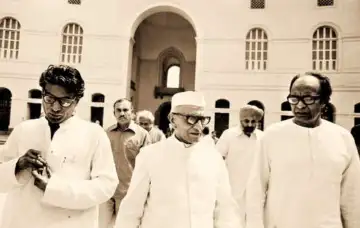
A 1977 picture of Biju Patnaik with Morarji Desai (centre) and George Fernandes (extreme left) in New Delhi. Credit: Facebook/George Fernandes
Compare the yesteryears' 'not me' idealism with today's smart politician. What had cost less than one lakh expense for a parliament candidate is now a multi-million investment with high returns provided you are from the ruling party with right access. Contesting elections has become an attractive business option with little risk.
Hence, fixing candidates has become an arduous exercise. Hectic lobbying, influence peddling and outright bribery in some parties have become commonplace. For the serious parties, the main criterion in contentious contests remains winnability. But personal loyalty to top bosses or their close hangers also works normal conditions.
In BJP, a panel of names for each constituency comes up before the parliamentary board for consideration. However, the actual decisions are known to be made in back-door discussions with Amit Shah's team. This then comes up before the board for formal endorsement.
We have reached a stage when the importance of MLAs and MPs is rated very high. Every political contest leads to their loyalty test. The occasionmay be a Rajya Sabha election orvoting in legislatures in critical situations. Quite often, it depends on money power, inducements and perception of invincibility of the contesting parties.
The pre-election portrayal of public mood in India was first done by Eric da Costa. A Delhi newspaper, Times of India, used to carry his analyses just before the polling date. It wasmodelled on the American Institute of Public opinion.
Then came the regular poll survey-based forecasts by Prannoy Roy. His predictions of 1980 and 1984 Lok Sabha elections were less accurate than those in 1989 and 1991. Despite this, Roy's pre-poll predictions had better acceptance. Simultaneously, instant surveys - exit polls and its variations - became a craze for the TV. In later years, most of these lost credibility due to mindless politicisation and miscalculations.
A decade later, there appeared a new set of glib talking, smartly dressed guys and gals representing political consultancy firms. They introduced data-driven strategies for political parties. This essentially meant snapping of the party's organic links with the grassroots. They focused on projection of personalty rather than policies or ideology.
This meant relying more on top-down leadership structure rather than the normal system of internal democracy. Assuring sure success, the consultancy firms have reshaped Indian elections by Americanising it by introducing corporate data-driven strategies. While their effects on our politics continue to remain murky, there are disturbing indicators of how they can de-institutionalise political parties in the name of business.
They treat elections as business projects, prioritising data analytics, targeted messaging and image management rather than grassroots mobilisation. The trend highlights a move-away from political organising towards a transactional, consultancy-driven approach, potentially weakening the long-term organisational health of Indian political parties.
The consultancy firms extensively use SuperCaller, which enabled them to reach voters daily with pre-recorded messages. Since then, an outcrop of firms, including the Populus Empowerment Network (PEN), Showtime Consulting and JPAC Persona have consolidated their positions as important stakeholders in Indian elections.
They have been hired by the BJP and the Congress and several regional parties. These led to sweeping changes in the business of politics, rendering it high cost and incompatible for opposition. Take public rallies. The old-style maidan rallies no more work as Modi's managers made it a closed-door, roofed affair with the participants sitting on chairs. Thus other political parties have also been forced to follow the system.
Now Modi himself comes on stage all alone, a safe 20-metres away from his audience as thisphoto shows. For a participant sitting at a far end and viewing the leader is not much different from watching it on TV. Insulating the leader away from the ranks is also a way of making him unique and pricey.
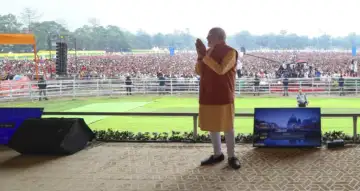
In this image received on April 1, 2026, Prime Minister Narendra Modi greets a gathering during a public meeting, in Gogamukh, Assam. Photo: PMO via PTI.
Essentially, poll predictions were initially patterned on market surveys. And campaign management by consultancy firms on marketing strategies and practices. The 'product' promotion invariably relies on preventing adverse reports and emphasising the invincibility of the person. A few years back, the Modi team was advised to cast himself as a super human and promote the sales pitch.
This had led to a new kind of cult build-up.Modi temples have came up in several places including Pune,Meerut and other places and statues have been set up in India and evenabroad. Ministers have ascribed super human values to him and he himself has said he is 'non-biological'. The cult around Indira Gandhi never reached this level.
From the times of party leaders showing reluctance to stand for elections and posters made out of newspapers by party workers, we have reached a long way indeed.
In an age of fractured mandates, personality cults and transactional alliances, P. Raman brings clarity to India's shifting political equations. With Realpolitik, the veteran journalist peers beneath the slogans and spin to reveal the power plays, spectacle, crises and insecurities driving India's politics.