
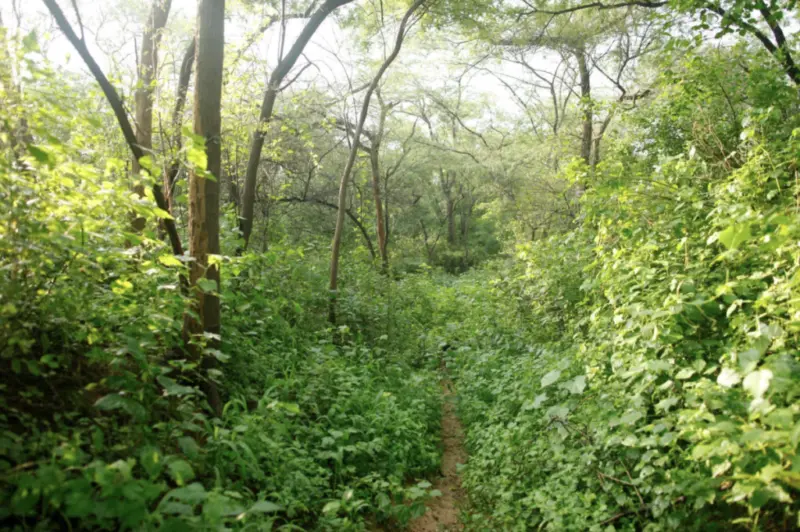

Delhi Ridge, the northern end of the Aravallis, lies fragmented in several patches in the city, from Jahanpanah city forest and Sanjay Van in the south to Kamla Nehru Ridge in the north.
The largest of these fragments, however, is the Central Ridge, also known as the New Delhi Ridge, which stretches over 864 hectares. In a move that will undeniably decimate this fragment is the creation of four more 'van' (forests) to join Sanjay Van in Delhi, as announced with the release of a tender by the Delhi Forest Department.
The tender, titled "Development of Special Vans - Tirthankar Van, Ritu Van, Rashi Van & Panchvati Van in Central Ridge under West Forest Division", is set to come up in the Central Ridge area. Quite unlike Sanjay Van, which is a wilderness area, these four forests will transform the Central Ridge into curated spaces that are most decidedly not wilderness.
The Ridge biodiversity
The Ridge belongs to the Aravalli west thorn scrub forests ecoregion - a large, geographically distinct region with distinct climate and biodiversity - that stretches from Gujarat to Punjab, and this region, along with the rocky Aravallis proper (mostly in Rajasthan), also comprises large swathes of topographically plain 'open natural ecosystems', such as grassland.
Large parts of this ecoregion have been taken over by pernicious invasive species such as Vilayati Keekar (Neltuma juliflora), Subabool (Leucanea leucocephala), Lantana (Lantana camara)and Gajar Ghaas (Parthenium hysterophorus), and the Delhi Ridge is no exception. Joining these invasive species are other exotics that were intentionally planted at a time when we knew no better, such as the various eucalypts. These invasive and exotic species today comprise much of the biomass of the Delhi Ridge. All the Ridge fragments as they are today are consequently extremely degraded parcels of land, ecologically speaking.
That is to say, the Ridge is a dysfunctional ecosystem. However, under the canopy of this largely woody list of species lies a herb and shrub layer that lies largely untouched. The Flora of Delhi, written by J.K. Maheshwari in 1963,records a few hundred species of native herbs, shrubs, and vines found in the Ridge.
One of them is the bulbous species Dipcadi montanum(Mountain Dipcadi). Endemic to the Indian subcontinent, this plant is rather uncommon throughout its range. In the Delhi region, it behaves as a spring ephemeral, emerging for just about a month, completing flowering and fruiting before returning to dormancy for the rest of the year.
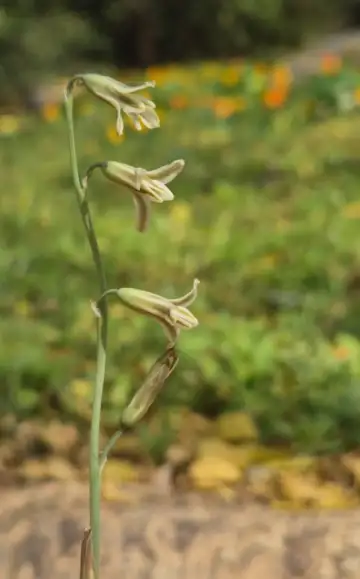
Dipcadi montanum. Photo: By arrangement.
Another example are the exceptionally pretty vines from the Apocynaceae family found in the Ridge. Apocynaceae, the milkweed family, plays host to the Danainae subfamily of butterflies, to which the famous Monarch butterfly belongs. An Indian example is the striped tiger (Danaus genutia). While some native Apocynaceae members of the Aravalli ecoregion such as Aak (Calotropis procera) prefer non-rocky habitat, several others, such as Stephanotis volubilis, Telosma pallida, and Pentatropis nivalis are found in the rocky Ridge habitat.
Abutilon ramosum, the sticky Indian mallow, is described as "rare" in The Flora of Delhi, and I have personally found (and photographed) it in the Ridge. Then come the grasses. Delhi records some 90 grass species, and several are Ridge inhabitants, rare elsewhere in the city.
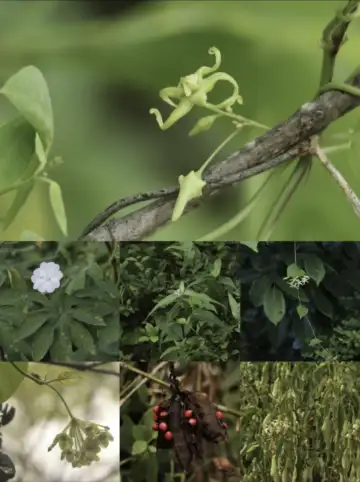
A few of the native non-tree species found on the Ridge. Top to bottom, left to right: Pentatropis nivalis (a vine), Ipomoea pes-tigridis (a vine), Commelina undulata (a herb), Telosma pallida (a vine), Stephanotis volubilis (a vine), Abrus precatorius (a liana), and Justicia adhatoda (a shrub). All photos by the author.
Clearly, even though the Delhi Ridge is a degraded forest with much of its woody biomass coming from non-native species, it is far from a condemned region to be earmarked for development.
Why current efforts to 'restore' the Ridge are ineffective
What the Delhi Ridge requires is carefully thought-out ecological restoration that preserves what is existing in the Ridge and supplements it with what it has today lost, involving comparison with existing reference ecosystems, trained ecologists up-to-date with the latest academic literature on ecological restoration and a proven track record, and intent. Such case studies are rare in India, but they do exist. India's capital deserves no less. Such an effort requires care and time. Unfortunately, efforts to deal with the invasive species in the Ridge have done none of this so far.
Take the existing efforts to curb the Vilayati Keekar (Neltuma juliflora)in the Ridge. It has been ineffective at best and outright harmful to the Ridge's biodiversity at worst. As I have argued here, much of the Ridge's value lies in its non-tree diversity, which has been relatively less affected than its tree diversity. And it is precisely this diversity that is cleared with earth-movers as one of the first steps performed in whatever interventions to deal with the exotic species in the Ridge have been made so far.
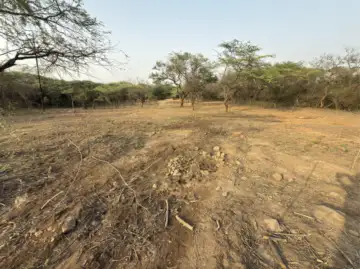
Current plantation efforts on the Central Ridge involve clearing most of the biodiversity-rich understory vegetation. Photo: By arrangement.
Invasive species like Vilayati Keekar are lopped to let light under the canopy, and vines are planted in an attempt to strangle the species. This is ineffective because VilayatiKeekaris allelopathic - influences growth, survival or reproduction of other organisms - to many native species. This means that it prevents or inhibits them from establishing under its canopy. Moreover, being an aggressive grower, it soon resprouts, vines notwithstanding. To replace the undergrowth are stick-straight saplings of trees - rarely vines, shrubs or herbs - planted extremely close together. What is worse is that the species chosen for these plantation activities are often not native to the rocky parts of the Aravallis like the Ridge.
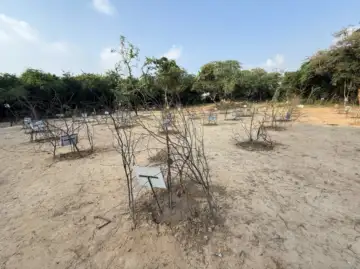
Plantation on the Central Ridge so far has been confined to stick-straight saplings planted in a grid. Photo: By arrangement.
An alarming example of this is when Aegle marmelos (Bael), Pithecellobium dulce (Jungle Jalebi), Kigelia africana (African Sausage Tree), Combretum indicum (Madhumalati/Rangoon Creeper) and Holoptelea integrifolia (Chilbil/Indian Elm)were planted at one site, and only the last is native to the Ridge. These saplings, heavily watered, are then allowed to grow for as long as irrigation continues, after which the majority perish, allowing the underground seed and soil bank of propagules like woody rootstocks and rhizomes to resprout, returning the Ridge to much of its former "glory".
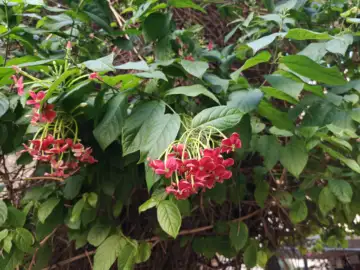
Combretum indicum flowers. Photo: Vikram Iyer.
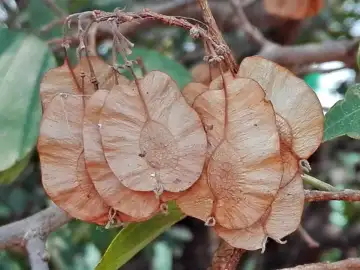
Holoptelea integrifolia seeds. Photo: Adityamadhav83/Wikimedia Commons.
The development of the city forests at the Ridge carry forward a century-long legacy of poorly thought out plantation in the Ridge, but at an unprecedented scale. Even the tender document reveals that "rank vegetation" including "grass, brush wood, and saplings" is to be cleared. Invasive species are to be pruned. Some of the species to be planted at Rashi Van, the only van for which an explicit species list is provided, is as follows:
Emblica officinalis (Amla)-70 Nos.
Syzygium cumini (Jamun)-70 Nos.
Acacia catechu (Khair)-70 Nos.
Ficus religiosa (Peepal)-70 Nos.
Butea monosperma (Palash)-70 Nos.
Aegle marmelos (Bael)-70 Nos.
Terminalia arjuna (Arjun)-70 Nos.
Bombax ceiba (Semal)-70 Nos.
Cassia fistula (Amaltas)-70 Nos.
Prosopis cineraria (Khejri)-70 Nos.
Mangifera indica (Mango)-70 Nos.
Azadirachta indica (Neem)-70 Nos.
Of these, Amla, Bael, Mangoand Neemare not native to the Ridge, whereas two more - Jamunand Arjun - are riverine species, growing only along perennial water courses. While the document specifies that "native" herbs, shrubs and climbers are to be chosen for all plantation activity, it is evident that what is "native" is misunderstood by those carrying out the plantation.
Such an outcome is inevitable when plantation work is outsourced to contractors instead of restoration ecologists. Such facets of ecological restoration, understood by the vast majority of restoration ecologists, are clearly unknown here. One more such instance is that a healthy forest contains trees of varying ages, shapes and sizes growing together. Ecological restoration recognises this, which is why it requires much time and commitment.
Stick-straight rows of trees in a grid are clearly not this. The legacy of irrigation continues, except that the scale of the van makes resprouting and the return of the native Ridge vegetation less likely.
Possible consequences
Are delicate bulbous plants found on the Ridge such as Dipcadi montanum and Drimia indica likely to survive this onslaught? Unlikely.
Plants with certain traits are favoured with increasing disturbance such as by earth-movers. Such species, called "ruderals", are often invasive and persistent disturbance in the Ridge will almost certainly shift the community composition of the plant diversity on the Ridge towards more of these.
Several plant species in the Ridge have wide geographic ranges. Adusa (Justicia adhatoda), for example, is found throughout the subcontinent. Such wide-ranging species show adaptations to their specific regions over their geographic range. That is, they display quite a bit of intraspecific variation that allows them to survive in their respective habitats. Evidence shows that without this local adaptation, plants, even of the same species, can struggle to grow elsewhere. So, Adusa plants from the Uttarakhand Shivaliks are genetically different from the ones in Gujarat, which are different from the ones in Delhi, and if one is transplanted to the other, it can struggle to grow.
Ecological restoration is mindful of this intraspecific diversity - a very important facet of overall biodiversity. Delhi's Ridge houses some of the last remnants of this diversity that once used to be found in the Delhi region, and is now swallowed by concrete. The plants grown from vegetative cuttings that comprise much of nursery stock are all clonal and miss out on this.
All this is assuming that the van will emulate how plantation is done on the Ridge so far, as the tender document indicates in parts. What is more worrisome is that it also lists much hardscaping activity such as the installation of chain-link fencing and wheeled waste bins, suggesting that the Ridge will be developed more along the lines of a municipal park.
That a park is not a wilderness area and far from a biodiverse haven does not need saying. If this is the future of the Ridge, then I weep for what is to become of Delhi and I weep for its biodiversity. Allowing the Ridge to be until it can be carefully ecologically restored would be the preferred, and a far better alternative to hastily thought out "development".
Vikram Iyer is a PhD student at the Indian Institute of Science Education and Research (IISER), Mohali.