





The Narendra Modi government frequently posits India as a 'Vishwaguru' or world leader. How the world sees India is often lost in this branding exercise.
Outside India, global voices are monitoring and critiquing human rights violations in India and the rise of Hindutva. We present here monthly highlights of what a range of actors - from UN experts and civil society groups to international media and parliamentarians of many countries - are saying about the state of India's democracy.
Read the monthly roundup for April 1-30, 2026.
International media reports
Foreign Policy, US, April 3
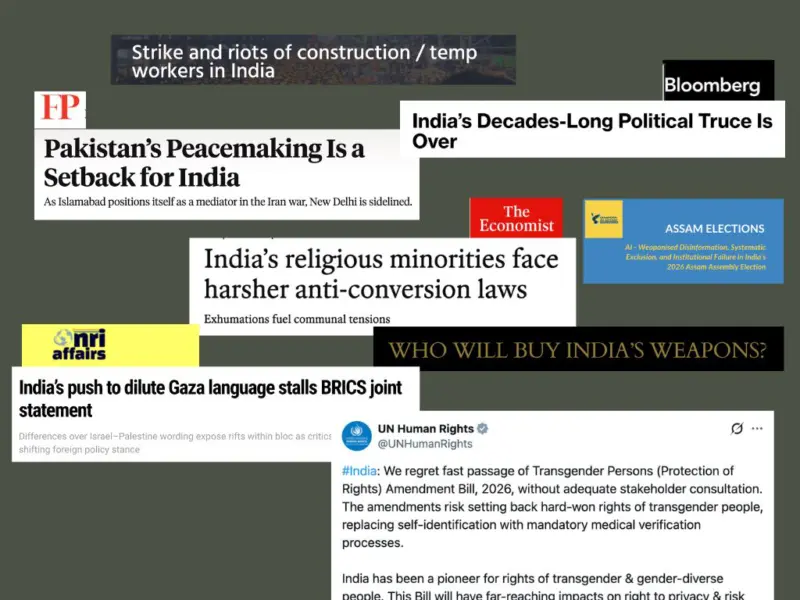
Sushant Singh highlights Pakistan's diplomatic role between the US and Iran and strengthened ties with China and West Asian powers as "a humiliating failure for Modi". While Modi's foreign policy has tried to diplomatically isolate Islamabad, the current spotlight on Pakistan is showing the limits of the US-India relationship and India's "poor standing in its extended neighborhood". Despite India's claims of being "a bridge between the global south and major powers", it is being "bypassed in the real corridors of power". Although Pakistan can quickly fall from favour, this moment should be a wake-up for Modi to "rethink the fundamentals of his foreign policy."
The Economist, UK, April 9
The Economist reports on attacks against freedom of religion in Chhattisgarh, for instance, "to stop Christian burials, locals have vandalised prayer halls and torched homes." Chhattisgarh has passed one of India's "most restrictive" anti-conversion laws shaped by government and police intrusion and punishes even the promise of "a better lifestyle". A maximum penalty of life imprisonment and a fine of 2,500,000 rupees can be levied on those responsible for "mass or forced conversions". Passed in 14 out of 28 states, "India's freedom-of-religion laws will continue to make a mockery of the very concept they claim to protect".
Bloomberg, US, April 21
Andy Mukherjee analyses the "political divide between India's north and south" in light of the recent defeat of a Constitutional Amendment Bill to expand the size of Parliament. Mukherjee points out that Opposition parties called out the Modi government for using women's representation "as a ruse" when "the real intent was to "redraw the balance of power" to further increase northern India's already dominant representation. This would bolster the Bhartiya Janata Party's (BJP) agenda of "stoking anti-Muslim religious polarization in the north". The effort to introduce the Bill also highlights the BJP's long-term need for a majority in Parliament, required for constitutional amendments, towards furthering its ideology
 The Guardian, UK, April 22
Hannah Ellis-Petersen and Aakash Hassan report on the removal of 9.1 million individuals, over 10% of the voting population, from the electoral rolls in West Bengal, just before state elections. Critics say that this Special Intensive Revision (SIR), in which Muslims and other minorities have been disproportionately deleted, is a strategic move by the BJP to gain an advantage over the Trinamool Congress (TMC). Economist and author Parakala Prabhakar describes the deletions as "bloodless political genocide".
NRI Affairs, Australia, April 23
The NRI Affairs news desk reports that India, currently the chair of BRICS, sought to soften the language of a joint statement which described Israel's military actions in Gaza and Lebanon. Ten members present at the high-level meeting in Delhi strongly opposed this effort at dilution, resulting in a failure to issue the statement. This is unusual for BRICs since meetings are typically followed by the release of consensus statements.
Indian diaspora and civil society groups
On April 6, the Diaspora in Action for Human Rights and Democracy (DAHRD) published an election monitoring report before Assam's state Assembly elections. The report documents an "industrial-scale" AI operation that "altered reality" in order to dehumanise Assam's Muslim community, through synthetic images and deepfake videos, reaching 407.4 million followers. Findings include a "propaganda-to-policy pipeline" within the electoral cycle during which "AI propaganda" around "Land Jihad" became law as well as the Chief Minister's on-record admission that campaign vocabulary was deliberately altered to evade liability. The report documents "four simultaneous exclusion operations - administrative, electoral, physical, cultural - against a single community during one active election."
InSAF India held the eleventh session - "Resisting State Narratives: Normalising Militarised Mining and Displacement in Adivasi Regions" - of the Deadline or Death Sentence series on April 18. This session examined Home Minister Amit Shah's "deadline" to eliminate the Naxal movement by March 31, 2026, in light of the current broader global political "Trumpian" language of "deadlines" and "decisive victories" in military operations. The international panel of speakers discussed the underlying intentions behind these declarations, particularly whether the core incentives are to use force to clear the ground for extraction, by the state in India or by the US and Israel over West Asia. The speakers reflected on how civil society should be navigating this moment, particularly those who seek to stand in solidarity with Indigenous struggles.
The Migrant Workers Solidarity Network released a compilation of "at least 28 major strikes and protests" by workers "mainly in the power and construction sectors" between January and March 2026 for payment of wages and basic workplace safety.
Experts say
On April 2, UN Human Rights
Rezwan, Regional Editor for South Asia atGlobal Voices, an international, multilingual community of writers, translators, and human rights activists, analysesthe rise of AI-enabled monitoring across India "without sufficient legal protections" on April 26. Despite the ruse of rights-oriented language used in policies, concerns about human rights, privacy, dignity, and civil liberties point to an urgent need to "reduce the risk of digital authoritarianism".
M. Rajshekhar presents findings published by the Polis Project on the consequences of the "aggressive reshaping" of India's weapons manufacturing sector. These include bringing in "localisation requirements" (due to the reluctance of international weapon-makers to share core technologies) driving India's private sector into weapons manufacturing. As Rajshekhar warns against the rise of a "private sector-led military-industrial complex", he finds the shift to the private sector has led to greater arms sales to paramilitary forces and state police. This hyper-militarisation has dire consequences for marginalised communities.
Dr. Nidah Kaiser analyses changes in anti-Muslim violence in India under the BJP based on the concept of a "religious ethnocracy" in a journal article. Since 2014, Kaiser identifies a "shift from sporadic large-scale riots to more routine, targeted violence against Muslims". The factors driving the shift are three-fold: collusion between police and vigilantes, victims denied recognition and recast as offenders, and framing everyday practices of Muslims as threats to national security and cultural integrity. Kaiser finds that "the partnership between state institutions and non-state actors enables violence to transform the ideological project of a Hindu Rashtra into a governmental project." Violence is also emerging "as a technique of governance within a religious ethnocratic state."
Christophe Jaffrelot writes on attacks on academic freedom in India as part of a larger series by the British Association for South Asian Studies (BASAS). Jaffrelot offers a detailed account of a range of attacks including the takeover of state-run universities and research institutes through political appointments, the curtailment of student activism through criminalising dissent and jailing students, and the "Hinduization of education" through changes in curriculum. Also covered are self-censorship by private universities and vigilantism by student organisations on campuses.
Five scholars shared findings of their study published by the Stone Center for Research on Wealth Inequality and Mobility at the University of Chicago on "Residential Segregation and Unequal Access to Local Public Services in India: Evidence from 1.5m Neighborhoods". Focused on Scheduled Castes (SCs) and Muslims, the study finds that disparities with respect to services is large and even higher at local levels of government which are furthest from scrutiny. So much so that "the religious and caste identity of the people who live in a given urban neighborhood are strongly predictive of public services in those neighborhoods".
Rohan Venkat interviews Tariq Thachil, former Director of the Center for the Advanced Study of India (CASI)at the University of Pennsylvania, to put together a reading list on the rise of Hindu nationalism and the BJP. The list includes books on the RSS; the importance of Narendra Modi as a leader; the appeal of Hindu Nationalism for women and Dalits as well for the North East region of the country. The reading list also includes selected books set in Egypt and US on why political parties attract non-elite followers and how they have emerged from faith-based movements.
Reporters Without Borders (RSF)rates India as "very serious" in its 2026 World Press Freedom Index. At 157th position, India scored particularly poorly in the Index's legal indicator: "judicial harassment of independent media is intensifying, driven by the growing use of criminal statutes - defamation and national security laws among them - directly targeting journalists". India is part of the overall decline of press freedom which RSF states is at its worst in 25 years. For the first time in the index's history, "over half of the world's countries and territories (52.2%)" are categorised as "difficult" or "very serious" for press freedom.
Read the previous roundup here.