





To argue that culture operates in isolation from politics is either a cop-out or delusional, or both. It is important, therefore, that we engage closely with the thinking that drives curatorial choices and programming decisions at film festivals, more so during Pride Month, which is beginning to lose its revolutionary character due to government interference and corporate involvement.
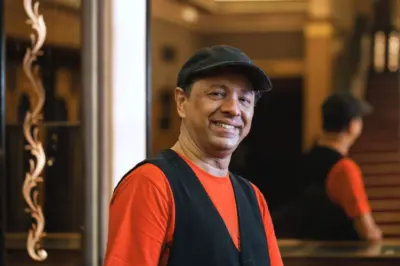
The Stonewall Uprising against police brutality and discrimination towards LGBTQ+ New Yorkers in June 1969, because of which we observe June as Pride Month, was not a networking mixer. It was a riot. It is in this spirit that we interviewed Sridhar Rangayan, the festival director of the Kashish Pride Film Festival in Mumbai, founded in 2010. The 17th edition of the festival opened on June 3, and will conclude on June 7. There are 153 films from 43 countries, across venues: Liberty Cinema, Alliance Française de Bombay and the National Gallery of Modern Art.
Sridhar is a film director, screenwriter and producer, known for films like Evening Shadows, Gulabi Aaina, Breaking Free and Purple Skies, and founder trustee of the Humsafar Trust.
Excerpts from the interview at the opening of the festival follow.
As we head into the 17th edition of Kashish, how do you look back at the festival's journey in terms of achievements, lessons learnt and course corrections? What have you learnt from the feedback that you have got from the LGBTQIA+ community?
The only word I can think of is 'rollercoaster'. Some years have been very good, some have been very challenging. And when I say 'challenging', usually two things come into play.
One is funding, of course. It has always been challenging but, in the last two-three years, it has been a nightmare. The other thing is government pushback on trans rights and same-sex marriage. It poses a challenge because, though we are not directly affiliated with the Indian government, we have to get a clearance for all the films from the Ministry of Information and Broadcasting. It was a bit of a stress because they were previewing a lot of films, and we were wondering if all the films would be cleared. But all 153 of them got a clearance. That's huge!
When I look back, I also think that the aspirations and appetites of the LGBTQ+ community in India have changed. In earlier editions of the festival, we used to program a lot of romcoms. People wanted to see sexy films on the big screen but, over the years, the interest has shifted towards films with more edgy, candid and realistic content with a worldview. It seems that people who come to the festival don't want fluff any more, so our programming has shifted a lot.
Like you said, we do take feedback from the community, so Kashish has become more inclusive in terms of the marginalised communities within the LGBTQ+ community. This year, more than 50% of the films focus on lesbian, trans and non-binary communities. They were not so well represented in previous editions of the festival. We used to receive fewer submissions of films about lesbian, bisexual and trans experiences. That number has gone up. We also have a panel discussion with transfeminine as well as transmasculine persons around the Transgender Persons (Protection of Rights) Amendment Act, which was passed by the parliament this year.
In terms of achievements, Kashish is being recognised as an important platform with Indian and international films premiering at the festival. It provides not only an exhibition space but also a forum for networking, outreach, funding and distribution. We have the Kashish QDrishti Film Grant to nurture emerging LGBTQ+ filmmakers with financing as well as mentorship.
You mentioned that funding has been a challenge, particularly in the last few years. Does this have anything to do with the fact that Donald Trump is now the president of the United States? International funding for a lot of organisations working with LGBTQIA+ people has disappeared after his re-election and crackdown on the community.
The US Embassy per se has never supported us, but we have been supported by many multinational corporations. Things have changed a bit globally because of US policies as some of these organisations have their headquarters in the US. It is true that some of our previous partners have left but I am really grateful for those who have stayed and continue to stand with us because they see the value in what we are doing to create awareness and sensitisation.
I want to mention Morgan Stanley because this is the 11th year of their support. What they bring to the festival is not just their money but also a set of volunteers. When they participate in the making of the festival, they also take back a lot more from the experience. At Kashish, we believe in the synergy between the LGBTQ+ community and allies, so even the juries for our various awards are made up of LGBTQ+ people as well as allies. When we learn to co-exist, we can create a safer and more beautiful world. That is our broader mission as a festival.
You have served on the Teddy Jury at the Berlinale in Germany, and on juries at the Queer Screen Mardi Gras Film Festival in Australia, the Iris Prize LGBTQ+ Film Festival in the UK, and Seattle International Queer Film Festival, Outfest and Tasveer Film Fund in the US. How have these experiences shaped your curation for Indian audiences?
I realised that the Indian audience is no different from any other audience because nowadays the world is a global village. Being part of all these juries has been an enriching experience but I have also benefited from attending a festival like Frameline in the US to show my work as a filmmaker. One learns not only about curation and programming but also how to build a film festival by talking to the community and learning from the people to get better.
We, at Kashish, also realised the need to engage with audiences throughout the year. That's why we have an initiative called 'Kashish Forward' that travels to college campuses across India with a selection of the films shown at the festival. Our objective is to create acceptance and respect, and address discrimination. It is always so moving to see how eager young people are to engage with all kinds of stories. There is curiosity, not judgement; so the questions are also pertinent.
Saim Sadiq's Joyland, which was banned by the Government of Pakistan a week before its release in cinemas, got a warm reception from audiences at Kashish. The film was eventually released in most of Pakistan but the ban on public screenings in the Punjab province still remains, which is unfortunate for a film set in Lahore. This year, you are screening two Pakistani films - Jameela and Cats Can Teach You To Die Alone. How does it feel to give a platform to films from countries where homosexuality is still criminalised?
Yes, that is a really sad situation. Thankfully, we are sitting in India right now where we have far more rights than many countries, and this is because we have fought quite a bit to arrive at a place where we can now talk more openly about homosexuality and trans rights. But it has been a struggle, so we want to make sure that even if some filmmakers do not find opportunities to show films on LGBTQ+ themes in their own country, we can provide a platform at Kashish. As the biggest LGBTQ+ film festival in South Asia, we are proud to show films from across the region - not only from India and Pakistan but also from Sri Lanka, Nepal and Bangladesh.
This year, you are also showing two films from Iran - Narmookand Jamaat. Homosexuality is not only criminalised in Iran; it can even lead to capital punishment. What are your thoughts on being able to bring these films to Indian audiences?
I don't know what struggles the filmmakers must have gone through to make the films in the first place, and then send them out to film festivals across the world. We do our best to make the festival inclusive and expand our reach. We hope to receive more and more films from people making them in difficult circumstances. We will be happy to showcase them.
Your press release mentions that Kashish is the first Indian LGBTQ+ festival to be held with approval by the Information and Broadcasting Ministry, Government of India. It sounds almost like a badge of honour. Why is this approval important to you?
I must put this in the right context. Any film festival in India that wants to have public screenings has to get approval from the Information and Broadcasting Ministry. There is no way you can avoid this unless you are planning to show the film in a private studio. The MAMI Mumbai Film Festival and the International Film Festival of Kerala too have to get clearances. That's a given, so we adhered to it. It's been smooth sailing but last year three films were rejected - one from Palestine, another called The Holy Curse, and a third that I cannot remember.
Was the Palestinian film Dima Hamdan's Blood Like Water? I saw it on the schedule last year, but it was eventually not screened at the festival.
Yes! Those three films got missed out, unfortunately, but this year we got clearance for all 153 films from the ministry.
International film festivals like Cannes and the Berlinale have become platforms for filmmakers to express solidarity with Palestinians and speak out against Israel. As a festival that submits its programme to the Ministry of I&B for clearance, are there any directives for Kashish to not show films that are critical of Israel or pro-Palestine? I ask because I see one Israeli film and no Palestinian films in your itinerary for 2026.
What we are able to screen depends on what it submitted to us, and the pool of films we can programme from. Last year, we got a Palestinian film so we programmed it, but the ministry did not give us approval. At Kashish, we want to support filmmakers from every country. I do not subscribe to the viewpoint of the political party ruling us. Of course, I don't. You see, I am a filmmaker too, so I know what it takes to make a film. I feel that we should not exclude a film just because of the politics of the country that the filmmaker is coming from. We are showing films from Iran and Israel. If we had got one from Palestine, we would have shown it.
I understand that you want to make a distinction between the government and citizens. In Israel military service is compulsory for most adult citizens. There are very few exceptions. It is quite possible that filmmakers applying to showcase their work at Kashish may have served in the Israel Defence Forces before making their film. What are your thoughts on the Palestinian Campaign for the Academic and Cultural Boycott of Israel?
I just feel that it is a bit unfair because the filmmakers have put their heart and soul into their work, and we need to support all filmmakers from any country. I mean, we are still showing films from the US and from India, right? Look at the current political environment in both these countries. We, at Kashish, do not want the politics of a country to dictate our programming.
Kashish relies heavily on corporate sponsorship. What do you think of pinkwashing, the use of CSR (Corporate Social Responsibility) and DEI (Diversity, Equity and Inclusion) funds to cover up environmental harm and human rights violations? With the No Pride in Genocide movement actively drawing attention to pinkwashing, what kind of checks do you have in place before you bring a corporate sponsor on board?
We take a look at their track record in terms of ethical practices. In the past, we worked with a corporate sponsor that I am not going to name but they were found to be defaulters with respect to human rights. We have not worked with them for the last 10 years. Sticking to these principles is not easy because money is so hard to come by. But we absolutely do not allow corporate sponsors to dictate terms when it comes to programming or any creative decision. We keep them at an arm's length. They give us money, and we acknowledge their support. We have been offered sponsorship from countries violating human rights at the moment. But we have said no even though we need the money. I will not name them but you know what I am talking about.
If funding was not a concern, what direction would you like Kashish to move in?
I would like Kashish to happen not only in Mumbai but Tier 2 and Tier 3 cities so that conversations about the rights of LGBTQ+ people can be created there as well. I would love for Kashish to become an Oscar-qualifying film festival. This basically means that, if we are recognised by the Academy of Motion Picture Arts and Sciences, a film winning an award from the jury at Kashish would automatically be eligible for consideration at the Academy Awards. We also want to set up a market at Kashish for filmmakers, producers and distributors to meet.
You did not jump onto the queer inclusion bandwagon because it is a fashionable cause to support. You have skin in the game. You are a gay man with a partner (Saagar Gupta, artistic director of Kashish) of almost 30 years, and you were both petitioners in the marriage equality case that came up for hearing before the Supreme Court in 2023. As someone whose trust in the system has been betrayed, what gives you the faith to continue working with a government that came in the way of legalising same-sex marriage?
You have to push open the doors. You cannot say that the doors are closed, and turn back. If you do that, you are going to stay in your own cocoon and closet. If you want mainstream integration of the LGBTQ+ community, you have to work with the legal system.
Isn't there an exhaustion, a frustration, from having to push continuously? Don't you want to sit back, relax and just enjoy your life after all these years of fighting?
(Laughs) That is a utopian dream. I still have a lot to fight for because it is not just for myself and my partner but for future generations too. I am 64 now. I just hope that legal recognition for same-sex marriage comes soon before I have to start using a walking stick.
Chintan Girish Modi is a writer, journalist, educator and literary critic. His work has appeared in various anthologies, including Borderlines: Volume 1 (2015), Clear Hold Build (2019), Fearless Love (2019) and Bent Book (2020). He can be reached @chintanwriting on Instagram and X.