





"These days we have severe blackouts, sometimes with only 3+3 hours of electricity during daytime with long breaks [in] between. When there is no electricity, there is also no heat or water at home.
I am lucky to have only heating and hot water absent during blackouts, but my sister is suffering full scale. The cities have become accustomed to these blackouts. Such is the life we are leading these days," wrote Yuri Shtanov, a 63-year-old Ukrainian physicist, in November last year. He was writing to his colleague and dear friend, Varun Sahni.
"This night was a heavy attack on our district again. Another neighbouring house, some 50 metres away, was hit again on the 16th floor, with a number of flats destroyed and people reportedly killed. Power plants were hit again, so there is no water, no heating, and no electricity in the houses. The outside temperature meanwhile is gradually going down, from -8 at present to -11 later today. They promise to restore electricity, but as regards heating, nothing is clear. Last time we did not have it for a couple of days, but the outside temperature at that time was about 0. Now it looks more grave," he wrote two weeks later in January.
"Things are worse. The power plant that supplied heating to about 1,000 houses was destroyed completely on Feb 3. Now we are without heating all through this winter, only unstable electricity and gas oven at my parents'. We manage to maintain the temperature at our place between 13°-16°C using gas and electric heater. At my home it is 5°C, I only visit it for checks. Many people here are in much worse conditions compared to ours," he wrote a month after.
In the days leading up to these messages between Yuri and Sahni, data from the US Dark Energy Spectroscopic Instrument (DESI) - an experimental setup that helps measure how fast the universe is expanding - confirmed some of the findings that the two had published in a landmark 2003 study.
Sahni, who is an Emeritus Professor at the Inter-University Centre for Astronomy and Astrophysics (IUCAA) in Pune, has known Yuri for nearly 30 years. In 2003, they wrote a paper about the expansion of the universe. And now, separated by continents and a war, their collaboration continues through emails exchanged between blackouts and air raids.

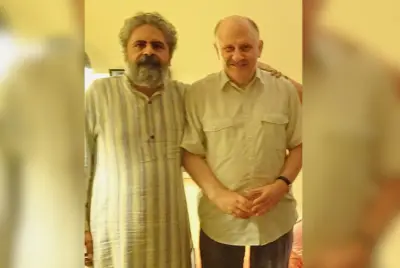
Yuri Shtanov visiting Varun Sahni before the Russia-Ukraine war. Photo: Varun Sahni.
The expansion of the universe
For centuries, scientists have wondered about the laws that govern our universe. Astronomers in the 1920s observed that other galaxies seemed to be moving away from the Milky Way. This, together with Albert Einstein's general theory of relativity, enabled scientists to conclude that the universe was expanding. The discovery of an accelerating universe in 1998 led scientists to postulate that the rate of expansion was largely governed by a cosmological constant, an idea originally proposed by Einstein in 1917. Recent findings from DESI indicate that this may not be the case.
"Scientists studied the speed of cosmic expansion and found that the universe was not expanding quite as fast as they thought. Recent observations revealed that the universe had expanded faster in the past, and its expansion was now slowing down. The 1998 study had already demonstrated that in addition to dark matter, which is localised near galaxies, the universe was permeated by a new invisible constituent called dark energy. Dark matter and dark energy make up almost 96% of the entire universe with the remaining 4% being contained in planets, stars, galaxies and other forms of visible matter. The nature of the dark universe has puzzled scientists. While dark matter constitutes roughly 30% of the universe, dark energy is more predominant and contributes twice as much as dark matter. In contrast to dark matter, which is attractive in nature, dark energy is repulsive and can make the universe accelerate. Since 1998, the most favoured means of making the universe accelerate was by assuming that dark energy was simply the cosmological constant. A cosmological constant is a form of energy that just sits there and doesn't change - as the universe expands, its value remains exactly the same. But now the community feels that perhaps the universe is more complex than just a cosmological constant," Sahni explained.
Drawing on a framework known as the "braneworld" model, Sahni and Yuri's approach was based on the idea that the universe might be a four-dimensional membrane, or 'brane', embedded within a larger, higher-dimensional reality. While matter and light remain confined to this brane, gravity can slowly "leak" into the extra fifth dimension. The effect is imperceptible in everyday life, but over billions of years and across cosmic distances, it can alter the rate at which the universe expands. This is what their 2003 study was about.
"We wrote up a paper in 2003 on this braneworld model. Yuri was visiting me at IUCAA those days. In fact, it is the most famous work that we did together. We wrote more than a dozen papers in addition to that one, but it is perhaps the most significant, with over 1,000 citations at present," Sahni told The Wire over a Zoom call.
He explained that if the universe does exist in five dimensions, then its expansion will have certain features that can be detected by observations - like the ones made by DESI. "The recent DESI results, which have excited the world of science, suggest that some of the features that Yuri and I discovered [in 2003] may in fact have been seen," Sahni said. A recent paper written by Sahni, Yuri, Swagat Mishra,Will Mathewson and Arman Shafieloo in 2025, clearly demonstrates that the DESI results are far easier to interpret within the framework of higher dimensional cosmology than they are by making the assumption that Dark Energy is the cosmological constant.
While Sahni seemed excited at the possibilities the new findings open up, his excitement was eclipsed by Yuri's inability to leave Ukraine.
'I can't imagine Yuri with a gun'
When the war began, their friends offered Yuri opportunities to leave the conflict-torn country, Sahni said. "We have friends internationally, and my friend from Canada, the same person who introduced us, told Yuri about fellowships for Ukrainians. At the same time, I wrote to him about visiting IUCAA for a long term," Sahni said. However, unable to leave his elderly parents and sister behind, Yuri declined. Eventually, it became impossible to leave. In their last conversation, when Sahni revisited the idea of him leaving, Yuri's reply was definitive. "There are no flights out of Ukraine anymore."
"I can't imagine Yuri with a gun. And at one point he told me that he may be recruited. I felt so bad - I couldn't sleep for three nights after that," Sahni said.
Despite the worsening situation in Ukraine, Yuri has continued his work with Sahni, alongside teaching at the Bogolyubov Institute for Theoretical Physics, where he heads the physics department. The institute is named after Soviet mathematician and theoretical physicist Nikolay Bogolyubov, who taught at the Moscow University, where Sahni did his PhD.
"Clearly, life is very hard for him. And he's mentioned that there's a lot of depression that is affecting people's minds. But he's very positive about science. It's remarkable. His views on science are concrete, his calculations are brilliant, and he responds to our email exchanges almost immediately. Compassion and generosity are very big qualities - I saw them on enormous display in Moscow amongst my friends - and Yuri embodies these very virtues and many more."