

When we grow up surrounded with stockpiles of information at our finger tips, and an infinite supply of preserved words, sounds, images loaded on our gadgets, we are on the verge of losing the capacity to obsess about memory.
Especially memories of wars. With all of West Asia on fire, the images being streamed live on the media looks like a freak show. Several people say they have stopped watching news about the war. What would they do with more stories of death and thuggery knowing much of it may be fake news.
The first verse in Rigveda is an ode to or powerful Agni or fire known as also a perennially hungry consumer of all matter: Hutbhuk. The poet describes Agni as the priest, the Lord of all fire sacrifices, the one who feeds the holy fire on behalf of mankind. Wars are fire : perpetually in motion, licking off all that is in their path, extinguished only to flare up again and again when fed by the Hota at the behest of humans hoping that the sacrifice will fill their homes with precious stones and riches of all kinds. Come, come to us as our Father Agni, be ever available to us like a Father, as our protector, the ninth verse says.
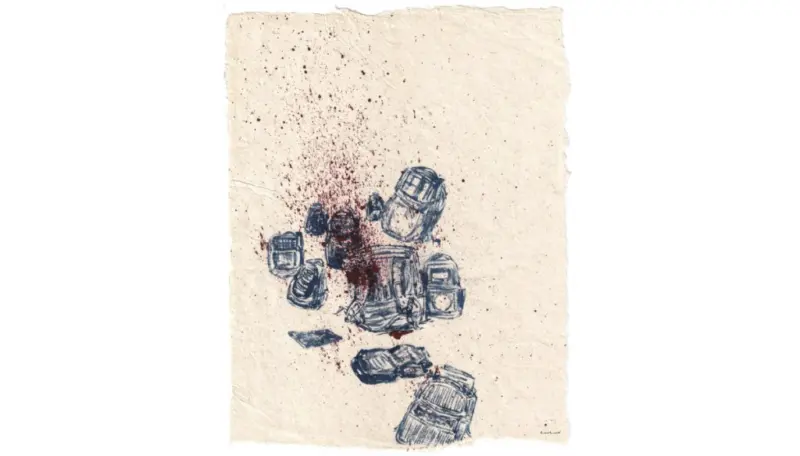
Illustration: Pariplab Chakraborty
Very subtly the verses seem to be answering some perennial questions of historians. Why have nations fed wars that destroy all in their path ? Why did the Pandavas, not really sired by their father Pandu, and the equally undeserving Kauravas, whose blind father became a king by default in denial of the laws of kingship, fight a bloody fratricidal war over a 'paternal' legacy ?
Why did that cradle of Western civilisation Greece, wage wars with Persia ? What about the historic battles to reclaim the Holy land from infidels by Christians, the Crusades that lasted for centuries , followed by push back battles to oust Muslims from Spain, and perceived heretics to oust them from France? Then nearer home the long lasting tussles and wars between India and Pakistan ?
Herodotus who travelled across the western world and Persia was told by some wise men of Persia that the actual instigators of these wars are not warrior kings or public leaders, but a third party wishing to reap mercantile interests. They gave him the example of Phoenicians who entirely controlled the trade of marketing purple dye, kidnapping Io, the daughter of the Greek king of Argos, which led to Greeks kidnapping Europa, the princess of Tyre which led to Paris of Troy seizing Helen and so on. Women like Sita or the three princesses kidnapped by Bhishma you begin to notice, were only the excuse to ignite the sleeping cinders of previous hostilities.
Will it always be thus? What were the wars actually fuelled by? Religious fervour or an insatiable lust for what is locally termed in the north as Zar Zoru and Zameen (Gold, Women and land )? The question to ask Herdotus tells is not who was kidnapped by who but who set off the chain of aggression first ?
In today's world there are dozens of nations and varieties of nationalism. Each nation, even the small and weak ones are keen to control their borders, their population, resources and cultural traditions. They may say they hate the powerful Big Brothers but all want to be more powerful. They admire the power of the USA, from a distance but baulk when they sense it is being used against their interests. A million screens over the world are bringing home the attacks and counter attacks mounted against and by Iran against those it perceives to be the friends of the Enemy.
In February, the revolt or Islamic Uprising against the severe regime of Reza Shah Pehlavi had begun in Iran in the year 1979. Then Khomeini's face replaced his. There is no room for foreign (read US) influence he said to the people, we must preserve our dignity. The people bought the argument and the Shah whose Great Civilisation seemed to them a foreign transplant anyway, was ousted. Reading Polish writer Ryszard Kapuscinski's excellent portrayal of those last days, some things began to fall in place amid the roar and the smoke as rulers change by the week.
The west once again, did not get it. The Iranians who have built and lost vast empires, have developed a different attitude to life and death over the ages. Intellectuals in politics like Bani Sadr will remain out of place there where liberal proponents of Republic are seen by the larger public as confused and confusing. A despot may go but fires of despotic control keep on being fed by mobs kept deliberately ignorant and entranced by dreams of an opulent way of life. Revolt comes only when even they can see all that spectacular show was never really for them but the coterie .
After the revolt of 1979, a humble seller of carpets Firdausi answers a Polish journalist, you ask what have we given the world ? We have given miniatures, poetry and the carpets. That is what has allowed Iran to retain its soul, a spiritual not material strength. Our poetry not our technology, our religion and not our factories. This has not made life easier only adorned it.
Resistance as we also realise by now can not be a natural outcome of this mindset. The dictatorial individual may be consumed by the fire of revolt in Asia, only to be followed by a religious radicalisation of the masses in the name of going back to "tradition". And with that it becomes clear that wars will begin to slip into a sinister dimension.
The nation may still contain patches of greatness but they keep getting less as also balance. With that rises an incoherent age of ancient hatreds for The Other, like a deadly spore from down under. Revenge for a mythical past that has been created for the mobs by mind manipulators. We, ordinary citizens everywhere are all no longer human beings but collateral damage to fundamentalists thereafter.
Looking at the escalating war in the Gulf, first lesson we are learning all over again is about the fragility of international relations, tall promises of international cooperation and institutions like the UN and NATO. The second lesson is even more grim; because our own society seems stable just now, it does not mean it will remain unscathed by global events.
All Indian migrants from humble workers doing menial jobs to the arrogant billionaires were sending home pictures of themselves in the Gulf region as proud flag waving Indians, until the missiles and drones began to hit. At that point they realised they were just outsiders and they must leave or die.
And now reports come of migrant workers from Surat returning home to Uttar Pradesh or Bihar because of a big jump in inflation and inaccessibility of cheap fuel from the Gulf. Another video clip by Dainik Bhaskar, a Hindi daily, shows small eatery owners in Bihar, also hit by a severe shortage of cooking gas, buying half burnt wood from pyres off cremation ground owners to feed their tandoors.
Dust in our eyes. Our leaders talk incessantly of elections in four vital states. They want us to write off the whole West Asia as an infinitely complex area full of tribal vendettas and breeding gangs of terrorists. But we know the story does not end there.
Mrinal Pande is a writer and veteran journalist.
Saakhi is a Sunday column from Mrinal Pande, in which she writes of what she sees and also participates in. That has been her burden to bear ever since she embarked on a life as a journalist, writer, editor, author and as chairperson of Prasar Bharti. Her journey of being a witness-participant continues.