
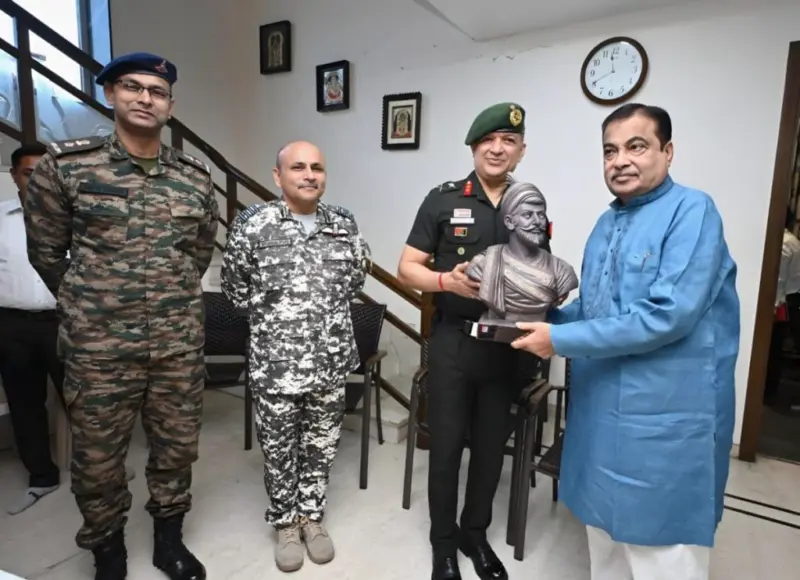

Chandigarh: Service veterans have expressed unease over a senior Indian Army officer's meeting with Union road and transport minister Nitin Gadkari in Nagpur last Friday (May 1), during which he sought support for expanding NCC infrastructure and training capabilities across Maharashtra - an interaction they claimed sat uneasily with established institutional channels for such requests.
They further contended that the Press Information Bureau's (PIB) projection of the May 1 meeting between Major General Vivek Tyagi, additional director general, NCC Maharashtra Directorate and Gadkari, went well beyond a routine recording of official engagements. Instead, it reinforced the optics of political sponsorship in India's civil - military interactions - a trend that has steadily intensified over the past 10-12 years.
The PIB's 320-word press note stated that during an 'inspection-cum-review visit' to Nagpur, General Tyagi had sought Gadkari's assistance for developing "dedicated infrastructure" for the NCC in Mumbai and Kolhapur, including the establishment of a State Academy for it in Nagpur. It also stated that Gen Tyagi had requested the minister's support in establishing "suitable training assets" for the Naval Unit at Nagpur's Futala Lake.
"What is revealing is not the meeting itself, but the phrasing and tone of the PIB note, which point to a steady politicisation of the military's relationship with the civilian executive," a three-star Army veteran said. Speaking on condition of anonymity, he remonstrated that there was "no basis or precedent" for a serving two-star officer to be "seeking assistance" from an individual minister, as though the Army were operating within a patronage system. "This reflects an increasing tendency within the armed forces to cultivate proximity to those in political authority by sidestepping established procedures," he cautioned.
Others within the veteran community in New Delhi and Chandigarh echoed similar concerns over the apparent bypassing of established Ministry of Defence (MoD) channels, noting that such requests ought to be processed through its budgetary and planning mechanisms, given that the NCC falls under its remit, rather than through individual political offices.
More troubling, many of them noted, was the tone of the PIB note's concluding remarks, in which Gadkari directed that "precise requirements" be formally conveyed to his ministry for necessary action and assured the Army of "comprehensive support."
Blurring the line between established procedures and personalised access
Veterans said this only further blurred the line between established procedures and personalised access, and that such phrasing in an official communication risked reinforcing the perception that military efficacy is contingent on political assurance, rather than organisational strength.
A Chandigarh-based one-star Army veteran said the interface between Gen Tyagi and Gadkari reflected the 'enduring creep' in recent years, in which military requirements have increasingly been routed through individual political offices, rather than accepted defence channels. Declining to be named, citing possible repercussions from Army Headquarters in Delhi, the MoD, or both, he said this was not how a mature democracy - or its civil-military culture - was meant to function.
Conversely, some serving Army officers framed these concerns somewhat differently, stressing that the issue in this instance was not the two-star officer's interaction with a central minister - often necessary for infrastructure-related requirements, logistics, and programmes like the NCC - but the manner in which it was conducted. For them, the concern lay not in the engagement itself, but in how it was perceived - specifically, the image of "undue deference" conveyed by PIB visuals showing Gen Tyagi presenting Gadkari with a bouquet.
"The optics matter," said a serving colonel-rank officer bluntly, "as Army officers are neither lobbyists nor supplicants." Such public displays of subordination to politicians, he cautioned, risk eroding the essential separation between the military and the political class - one that is not ceremonial, but foundational to a professional, apolitical armed force, he added, declining to be named.
Even so, veterans counter that incidents like last Friday's Nagpur meeting are no longer aberrations and, over the past 12 years or so, have become frequent enough to pass with little comment, effectively constituting a troubling 'new normal'. Individual instances, viewed in isolation, may appear insignificant, but together they have begun to acquire cumulative weight, signalling a discernible shift in expectations and behaviour between the Army and the country's present political leadership.
"Consequently, officers begin to internalise the idea that cultivating political goodwill is part of their role, while politicians, in turn, begin to see themselves as patrons of military institutions. Neither outcome," he added, "is consistent with the professional distance the armed forces have traditionally maintained from the political class."
As one retired colonel in Delhi succinctly put it, one such occurrence can be dismissed as an aberration, a second as a coincidence, but a third begins to look like a habit. "A pattern of such engagements - publicised and framed in deferential language - normalises something more corrosive, revealing deeper institutional fault lines," he said, declining to be named. If this continues, he added, it risks hardening into standard operating procedure.
This perceived drift is reflected in an increasing number of publicly visible engagements that critics argue suggest a blurring of professional soldierly boundaries, with some also pointing to the senior military brass as both complicit and willing participants in the trend. While limited editorial space does not permit a full accounting of such episodes, a few prominent examples are instructive.
In January, for instance, a video clip from the Army's official X handle showed then-Southern Army Commander Lieutenant General Dhiraj Seth accompanying Maharashtra chief minister Devendra Fadnavis at the inauguration of an Army Mela in Pune. Separately, social media clips depicted Gen Seth standing at the rear of an Army jeep with the chief minister, while an unnamed two-star Major General drove the vehicle and a brigadier rank officer sat beside him.
These visuals drew sharp criticism from sections of the veteran community, who said they reflected poorly on the Army's professional standards and institutional dignity. One officer noted that not even the President stands at the rear of a jeep with senior officers driving, suggesting a troubling image of perceived uniform subordination to political authority. Another retired two-star officer said this instance did little to inspire confidence in the apolitical ethos the military claims to uphold.
Gen Seth has since been appointed Vice Chief of Army Staff and is widely regarded as a leading contender for the post of Army Chief after the incumbent, Gen Upendra Dwivedi, retires on June 30.
Furthermore, veteran unease has proliferated in recent years by attempts to draw the armed forces into political messaging and visibility campaigns. This has included initiatives encouraging soldiers to act as grassroots "ambassadors" of government schemes like Swachh Bharat Abhiyan and Ayushman Bharat during periods of leave. These activities are monitored by individual units through quarterly feedback, supported by photographs and video clips.
Additionally, these so-called "soldier ambassadors" have been tasked by the Army's Ceremonials and Welfare Directorate, operating under the Adjutant General's branch, which oversees the force's overall administration, with promoting messages on patriotism, hygiene, drug abuse prevention, and road safety, as well as mentoring youth and organising sports activities. Senior officials said the Army Training Command in Shimla had issued guidelines to structure these efforts, aimed at "leveraging" soldiers' discipline and experience towards nation-building objectives as directed by the government.
Reacting to these developments, former Northern and Central Army Commander Lt Gen H. S. Panag argued in an online news portal that such initiatives risk eroding organisational autonomy and weakening the ability of senior leadership to resist political signalling. In his assessment, while the armed forces remain under civilian control, they are increasingly being drawn into activities that border on political projection, blurring the line between governance and partisanship.
The respected three-star officer estimated that at any given time, around 350,000 personnel could be engaged in such efforts, describing them as "social warriors" and calling it the "largest government-led social service drive" to date. Military personnel are entitled to two months' annual leave in addition to 30 days of casual leave, indicating the magnitude of human resource absorption involved in such social and political campaigning.
Former Indian Navy Chief Admiral Arun Prakash is among the few senior veterans who have been publicly forthright on the issue of the military's politicisation. Writing in the June 2019 edition of Vayu Aerospace and Defence Review, he warned that while governments are entitled to take credit for authorising military operations, the line is crossed when political parties exploit them for votes and personal aggrandisement. He pointed, albeit indirectly, to the political capital drawn from the 2016 surgical strikes across the Line of Control and the 2019 Balakot airstrikes in Pakistan's Khyber Pakhtunkhwa province - both of which featured prominently in election narratives that year.
Historically, India's military has guarded its political neutrality with considerable care since Independence - a reputation built over decades of institutional discipline, professional restraint, and a deeply internalised ethos of separation from politics. Earlier, senior officers typically avoided interactions that could be construed as proximity to political figures, recognising that their uniform represented the state, not the government of the day, and certainly not individual politicians.
For much of the post-Independence period, till around 2014, this survived as an unwritten code - almost a Freemason-like credo - of steering clear of both politics and religion, seen as inherently divisive. Professional identity rested on institutional loyalty and personal restraint: politics was rarely discussed at military gatherings, while those passed over for promotion retired with dignity, and dissent within the services remained professional rather than litigious or politically influenced. But veterans said that promotions, once largely merit-based and insulated from external considerations, are now increasingly seen within sections of the services as being influenced by extraneous and political considerations, becoming a recurring phenomenon.
When service chiefs and senior commanders brooked no political interference in operational matters
Alongside, service chiefs and senior commanders brooked no political interference in operational matters and were heard with respect by the political establishment. A story often cited by veterans to illustrate this facet concerns General - later Field Marshal - Sam Manekshaw, India's Army Chief between 1969 and early 1973.
When asked by Prime Minister Indira Gandhi in early 1971 to move into East Pakistan in response to the refugee influx, Gen Manekshaw firmly stated that it would take at least 10 months for the armed forces to be combat-ready. Acting immediately, he warned, would present challenges far more complex than those faced by the German general staff across two World Wars - fighting on multiple fronts with Pakistan and China.
He further cautioned against relying on diplomatic assurances that China would remain neutral, proposing instead that India wait for winter to block the northern passes and reduce the risk of Chinese intervention. The delay, he argued, would also allow adequate military preparation. Gandhi accepted his advice, and Bangladesh emerged in mid-December 1971.
"That culture of fierce institutional independence has eroded - perhaps irreversibly", said the earlier-mentioned retired three-star army officer. Military tribunals and civil courts, he noted, are increasingly dealing with promotion disputes, reflecting a shift from quiet acceptance to contested advancement. Such apolitical-ness, he asserted, has, to a large extent, been replaced by influence and proximity to power increasingly shaping outcomes within the services, including promotions and career progression.
Some veterans go even further, describing this as a "deepening Faustian bargain" between the armed forces and the political leadership, with each deriving mutual benefit from the symbiosis at the expense of institutional integrity.
Political leaders, they state, leverage the military's operational successes for electoral gain, while sections of the armed forces, conversely, benefit through promotions or post-retirement appointments - sometimes both. Over time, this exchange risks normalising a cycle in which professional military boundaries are steadily eroded, rendering them increasingly difficult to restore.