




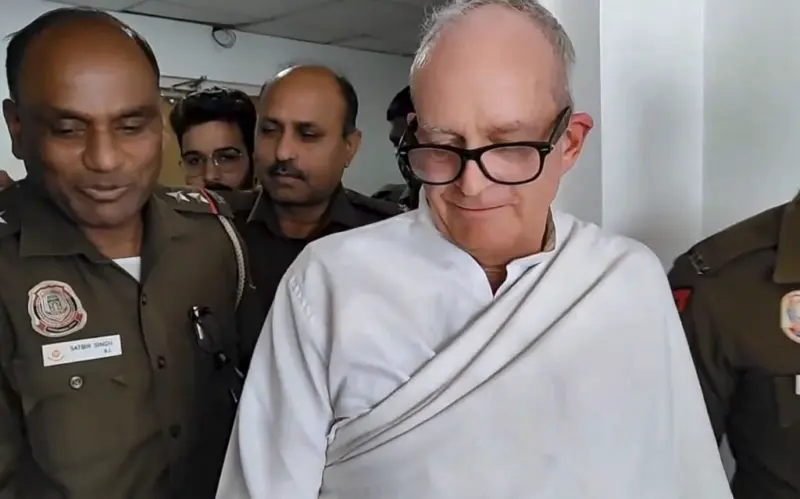

This week, a two-member bench of the Supreme Court of India, comprising of Justices Vikram Nath and Sandeep Mehta, issued notice to the government of India and its ‘caged’ law enforcement agencies, the Central Bureau of Investigation (CBI) and the Directorate of Enforcement (ED), seeking their response to them allegedly violating the Indian Extradition Act of 1962.
The authorities are accused of applying one standard in pursuing a person in London and another when doing the same in Delhi in respect of economic crimes. The individuals concerned are a person of Indian origin Nirav Modi in London and British national Christian Michel in Delhi respectively. The matter will be heard in July after the summer recess.
Diamond merchant Modi, who has been in judicial custody in London since 2019, is accused of defrauding Punjab National Bank to the tune of around USD 1 billion and is wanted by the CBI and ED for prosecution in India.
In approving Modi's extradition to India on March 25, 2026 - though now subject to ratification or otherwise by the European Court of Human Rights in Strasbourg in France - Justices Jeremy Stuart-Smith and Robert Jay of the High Court of England and Wales in London, cited in section 27.e. of their judgement that on December 2, 2025 Rakesh Pandey, joint secretary at the ministry of home affairs (MHA) of the Government of India, gave an undertaking to the British government: “In Accordance with the Rule of Speciality, Mr Nirav Modi will not be subjected to any trial concerning offences beyond the scope of the extradition offences without taking consent of the Government of the UK.”
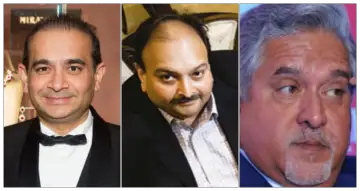
Nirav Modi (L), Mehul Choksi (C) and Vijay Mallya (R) - all wilful defaulters - have fled the country. Credit: Nirav Modi/Facebook; Gitanjali Jewellers; PTI
It is well known that the Narendra Modi-led BJP regime has been keen to bring back high-profile fugitive businessmen from abroad, given Modi’s shrill anti-corruption promises in the 2014 and subsequent general election campaigns. But with little success so far.
The fact is, the late Sushma Swaraj, as external affairs minister between 2014 and 2019, scuttled the government's efforts to obtain cricket administrator Lalit Modi’s deportation from Britain. He had been charged by the Board of Control for Cricket in India (BCCI) with embezzling Indian Premier League (IPL) funds.
Blatantly ignoring protocol, Swaraj requested the British high commissioner in India and Keith Vaz, British MP, who was then chair of the House of Commons' influential Foreign Affairs Committee, to provide a travel document to Modi on compassionate grounds - since the previous Manmohan Singh administration had cancelled his Indian passport. Swaraj's move was virtually a granting of a clean chit to Modi, which demolished India’s pursuit of him before British courts.
Besides, the UK's courts and tribunals have so far refused the return of Indian arms dealer Sanjay Bhandari and liquor baron Vijay Mallya to India; while jewellery magnate Mehul Choksi has filed a civil suit in London against the Indian government for abducting, torturing and attempting to rendition him to India from the Caribbean in 2021.
In Delhi, Michel, a British arms and aviation consultant, has been imprisoned in Tihar Jail for nearly seven and a half years without the CBI and ED framing final charges in court against him, let alone engaging in a trial. The insinuation against him is he bribed Congress party leader Sonia Gandhi to secure an Augusta Westland VVIP helicopter contract for an Italian company Finmeccanica in 2010. He has always denied the charge and continues to do so.
It is, in fact, extraordinary that even after 13 years' investigation, the CBI and ED have failed to produce substantive proof of wrongdoing in the matter before a trial court. Among those punished by their tardy or arguably vindictive process is no less than a former Indian Air Force chief, Shashindra Tyagi.
In 2018, the highest court in Italy in acquitting two senior executives of Finmeccanica not only exonerated Michel, but described suspicions about him as merely a 'hypothesis'. The Indian government were party to the proceedings; yet disregarding their obligation, the Modi dispensation chose to dishonour the Italian verdict by questionably transporting him to India in league with the United Arab Emirates' (UAE), especially Dubai's authorities - as an indictment by a United Nations Working Group on Arbitrary Detention (WGAD) noted.
In the special leave petition triggering the Supreme Court’s notice, Michel's lawyer Aljo Joseph submitted that the Indian Extradition Act 1962 was passed by the Indian parliament and is, therefore, the law of the land. An extradition treaty signed by India with any country - in this case the UAE - cannot be superior to Indian law or any part of it - in this case Section 21 of the Act, which outlines a 'Doctrine of Speciality'.
Joseph stated in the writ, “A prima facie reading of the findings given by the Hon'ble High Court (of Delhi) shows that, according to it, the law made by Parliament is inferior to a treaty entered between India and any other country.” He continued, “Article 21 of the (Indian) Constitution guarantees the personal liberty of individuals, including aliens (a term sometimes used for non-Indian nationals).”
He also illustrated that an affidavit presented by the ministry of external affairs and MHA to the High Court of Delhi said, “It is humbly submitted that the Treaty (between India and the UAE) aligns with the (Indian) Extradition Act, 1962 and that the clause ‘connected therewith’ under Article 17 of the Treaty expands the Doctrine of Speciality permissibly, without violating Article 21 of the Constitution of India.”
Joseph pleaded before the Supreme Court that by being incarcerated for the period he has been, Michel has more than served his full sentence for the offence he was extradited for, namely under Section 420 of the Indian Penal Code (IPC) - without being found guilty; and, consequently, the Indian government ad its agencies have been in “violation of the article 21 of the constitution of INDIA”.
Joseph also contended that the Indian authorities’ actions contravene Article 11 of the Mutual Legal Assistance in Criminal Matters Treaty (MLAT) between India and the UAE, which reportedly says, “A person present in the Requesting Party (India) in response to a request seeking that person's attendance shall not be prosecuted, detained or subjected to any other restriction of personal liberty in the territory of that Party for any acts or omissions which preceded that person's departure from the Requested Party (UAE), nor shall that person be obliged to give evidence in any proceeding other than the proceedings to which the request relates.”
Furthermore, that the person “shall not be prosecuted or detained or subjected to any other restriction of personal liberty for acts of omission or commission which preceded that person's departure from the Requested Party, not specified in the request”.
The foregoing is relevant because supplementary charges under Section 467 of the IPC were slapped on Michel after he was brought to India, which carry up to a life sentence, if the accused is convicted. These, it would appear, are ultra vires of not only the Indian Extradition Act, but the extradition treaty between India and the UAE.
The Conservative party government, which was in power in the UK up to July 2024, made at best routine, minister-of-state-level representations to the Indian government about their citizen Michel. Subsequently, the Labour party prime minister, Keir Starmer, an erstwhile human rights barrister, has raised the issue twice with Modi, according to the Britsh government.
It is noteworthy, though, that in their pronouncement on Nirav Modi, Justices Stuart-Smith and Jay handed down a veiled warning to India on the lines of, “In our judgement, it is sufficient for present purposes that the assurances are cognisable at a diplomatic level because the consequences of any breach would be extremely damaging to the relationship of mutual trust and confidence between India and the United Kingdom, particularly in the context of such a high-profile individual as Mr (Nirav) Modi.”
No judge in India has, however, up to now shown the courage to read the riot act to the Narendra Modi machine's misuse of agencies on the subject of Michel.