






In the highly charged political atmosphere of the 1970s, Zulfiqar Ali Bhutto - a hero lovingly called as a comrade by the Pakistani youth - steps on to the stage one day and infuses a passion for justice, equality and ownership in its audience.
The atmosphere is charged with the promise of a better life. A promise that common people will be able to claim what's rightfully theirs. But in the turbulent Pakistani politics of the late 70s, promises were short lived and it did not take long for socialist ideals to fall apart.
In his most recent novel, This is Where the Serpent Lives, Daniyal Mueenuddin has not dealt with the rise and fall of empires, but of people. Differing from the structure of his critically acclaimed short story collection, it's a striking combination of four interconnected novellas, spanning the 1970s when Zulfiqar Ali Bhutto was rising to power in Pakistan to mellowed down ideals of socialism in the 2000s. Drawing from his own experiences of owning and operating a farm in Pakistan's South Punjab, Mueenuddin tells the story of what it takes to truly get hold of the reins of power.
One of the major themes in this work is the sharp division between the rich and the poor in Pakistani society. Pakistan's economy is largely dependent on agriculture, and most of the farmland is owned by a small group of elites who don't contribute directly to agricultural production. When this small percentage of landowners gain power by entering politics, administration and the judiciary, it becomes even difficult for poor farmers and peasants to raise their voice against feudal forces or rise above their station.
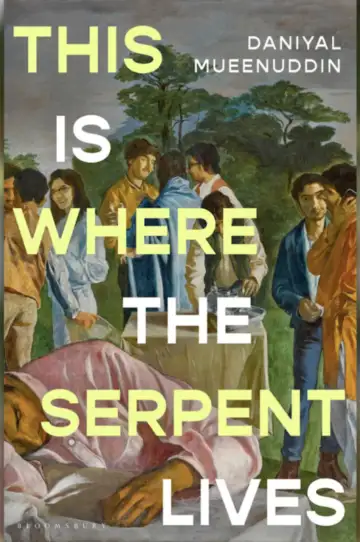
‘This is Where the Serpent Lives’ by Daniyal Mueenuddin. Photo: Bloomsbury Publishing
The work is a sensitive reflection of South Asia's feudal society, where power is passed down through generations. This is represented best in Rustom, a character mirroring Mueenuddin's own experiences, who is called back from America to manage his farm in South Punjab. The farm becomes Rustom's education of how to prove himself as a successful landlord who is both respected and feared.
Another such farm is Ranmal Mohra, owned by Hisham Atar, where while friendships go back for decades, so does oppression. This oppression is what makes basic aspirations a faraway dream for servants working there, especially one called Saqib, whose story is the telling of how wrong it is to presume that a little greed on his part will be forgotten.
In the first section of the book, we meet Bayazid, a little boy who is clutching a pair of shoes to his chest, abandoned on the streets. Soon, he's taken in by the roadside tea seller Karim Khan, who gives him a name and thereby, a life. In Daniyal Mueenuddin's world of fact and fiction, the act of naming - of a person, a place, or a business - gives birth to a new identity and by extension, new powers. When Karim Khan names this resolute boy who was fiercely clutching his shoes waiting for his parents to come, he is born anew into a world where the rules are very different. This world gave him a makeshift room attached to the tea stall which he would call his home. His experience and growth was limited - like the circumference of the rotis he'd sit and make by the tandoor all day.
When one of his friends, Zain, takes him to his house, he is enamoured by Yasmin who is Zain's sister. Aware of the differences in class and caste, he knows that marrying someone who's below her station would be unacceptable. Here, love becomes a social ladder where Yazid is at the bottom. In the hopes of getting Yasmin, he keeps himself hooked to his "invisible" status - assuming that his beginning - where he was born, would give him a social status. But this all remained imaginary. What mattered was not where he came from but who adopted him and gave him a life. And in his case, it’s a tea-seller, Karim Khan, and his nights spent on a charpoy outside the tea stall.
A surreptitious air surrounds the novel, always lingering behind dialogue, actions and decisions. The scope of betrayal, either from managers of the farm or one's own mentee, extends the paranoia of characters to the readers. Because it is us, the readers, who know the intentions of everyone, all at once, as opposed to the characters who only know so much about the lives of their masters and servants. However, this suspicion doesn't surround our "golden boy," Bayazid, for even though he has the desire to grow more in life, he has his principles. Bayazid is an emotional relief - a reminder of hard-won success no matter how small - for the readers, a break from a world where the biblical theme of a serpent whispering and coaxing in ears runs abound.
The novellas are structured in a way that they put in a dialectical opposition to the rural and urban Pakistani society and show what happens when the laws of upper-class lands are transgressed by the poor. In the division of these two worlds, the oddities are the characters belonging to lower classes, making sense of the power dynamics in a world different from their own. Even though the past and present of principal characters stand out as individual stories of their own, it is when they meet, intersect, and move around with intent and deliberation in each other's world that the main themes of Mueenuddin's work - power, status, and desire - exhibit themselves.
Being released 17 years after his short story collection, In Other Rooms, Other Wonders, it reflects some of the earlier themes but in a sharper manner. Like a hungry bird looking for breadcrumbs, Mueenuddin's writing doesn't lose the details of the lives of his characters.
This is what makes this work extremely relatable to the readers, because our homes, workspaces, and streets all have such stories. The book becomes an equaliser, reminding everyone that power politics is as much the game of common people as it that of politicians.
Arifa Banu is a critic and researcher based in Delhi.