
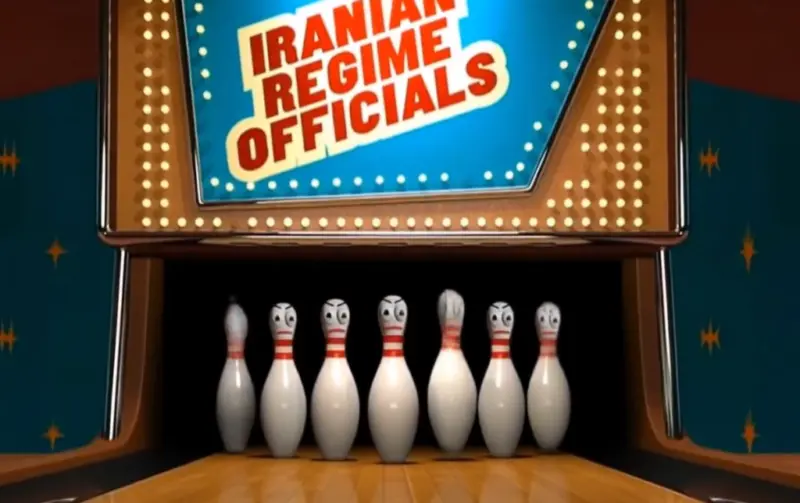

Operation Epic Fury could as well have been a video game; it comes packaged with visuals of live combat footages and slick social media montages.
Since the start of the attacks on Iran, the communications team has been releasing clips of strikes juxtaposed with footage from Call of Duty, Top Gun and Mortal Kombat's 'flawless victory' soundbite. The White House has turned its war communication into spectator sport, sharing memes and trolling videos of real missile impacts blended with Hollywood style entertainment, and sports. The US successfully gamified the war. At the same time Iran responded to its war and AI slopaganda with its own
Iran's videos have been more nuanced; with actual storylines, showing actual people involved in the war - Lego versions of Trump, Netanyahu, Ayatollah Ali Khamenei, Abbas Araghchi, the 160 girls killed in a primary school in Minab and more. One of the most popular Lego video from that begins with the lines, "you crossed the ocean just to find your grave." Though English is not the first or second language in Iran, this rap in American English, is as much a message to the American administration and its citizens, as to the people of the world.
There is another video from Iran titled: , that goes on to call for justice for the victims of Epstein Island, for the children of Gaza, for the girls of Minab, in memory of people of villages killed in Afghanistan and Vietnam.
There is a subtext to the type of games chosen by these countries. While the US chose popular war game imagery, sports and action films, Iran chose a harmless game, Lego, that rests on the idea of 'building and creating.'
Yet this marks a shift in how the governments communicate during wars. Corporate media has taken a backseat in war reporting, while brave independent journalists have been killed in the war. The information about war has moved from sombre reporting to a full-blown spectator sport. The global public is invited to watch, cheer and swipe.
Success is measured every week in flashy metrics: 5000 targets destroyed, 150 naval vessels eliminated, Iran's air force decimated, etc. TV media headlines are filled with words like assets, targets, markets and fighter jets, while the actual human toll of the war, civilian deaths, and displaced families are absent from the official feed. Even the news of 13 US troops killed and about 380 wounded is blurred between the flashy memes, and equally trashy speeches.
How did the world arrive at a place like this, and what role does the US game industry play here?
The gaming demographic
Call of Duty is a popular video game originally built on a World War II setting, the third-highest selling game globally. It is a first-person shooter military video game, with different versions and spin-offs extending to modern warfare. A large number of US citizens have now grown on a steady diet of war games. If you have never played a war based video game. This is how it goes - You appear as a tough soldier on a realistic battlefield with guns, explosions, and missions to complete.
For better ammo, stronger weapons, or special upgrades to make the game easier and more fun, you often have to pay real money. (Also highlighting the fact that gaming is not really a level playing field, the gamers who can pay have better equipments!) When you die, you can also pay to get a new life right away instead of waiting, this turns the whole war into a fast, exciting power fantasy with almost no real consequences.
One interesting aspect of video games are NPCs, or Non-Player Characters, who remain in the background and are pre-programmed to act or speak in a certain way. They are the ones with no personality, no name, often appearing in uniform colours or forms. They are easy to kill. Without consequences, collateral damage. US wars in many countries have treated people as NPCs. This time the death toll is classified information, the strikes, the explosions are up for show to exert power.
Gamers are a huge demographic in the US, as per Activision Blizzard Media 86% of US population played video games in 2025. Trump has been pursuing this demographic since his first presidential campaign. Media executive Steve Bannon, who joined his first campaign as chief strategist and senior counsellor in August 2016, was involved with securing funds for World of Warcraft. Bannon observed the game's online community and has been quoted describing it as "rootless white male, [who] had monster power".
The US military is deeply embedded in the gaming world, reported the Guardian, often targeting to recruit teenagers. Military enlistment numbers have been the lowest since the Vietnam War. Since 2018, military turned to games to find new recruits, and young, tech-savvy gamers are a perfect match from the military's perspective. So, the military has integrated its soldiers in the gamer culture.
Their content flows across Twitch, YouTube, Instagram and Discord. The army, navy, air force, cost guards, and US Marine Corps have their own e-sports teams. These teams host some of the most popular game tournaments including Fortnite and Valorant. Their players command influential following among teens and young adults.
Gaming and war: A match made with AI
Gaming culture shaping war communication is not so surprising if you also look at how soldiers are now trained to fight wars and how wars are being fought with AI. It is not something new, in fact the US military has deliberately blurred the lines between video games and pre combat training for over two decades. US Army has its own game launched in 2002, known as America's Army. It worked as an authentic training tools that let civilians and recruits experience basic soldiering in a first-person shooter mode. Today, there are many games doing that work.
The US army relies on game based synthetic training environments with deployment of models like Bohemia Interactive Simulations' (BISim) Virtual Battlespace 4 (VBS4). This system provides enhanced realism, scalability, and performance for mission rehearsal and tactical exercises.
That same game-like interface has now moved from training into live operations through AI.
In January 2026, Defense Innovation Unit in Silicon Valley announced that it is going to offer up to 100 million dollars in prize money for anyone to build drone swarms that can operate under a single voice command. So one operator sitting away from the actual war zone, would be able to fly drones that recognise targets, swarm like bees with a hive mind, and kill.
Several tech and defense firms including SpaceX, xAI, OpenAI, Anthropic and others submitted their bids. Reports suggest a proposal involving SpaceX and xAI were among the ones finalised. The overlap is hard to ignore, the same tech that is building games for civilians is building kill machines for the military.
In 2015 the Guardian reported on 'the life of a drone operator' in the US army and highlighted how young men hold power over the life and death of a person thousands of miles away from them. The operator explained how the remote, screen-based nature of the job creates psychological distance. Targets often appear as indistinct dark shapes (thermal or infrared imagery) rather than recognizable human figures, even on high-resolution feeds. In his words, "Ever step on ants and never give it another thought? That's what you are made to think of the targets - as just black blobs on a screen."
When soldiers train, fight, and command through interfaces deliberately designed to feel like video games, the leap to public communication as spectator sport becomes inevitable. The same slick editing, score-like metric, and victory soundbites that operators see on their screens are repackaged for the public on social media.
The real threat is what is overlooked in all this. Trump has not been able to give a single decent reason as to why the US is fighting this war. There are everyday conferences, yet they are communicating with their citizens with confusion, blatant lies and sheer shock value. There is newer trash talk every day to divert from the actual casualties of the war.
The issue of Epstein files has taken a backseat. Over one billion dollar spent on the war by the US is largely overlooked. Gas prices are shooting up in the US, and people are restless. Crude oil prices are up, and global supply chains are wrecked.
Yet the real fear is the precedent this gamification and memefication of war sets. The difference between propaganda and information is lost. Is this going to be the future of war communication? Are countries now going to speak to their citizens in games and memes?
Kavita Kabeer is a writer and a satirist, currently helming the shows 'Cracknomics' and 'Digital Arrest' for The Wire.