

A granular analysis of deleted voter rolls in three West Bengal constituencies suggests that what is being presented as routine revision may in fact be a far more selective exercise, driven through the opaque Under Adjudication category created for the process.
In election administration, mass deletions from voter rolls are usually explained in the dry language of procedure. Names are removed because a voter is dead, has shifted residence or cannot be traced. But in the Mothabari, Nakashipara and Habra assembly constituencies of West Bengal, deletions appear to cluster not randomly but along politically and demographically significant lines. These point to a pattern that is difficult to dismiss as ordinary electoral maintenance.
Mothabari, in Malda, a Muslim-dominated constituency in the news over recent unrest, has also witnessed a very high volume of deletions. Nakashipara has a Muslim population of around 40%, and also recorded a strikingly high rate of deletion. Habra is a Hindu-Scheduled Caste-heavy constituency where large-scale unmapping appears to be the central issue.
Examined together, these three seats make it possible to test whether deletions have been confined to certain types of constituencies or whether they cut across districts, demographics and local political contexts.
Fragmented roll, opaque process
For each constituency, the deleted lists for every polling station has to be downloaded 14 separate times to reconstruct the full constituency-wide picture. These files, which are not OCR or machine-readable, were downloaded through a captcha-based process. Plus, these are large constituencies: Habra has 261 polling stations, Mothabari 205 and Nakashipara 262.
Once the fragmented data is reconstructed, the data reveals a stark divide between two categories of deletion. One is ASDD, or voters marked Absent, Shifted, Dead or Duplicate. ASDD deletions are the standard method of electoral roll correction, resting on verifiable grounds and field-level confirmation.
The other is an opaquer category, "Under Adjudication". Across all three constituencies, the granular analysis suggests that ASDD behaves as one would expect a normal clean-up process to behave. The Under Adjudication category does not.
To follow what is being said below, click on the two dashboards here and here, to check the data for yourself.
If the deletions were the result of a legitimate roll clean-up, both categories would be expected to produce broadly similar demographic patterns. Instead, irregular contractions are seen, driven disproportionately through Under Adjudication, a category whose effects vary sharply by local political context.
Mothabari: A roll contraction too large to ignore
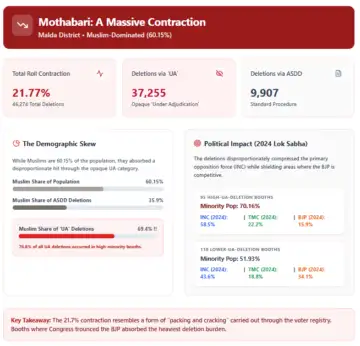
The most dramatic case is Mothabari, where the voter roll appears to have contracted by 21.77%, amounting to 46,274 deletions in a constituency with a 60.15% Muslim population.
Bengal SIR: What the Patterns of Exclusion for Muslim, Scheduled Caste and Urban Voters Say
Of the total deletions, 9,907 came through standard ASDD procedures and another 317 through Form 7. Only 1,657 voters, or 0.78% of the electorate, were marked as unmapped or lacking any link with the 2002 electoral roll. The remaining 37,255 were routed through the Under Adjudication category. As the data shows, the opaque Under Adjudication administrative mechanism overwhelmingly led to the deletions.
This is a problem because a contraction of more than one in five voters should be seen as a red flag - not a routine correction due to death, migration and correction.
The skew is further sharpened when the demographic details of booths are taken into account. The analysis estimates that 67.3% of all deletions impacted Muslim voters, and 74% of all deleted voters came from booths where the Muslim population was above the constituency average.
The ASDD deletions did not show that pattern. Only 35.9% of standard (ASDD) deletions were Muslim names, lower than the community's population share. But the Under Adjudication deletions have an estimated 69.4% impact on Muslim voters with 76.8% of all Under Adjudication deletions occurring in high-minority booths.
There is also a political reality to these deletions. In Mothabari, the contraction burden fell the most heavily on booths hostile to the Bharatiya Janata Party (BJP). Cross-referencing with the 2001 and 2024 rolls suggests that the deletions disproportionately compressed the primary opposition force in the constituency, the Congress party, while also applying pressure on the TMC base.
The correlations are revealing: In Mothabari, Under Adjudication deletions and the Congress party’s vote share in 2024 show a +0.28 relationship. Conversely, Under Adjudication deletions and BJP vote share show a -0.29 relationship. Plus, Under Adjudication deletions and minority population are found positively correlated at +0.30.
That matters because minority concentration correlates almost perfectly, +0.93, with the Congress vote share.
In other words, the deletions help the BJP and hurt the Congress, potentially creating a political fallout in the constituency.
The booth-level split makes the point more concrete. Consider a subset of the 95 booths that had high deletions on account of the Under Adjudication category. Those that had more than 175 voters deleted per booth had an average minority population of 70.16%. These booths were Congress strongholds in the 2024 Lok Sabha election, where it averaged 58.56% of the vote. The TMC secured 22.26% of the vote, while the BJP lagged at 15.97%.
By contrast, consider the 110 booths that had lower deletions on account of Under Adjudication. They had a lower minority share in the population, at 51.93%. On these very booths, the BJP secured a competitive 34.12% vote share in 2024. The Congress had a 43.61% vote share, while the TMC could get 18.84% of the votes.
In other words, the heaviest contraction due to the Under Adjudication process has concentrated in booths where the BJP is the weakest and the Congress strongest.
Let us now consider the 2021 assembly election. That year, the TMC won both the high-deletion and low-deletion booth clusters with roughly 54% of the vote. However, by 2024, the anti-BJP vote in Mothabari shifted significantly - it moved away from the TMC and towards the Congress.
In the 2026 SIR, the Under Adjudication purge appears to have concentrated around booths where that shift in favour of Congress (against the BJP) was the strongest.
Certain polling stations stand out for the sheer scale of deletions. Part No. 209, Nangla Hajimolla Prathamik Bidyalay, and Part No. 242, Kanchakuli Prathamik Bidyalay are especially striking. They have minority populations of 77.42% and 91.88%, respectively, and both saw exceptionally high levels of Under Adjudication deletions, at 393 and 385, respectively. These were far higher than seen on most other booths in the constituency.
Taken together, the Mothabari data suggest that the 21.7% contraction in the voter roll is not random administrative attrition. The booths where the BJP was more competitive appear relatively shielded, while the booths where the Congress trounced the BJP absorbed the heaviest deletion burden. The effect is to tighten the electoral field well before a single vote is cast.
Nakashipara: The Under Adjudication category as near-certain deletion
If Mothabari shows the scale of the deletions, Nakashipara reveals the rate.
Here, in a constituency with a 40.02% Muslim share in the population, the voter roll is contracted by 14.95% during the SIR.
The ASDD list initially showed 13,347 deleted voters and 5,819 unmapped cases (those who could not link themselves with the 2002 rolls). This was followed by an additional 3,124 deletions in the final roll published on February 28, 2026.
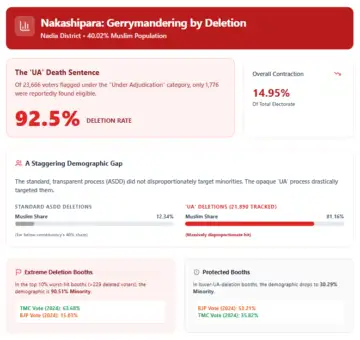
Again, Nakashipara's most striking figure is the Under Adjudication deletions. Of 23,666 voters flagged under the category, only 1,776 were reportedly found eligible, resulting in a 92.5% deletion rate.
Of the 13,3347 ASDD deletions, only 12.34% were Muslims, far below the 40% Muslim share in the the constituency's population. But among those deleted by the Under Adjudication category, 21,890 or roughly 81.16% were Muslims. This is a staggering gap.
When Nakashipara deletions are read alongside the 2021 assembly and 2024 Lok Sabha results, the heaviest deletions appear concentrated in TMC strongholds, largely by targeting the Muslim minority electorate that forms the backbone of the party's support in the constituency.
The data finds Under Adjudication deletions and TMC vote share in 2024 correlated in a +0.47 relationship. Meanwhile, Under Adjudication deletions and the BJP vote share show a -0.50 relationship. Further, the Under Adjudication deletions and minority population show a +0.70 relationship, confirming that booths with higher Muslim populations absorbed the brunt of the contraction.
That is, the deleted voters belonged to the pool of TMC voters and did not support the BJP in almost equal measure. Plus, those deletions were heavily tilted towards Muslim voters.
The booth-level split reinforces this pattern: In the 96 booths with more than 84 voters deleted per booth due to Under Adjudication (higher than average deletions under this category), the average minority population rises to 78.39%. And these are also clearly TMC strongholds.
In the 2021 assembly election, the TMC averaged 53.08% in these booths, against the BJP's 33.33%. In the 2024 Lok Sabha election, the TMC's dominance became even more pronounced, rising to 57.48%, while the BJP managed only 22.38%.
The 163 booths in Nakashipara where Under Adjudication deletions were lower tell the opposite story. These booths have a much lower minority population of 30.29% on average. And these booths were also far more competitive for the BJP - or outright BJP leaning.
In 2021, these booths were closely contested, with the TMC gaining a 44.65% vote share and the BJP at 42.99%. By 2024, the BJP had moved clearly ahead in these areas, securing 53.21% of the vote, while the TMC fell to 35.82%.
In other words, the booths that appear relatively protected from intense Under Adjudication deletions are where the BJP is the strongest or most competitive.
The pattern reaches its sharpest point in the top 10% of worst-hit booths in Nakashipara. These are 26 booths where more than 229 voters were deleted through the Under Adjudication category (per booth). Here, the average minority population share is 90.51%. These are some of the TMC's strongest electoral pockets.
In these extreme-deletion booths, the TMC's 2024 vote share was 63.68%, while the BJP's vote share was just 15.03%.
Taken together, these numbers suggest that the voter roll contraction in Nakashipara was a form of localised gerrymandering through deletions, the heaviest blows landing on booths where minority concentration and TMC support overlap most strongly. Meanwhile BJP-leaning booths with lower minority populations were comparatively insulated.
Habra: The same pattern, now in reverse
This Matua-heavy constituency in North 24 Parganas points in the reverse direction - but it only strengthens the larger argument about gerrymandering. Here, the contraction in voters appears to fall most heavily on booths that are demographically Hindu majority and politically favourable to the BJP.
The macro picture itself is striking. Habra’s pre-draft roll of roughly 2,50,684 voters saw an overall contraction of 17.20% amounting to 43,117 deletions. That is extraordinarily high for a standard revision cycle, which, as noted earlier, would normally be expected to remain in the low single digits.
At the draft stage, 18,736 names - 7.47% of the electorate - was deleted, while 34,112 voters, or 13.61% of the electorate, were marked as unmapped.
In the final roll, 5,587 names were deleted through Form 7, and another 28,264 voters flagged as Under Adjudication. Only 9,473 were eventually found eligible to vote, while 18,791 were declared ineligible and deleted - a 66.48% deletion rate.
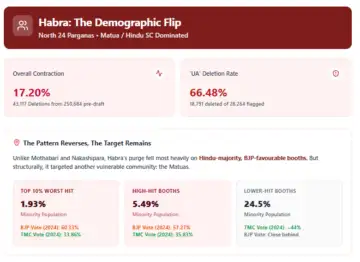
In effect, once a voter was pushed into the Under Adjudication category, there was roughly a two-in-three chance of losing the right to remain on the roll.
In Habra, the four most abnormal booths all have virtually no minority population. Part No. 2, Baluigachi Paul Para F.P. School, recorded 707 deletions, while Part Nos. 36, 10 and 203 recorded 490, 482 and 449 deletions, respectively. All four lie in areas with negligible minority presence, and all four saw deletion numbers far above the constituency norm.
In the 114 booths that saw high deletions - more than 165 per booth - the average minority population is just 5.49%. These are also unmistakably the BJP's stronger booths. In the 2024 Lok Sabha election, the BJP averaged 57.27% of the vote here, while the TMC trailed at 35.83%.
The contrast is visible in the 143 lower-hit booths, each with fewer than 165 deletions. Here, the minority population rises sharply, to roughly 24.5%. Politically, these are the more TMC-leaning or competitive areas. In the 2024 Lok Sabha election, the TMC narrowly led in these relatively protected booths with around 44% of the vote, while the BJP was close behind.
Among the top 10% of polling stations in Habra, a booth had to record more than 302 deletions to fall into the category of the 26 most heavily hit booths. In these 26 booths, the minority population drops to just 1.93%, effectively making them near-homogeneously Hindu-majority booths.
Politically, they are even more clearly identifiable as BJP bastions. In the 2024 Lok Sabha election, the BJP averaged 60.33% of the vote in these locations, while the TMC was reduced to 33.86%.
Taken together, these findings suggest that the SIR's two biggest social victims were Muslim voters and the Matua community. In Mothabari and Nakashipara, the burden fell overwhelmingly on Muslim-concentrated booths, shrinking an electorate that forms the core of opposition strength in those constituencies.
In Habra, the pattern flipped demographically but not structurally. The same opaque categories appear to have fallen the hardest on Matua-heavy refugee settlements marked by chronic documentary vulnerability, citizenship anxiety and dependence on bureaucratic recognition.
In sum, the SIR appears to have worked most harshly against those communities for whom paperwork, presence and political belonging are already fragile.
The most obvious forms of electoral manipulation are usually imagined as things visible on polling day - intimidation, capture, coercion, violence. But SIR in West Bengal shows that a new form of electoral engineering now deserves equal scrutiny, one carried out much earlier, through bureaucratic invisibility.