
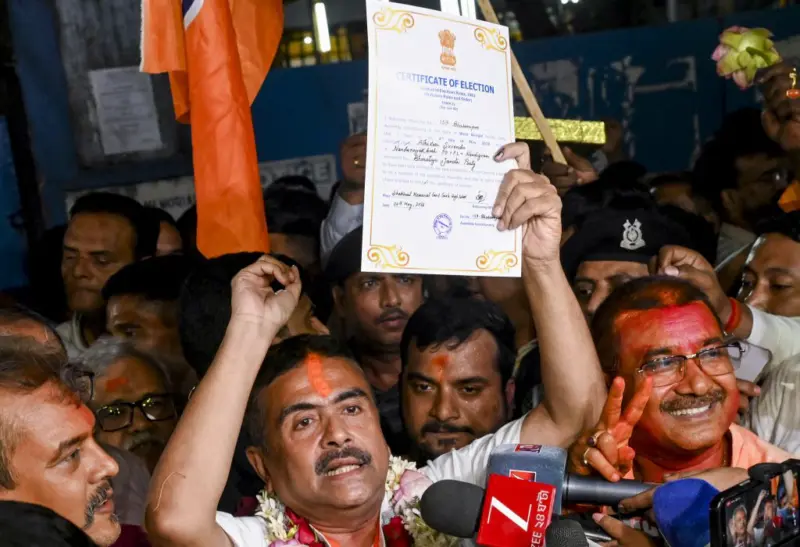

In a ruthlessly crafted mission, with the Election Commission of India (ECI) and the ruling Bharatiya Janata Party (BJP) being close collaborators, the Trinamool Congress (TMC) government has been laid low in west Bengal.
In a shameful first, 2.7 million voters came to be disenfranchised because their "logical discrepancies" - a device never used before by the Election commission - could not be sorted out for want of time.
What that unprecedented breach of the Constitutional injunction that "free and fair" elections cannot be said to have been held should even a single eligible voter be prevented from casting her vote does to the republic order is for residual democrats to ponder.
Imagine that the total difference of votes cast for the BJP and the TMC has been three million or so.
What might have happened had the 2.7 million disenfranchised voters actually voted is for all to wonder at, especially in view of the seats that were lost or won by less than 5,000 votes.
A travesty of an electoral process if there ever was one. The felling of the feisty Mamata Banerjee has brought cheer equally to the Left and the Right.
Illustration: Pariplab Chakraborty.
Long viewed as an unpedigreed usurper who had the temerity in 2011 to rudely bring down the 34-year-old Left front regime - high priests of theory and iron-clad organisation notwithstanding - by, of all things, mobilising the farming community against industrialists who were eyeing to acquire agricultural land to set up manufacturing units, leading to an episode of police firing on agitating peasantry with many fatalities resulting, the vandalism visited now on a statue of Lenin seems less consequential than the ignominious exit of Banerjee, the bete noir.
That Left cadres have for some time now been openly raising the slogan "pehle Ram, phir Vaam" (first the party of Ram, meaning the BJP, then the Left) is not exactly the best kept secret of recent West Bengal politics.
Therefore, it is just as well that the Mamata party has been brought low, even if by the fascist right-wing that has played the communal card to the hilt.
Never before have Bengalis been so nakedly appeased as Hindus as during the campaign run by the Modi-Shah combine.
Even the memory of the constitutional/electoral imperative that no appeals may be made to religious or other identity markers during electoral campaigns has now been lost to the ECI, the executive, and wretchedly, vast sections of the populace as well.
Mamata, conversely, has been arraigned for molly-coddling Muslims in the name of secularism. Indeed, the erstwhile TMC leader-turned-BJP frontrunner, Suvendu Adhikari, has loudly let it be known that since only Hindus voted for him, there was no call on him to look after Muslim issues.
It is another matter that his party did not put up a single Muslim candidate.
The least attention to Muslim problems is no longer to be viewed as the State's constitutional duty to protect and preserve minority interest within a still-secular Constitution.
Indeed, the fall of West Bengal has brought nearer the coveted Sanatan goal of forging a unitary state - a sort of one-party right wing parallel to the Chinese model, dumping the principle of federalism as anathema to national unity.
Peninsular India still remains rather cussed in its refusal to prostrate to the unitary idea, but West Bengal has shown that the captive State now has all the wherewithal to breach the Deccan in time to come.
When that happens, the argument and the ground would have been made available to formally effect the transformation of the State into a majoritarian theocracy, with civilisational oneness crushing the decrepit pluralisms of old.
There remains though one thorn in the side of this unitary project - like it or not, the Indian National Congress.
The animal refuses to embrace the extinction so often pronounced and prophesied by the loud mouths of the right-wing.
Admirably, Rahul Gandhi, giving proof of a sagacious political vision, has rebuked the local unit of the party in West Bengal for their petty gloating over Mamata's defeat, rectifying some of his own negative observations of earlier days.
Conversely, Mamata has lost no time in acknowledging the gesture and reciprocating the sentiment, vowing to work to strengthen the INDIA bloc.
It is to be hoped by all those still wedded to the ideal of a pluralist, multiparty democracy, underpinned by staunchly independent institutions, that not only the TMC but other factions as well who once were part of the Indian National Congress, will see the pit that awaits Indian Constitutional democracy, and forge a new unity across the republic that may acquire the clout to build a people's movement forged not just on lung power but a deeply considered conjoint understanding of how a manifesto of a people's charter may be drawn up, and what organisational mechanisms may be conjointly put in place across northern and central India to unravel the depredations wrought by a rampaging right-wing that now needs the Constitution only as a facade till brought down.
The need for a thoroughly analysed and assimilated alternate politics
Mamata and all other elements of the secular-democratic INDIA bloc will need to understand that the return to a collectivity cannot just be a Pavlovian response to political adversity, but a thoroughly analysed and assimilated alternate politics that has the substance to defeat the right-wing in the hearts and minds of the common citizenry.
Now that both the Dravida Munnetra Kazhagam (DMK) and the Left front in Kerala have also been ousted, it will be for them and parties like the Samajwadi party and the Rashtriya Janata Dal (RJD) in Bihar to hold hands with the Congress to salvage the centre before worrying about their pocket-boroughs as their chief myopic concerns.
There is a new youthful generation of Indians gone quite American in foregrounding money before emancipatory or enlightened social and political ideas.
In a grand capitalist phrase, the corporate media calls them the "aspirational class". Surely, a nation's educational system cannot be geared merely to feeding the aspiration for higher incomes to the exclusion of ethical, altruistic orientations of mind.
And surely, our pride in civilisational values can hardly square with a world view which regards the acquisition of private wealth as the acme of developmental nationalism.
Corporate media houses and the ubiquitous barrage of commercial messages, made poisonously addictive through digital instruments, are now a formidable Epsteinian reality, and the task of retrieving an ethical state and polity are stupendously intractable.
And, contrary to propagated belief, religiosity, now ubiquitous to the nth degree, does not function as antidote to this phenomenon, but as a comforting affirmation of the value of lucre.
Not until the general elections of 2029 bring about a parivartan may the least rays of light grace the realm, preceded by an electoral victory in Uttar Pradesh towards which the INDIA bloc must strain every mental and physical sinew from this day on.
And if that does not happen, it may be curtains for the republic.
Badri Raina taught at Delhi University.
This piece was first published on The India Cable - a premium newsletter from The Wire - and has been updated and republished here. To subscribe to The India Cable, click here.