
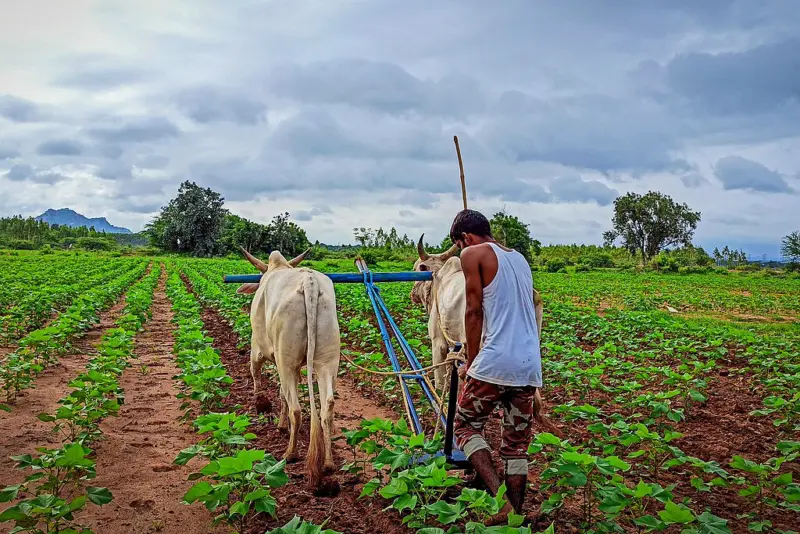

The rain gods don't seem to be very happy with our farmers. First, the western disturbances caused untimely rain and hailstorms that have damaged over 2.49 lakh hectares of near-harvest Rabi crops.
And now comes the dreadful prediction of the Indian metrological department (IMD) about a "below average monsoon". Citing El Niño, this is the first time in eleven years that Indians are being proactively warned about the monsoon. Couple this with the Iran war and its agri-chemical fallouts such as high fossil fuel prices and low availability of agri-chemicals and hyper inflation. So what is next for Indian farmers? A dry kharif?
Official position is - India will receive 92% of its long period average (LPA) of 87cm rainfall between the months of June and September. Although it doesn't sound bad, but one has to be cautious in interpreting government data nowadays. Sometimes the government doesn't want to create panic or lose votes, hence chooses euphonic data sets. For example in 2015, the IMD said India will receive 93% of LPA, but in reality it turned out to be the worst drought years in the country with the real time LPA standing at 86%.
Now, for better or worse, the current official number for 2026 is 1% below the 2015 official figure of 93%. Even private weather companies are predicting a below average rainfall this year, especially as the current Western disturbances are also changing the winds pressures in the region.
So, should our farmers be concerned? Yes, they should, because the monsoon could be delayed and very weak this year. Plus there is 25% possibility this will be a Super El Niño year. As the waters over the Pacific Ocean heat beyond 2 degree Celsius, the global weather starts to go chaotic. India unfortunately experiences drought-like conditions and drier and erratic monsoon as a result. Farmers and policy makers should not only be concerned, but should begin preparation to combat this food security challenge. If this scenario manifests, Kharif rice production could take a beating.
Also know that around 61% of farmers in India depend on rain-fed agriculture, making it the most widespread farming practice in the country. This method spans nearly 55% of the total cultivated land (about 139 million hectares) and is responsible for producing 89% of millets, 88% of pulses, and 69% of oilseeds as per an ICAR report from 2022. So bad monsoon, is doomsday for 61% of Indian farmers who don't have access to any irrigation systems and only depend on monsoon rains for a good harvest.
Combating weak monsoons
In light of the monsoon, Indian policy makers need to work out contingency plans if the monsoon falls much below the predicted number. First on their list should be irrigation. With a bad monsoon, the pressure on canals, ponds, reservoirs and ground water will increase tremendously. Farmers won't shy away from exploiting ground water, if their crops are in dire straits especially in the rain fed areas. So, to combat this, Indian officials should check the health of our reservoirs and canal systems to ensure all gaps are plugged. To reduce further calamity, Indian government in the next three months should plan an aggressive drive for building new ponds and repairing old water structures.
The priority for Mahatma Gandhi National Rural Employment Guarantee Act (MGNREGA) workers should be to build water conservation structures over these months. This way Indian villages will water retention capacity and ground water recharge will both increase. In extremely dry zones and rain fed zones, officials need to reach out to farmers for a crop planning. Paddy farming should be discouraged in these areas at all cost, and instead, the focus should be on legumes or oilseeds for this kharif season.
Overall in the country, paddy should be discouraged in un-irrigated areas. We shouldn't discourage paddy production at a national level, because rice is one of the major staples of our country. Nevertheless, the government needs to stop paddy procurement in water scarce or rain fed areas only for this kharif season. Paddy procurement should be focused on water rich areas. Hence we need to better manage our paddy economy. States like Chhattisgarh which procure 3-4 quintals over their state average per acre should be told to procure lesser or align with the state average of paddy per acre.
Gauging the more unpredictable weather lies ahead, and agriculture extensions officers need to advocate for multi-cropping for Kharif of 2026. So, even if one crop suffers because of untimely or no rain, other two or three crops on the field can still prosper and give the farmers nutrition and income. Keep in mind that because of the Iran war there is a fertiliser crunch, and multi-cropping can be a low cost way to climate proof the farm.
A combination of millet, oilseeds and legumes should be financially encouraged and states should offer support to farmers especially in rain fed areas. Also, National Seed Corporation (NSC) needs to actively produce and spread drought resistant seeds for the farmers too use as a contingency. It’s hard for farmers to change seeds choices or crops at short notice, but the government has the power to even tell the seeds companies to breed drought resistance in future varieties. Heirloom and native seeds should also be encouraged as an alternate to hybrid seeds to combat erratic and drier monsoons.
The government can also provide drought resistant varieties of paddy in water rich areas also for a lower costs. At the next stage a new ICAR-IARI institution should be established to prepare for the challenges of drought, floods and erratic weather. This will pave the way for new paradigm in agrarian thinking.
Finally, because the government is short of agri-chemicals, we need to ramp up bio-fertiliser and bio-pesticides trainings and infrastructure through the country, especially in rain fed areas, to safeguard against pest and disease outbreaks. Also, by using bio-fertilisers, the organic matter of the soil increases, which in return increases the soil water retention capacity by thousands of litres per acre.