

The story of Andhra Pradesh has long been intertwined with the politics of dissent, identity and regional assertion. It was here that one of independent India's most defining struggles unfolded - a movement that reconfigured the very idea of statehood.
Yet today, the same state stands curiously apart from its southern counterparts, choosing caution over confrontation on one of the most consequential federal questions in recent times - delimitation.
At a moment when southern states are raising alarm over the potential consequences of the impending delimitation exercise, Andhra Pradesh has exhibited a rare political consensus. Both the ruling alliance, aligned with the National Democratic Alliance, and the opposition YSR Congress Party have refrained from mounting any significant resistance. This convergence is not merely tactical - it signals a deeper transformation in the state's political culture.
A legacy built on resistance
The origins of Andhra Pradesh lie in one of the most profound acts of political dissent in postcolonial India. Potti Sriramulu's fast unto death in 1952 forced the Indian state to concede the creation of a Telugu-speaking region, making Andhra Pradesh the first state formed on linguistic lines. This moment reshaped the Indian Union, legitimising linguistic identity as a basis for federal reorganization.
Decades later, N. T. Rama Rao revitalised this legacy through the Telugu Desam Party, building a mass movement around "Telugu self-respect." His politics was explicitly oppositional - challenging the dominance of national parties and asserting the autonomy of regional aspirations.
Andhra Pradesh, therefore, was never politically passive. It was a state that argued, resisted and reshaped the contours of federalism. That historical memory casts a long shadow over its present silence.
The delimitation debate and southern anxiety
The delimitation exercise - scheduled after 2026 - seeks to redraw parliamentary constituencies based on population. States with higher population growth, largely in northern India, stand to gain more seats in the Lok Sabha. Southern states, which have achieved relatively stable population growth through decades of social investment, fear a proportional decline in representation.
Leaders like M. K. Stalin in Tamil Nadu articulated this concern sharply, arguing that such a move effectively penalizes states for successful population control. In Kerala, chief minister Pinarayi Vijayan has warned that population-based redistribution risks undermining the principles of federal equity.
In Karnataka, Siddaramaiah has pointed to the need for safeguards to ensure that states are not penalised for successful demographic management.
Telangana under A. Revanth Reddy has also indicated apprehension about the implications for representation. Yet, Andhra Pradesh remains an outlier - its political establishment largely aligned, or at least not opposed, to the process.
Across the aisle consensus
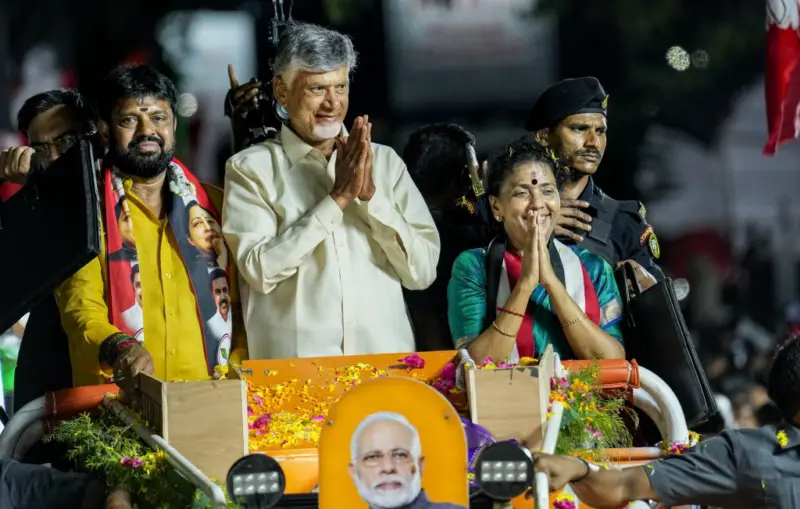
What distinguishes Andhra Pradesh in this debate is the convergence of its entire political spectrum. The positions of N. Chandrababu Naidu, Pawan Kalyan, and Y. S. Jagan Mohan Reddy reveals not fragmentation, but alignment.
Having joined the NDA alliance, Naidu has shifted to a language of process. While his remarks speak of equity and moderation in the redrawing of boundaries, he refrains from framing any substantive objections to the process itself. It is a strategy dictated by the need to stay close to the Union government while respecting regional concerns.
Similarly, Pawan Kalyan, head of the Jana Sena Party and an ally in the same political camp, has remained relatively muted in his responses to the matter at hand. His reactions have largely sidestepped the federal dimensions involved in the exercise of delimitation, instead taking a more national perspective.
Perhaps more revealing is the stance of Y. S. Jagan Mohan Reddy. As the leader of the YSR Congress Party and the principal opposition figure, his response could have introduced a counterpoint. Instead, it mirrors the same cautious pragmatism. There has been no sustained campaign, no attempt to forge a southern alliance, and no effort to frame delimitation as a threat to Andhra Pradesh's political future.
This bipartisan convergence is unusual in Indian politics. It reflects not consensus born of ideological agreement, but one shaped by structural constraints and political calculation.
The post-bifurcation reality
The roots of this convergence lie partly in the aftermath of the 2014 bifurcation, which created Telangana and left Andhra Pradesh without its primary economic hub, Hyderabad. The loss triggered a prolonged phase of economic and administrative rebuilding.
In this context, dependence on central support became unavoidable. Infrastructure development, capital formation, and fiscal stability all required sustained engagement with the Union government. Political confrontation, therefore, carries tangible risks.
Both the ruling alliance and the opposition appear to have internalised this reality. Their positions on delimitation cannot be separated from this broader context of economic vulnerability and institutional transition.
Competitive welfare politics
Another factor shaping this shift is the transformation of electoral politics within the state. The ideological battles that once defined Andhra Pradesh have given way to competitive welfare politics.
Under Y. S. Jagan Mohan Reddy and his predecessors, governance has increasingly centered on direct benefit schemes, subsidies and targeted welfare interventions. Political legitimacy is derived less from ideological positioning and more from delivery.
In such a framework, maintaining a cooperative relationship with the Union government becomes essential. Fiscal flows, project approvals, and policy support are critical to sustaining welfare programs. Dissent, particularly on issues like delimitation, risks disrupting this equilibrium.
Erosion of regional assertion
The decline of strong regional assertion is also linked to the weakening of ideological anchors within major political parties. The TDP, once synonymous with federal resistance, now operates within national alliances.
Similarly, emerging political forces have not fully embraced the language of regional autonomy. The emphasis has shifted towards governance efficiency, development narratives and electoral pragmatism.
This transformation has altered the political grammar of the state. Dissent is no longer a primary instrument - it is a calculated risk.
What is lost in consensus
The absence of dissent in Andhra Pradesh's response to delimitation raises fundamental questions about the nature of democratic politics. Consensus, while often desirable, can become problematic when it emerges without public debate or ideological engagement.
Delimitation, therefore, is not just a technical process; it carries great significance for representation, federalism and political power. An alteration in the power balance in favour of northern states would have repercussions well beyond elections.
For a state with Andhra Pradesh's history, the lack of a robust internal discourse is particularly striking. It suggests a narrowing of political imagination, where consensus is prioritised over articulation.
Between pragmatism and principle
It would be reductive to interpret Andhra Pradesh's stance as simple acquiescence. There is a clear element of pragmatism at work. A state navigating economic challenges and institutional rebuilding may choose cooperation over confrontation.
Yet, the question remains whether pragmatism has come at the cost of principle. The legacy of Potti Sriramulu and N. T. Rama Rao was built on the belief that regional voices must be asserted, not negotiated away.
Today's political leadership, represented by figures like N. Chandrababu Naidu, Pawan Kalyan, and Y. S. Jagan Mohan Reddy, operates within a different paradigm-one defined by strategic alignment and cautious engagement.
Andhra Pradesh once stood at the forefront of India's federal evolution. It was a state that compelled the Union to listen, to adapt, and to change. Today, it stands apart once again-but for very different reasons.
Its silence on delimitation is not merely a political choice; it is a reflection of deeper structural shifts in Indian democracy. The move from dissent to consensus, from assertion to accommodation, marks a turning point in the state's political journey.
Whether this represents maturity or retreat will be debated in the years to come. But one thing is clear: when a state that once defined the politics of resistance chooses silence, it reshapes not only its own future, but the contours of federalism itself.
Amir Hyder Khan is a Bachelor of Architecture (B.Arch) student at Jamia Millia Islamia, New Delhi.