
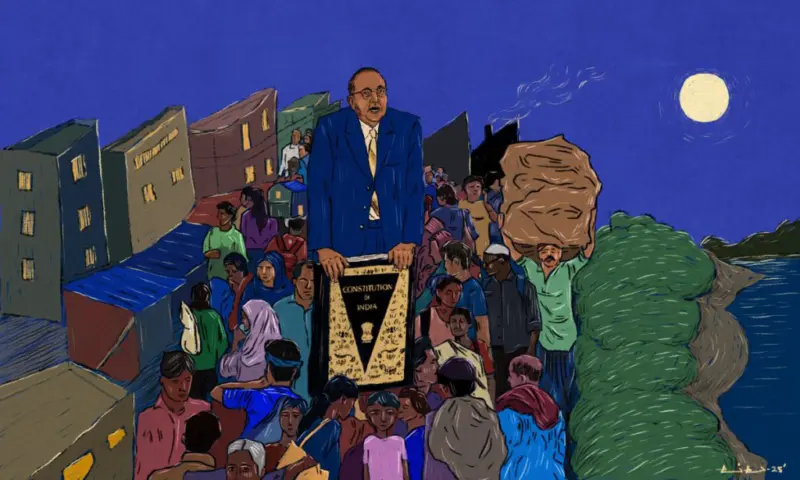

Today, April 14, is Ambedkar Jayanti.
There are numerous tangible and historically grounded reasons for remembering Dr. B. R. Ambedkar.
However, among the most salient and analytically significant aspects that distinguish him from other thinkers are his conception of the nation as a moral-social formation, his notion of freedom as the essence of life, and his articulation of a universal principle of morality, all developed through a sustained critique of social irrationalities that are part of a caste-ridden patriarchal society.
Ambedkar's intellectual project offers a systematic and sociologically grounded critique of Indian society, wherein nationhood, freedom, morality, and constitutionalism are conceptualized as interdependent normative domains. Contrary to cultural nationalist and liberal constitutional traditions, Ambedkar insists that political democracy is structurally unsustainable without social democracy. His thought therefore constitutes not merely a constitutional doctrine but a theory of social transformation rooted in the annihilation of caste, in particular, and in all of his writings in general.
Nation as a moral and social construction
In Annihilation of Caste, Ambedkar rejects primordial definitions of nationhood based on territory, language, or civilizational continuity. For him, such markers may constitute a state but not a nation in the sociological sense. A nation, in his formulation, is a "conscious community of associated life" grounded in fraternity. However, caste society in India structurally prevents the emergence of such a community.
Ambedkar's critique is grounded in the concept of graded inequality, where social hierarchy is not binary but vertically stratified, producing segmented moral communities. This prevents what he terms "social endosmosis", or the free circulation of social interaction across groups. Without such interaction, neither shared identity nor a collective moral imagination can emerge.
This position resonates with later sociological critiques of nationalism such as Partha Chatterjee, who argues that Indian nationalism is historically fractured between elite and subaltern domains, though Ambedkar's diagnosis is more radical in locating caste as the structural blockage of nationhood itself. Various studies in recent times have proved Ambedkar's point by extending this aspect. Ambedkar remains relevant in contemporary times when we see challenges to the nation as it becomes a new social formation.
Freedom as substantive social capability
One of the most resonant elements while conceptualising the nation is Ambedkar's conception of freedom, which extends beyond liberal negative liberty. In States and Minorities, he argues that political rights are meaningless without the social and economic conditions that enable their exercise. Caste, by enforcing hereditary occupation, endogamy, and social exclusion, produces a condition of structural unfreedom.
This anticipates the capability approach of Amartya Sen, where freedom is defined as substantive capability rather than formal entitlement. Similarly, Ambedkar's critique parallels Marxian concerns with formal equality under conditions of material inequality; however, Ambedkar uniquely centres caste as the primary structure of domination in the Indian context. This contextualisation further helps other parts of the world to understand their own variants of suffering while moving away from the ruthless generalisation of grand theories.

A portrait of BR Ambedkar on the eve of his birth anniversary, in Moradabad, Monday, April 13, 2026. Photo: PTI.
Morality: From conditional to unconditional ethics
Ambedkar develops a distinct moral sociology by distinguishing between conditional and unconditional morality. Conditional morality refers to caste-embedded ethical systems where moral obligations are restricted within bounded social groups. Such morality produces what can be called "ethical segmentation," where empathy does not extend beyond caste boundaries.
In contrast, unconditional morality is universalist, grounded in equal human dignity. This aligns Ambedkar with Kantian universalism, but with a crucial difference: Ambedkar derives universality not from abstract reason but from the concrete critique of social oppression. His conception of morality can be traced both to the Buddha as an emancipatory tool and to his own ontology shaped by lived realities.
In later times, this sociological grounding of morality aligns with Jürgen Habermas, particularly his notion of communicative rationality and an inclusive moral-public sphere, although Ambedkar's framework is more materially grounded in caste relations than Habermas's procedural universalism.
Constitutional morality as transformative ethics
Ambedkar's most enduring contribution is his articulation of constitutional morality during the Constituent Assembly Debates (November 25, 1949). Drawing on George Grote, he defines constitutional morality as the ethical commitment to uphold constitutional values justice, liberty, equality, and fraternity - even when they conflict with dominant social norms.
Constitutional morality is therefore not merely procedural legality but a transformative ethic aimed at restructuring society. As Upendra Baxi argues, it functions as a "counter-majoritarian moral discipline" essential for sustaining democracy in deeply hierarchical societies.
Caste, democracy, and the crisis of social integration
Ambedkar's critique of caste as an anti-national structure is central to understanding the limits of Indian democracy. In Annihilation of Caste, caste is not merely social differentiation but an institutionalised hierarchy that destroys fraternity and moral unity.
Contemporary scholarship by Gopal Guru and Sharmila Rege demonstrates that caste continues to shape access to dignity, education, and justice. Rege's concept of the "Dalit standpoint" particularly extends Ambedkar's epistemology by showing how the lived experience of humiliation produces critical knowledge.
Empirical studies on caste violence like the NCRB reports and as reflected in the works of scholars like Anand Teltumbde further indicate that caste remains a persistent structure of domination rather than a residual cultural artefact.
The Solicitor General’s Quarrel With B.R. Ambedkar
Contemporary crisis of constitutional morality
In contemporary India, multiple forms of democratic breakdown reflect the weakening of constitutional morality. Caste atrocities, gender violence, and communal polarisation demonstrate that equality remains formally guaranteed but socially undermined.
Christophe Jaffrelot argues that India is witnessing a shift toward "ethnic democracy," where majoritarian mobilisation coexists with formal constitutionalism. This aligns with Ambedkar's warning that political democracy without social democracy is inherently unstable.
Selective moral outrage - where public and institutional responses vary depending on the caste, religion, or gender of victims reflects the persistence of conditional morality in public life.
Ambedkar and the contemporary politics of appropriation
The intellectual legacy of B. R. Ambedkar occupies a paradoxical position in contemporary Indian politics. On the one hand, Ambedkar has become one of the most widely invoked constitutional thinkers in public discourse; on the other, his ideas are frequently detached from their radical social content and selectively mobilised within competing political narratives. This dual process - widespread invocation coupled with ideological dilution constitutes what can be described as the contemporary politics of appropriation.
At the core of Ambedkar's thought lies a radical critique of caste as a system of graded inequality and moral fragmentation, as elaborated in Annihilation of Caste. He does not treat caste merely as a social problem but as a civilisational structure incompatible with democracy itself. However, in contemporary political discourse, Ambedkar is often symbolically invoked as an icon of representation rather than as a theorist of structural transformation. His radical demand for the annihilation of caste is frequently replaced by a narrower politics of inclusion within existing hierarchies, thereby muting the transformative thrust of his philosophy.
A second dimension of appropriation lies in the selective emphasis on Ambedkar as a constitutional jurist while underplaying his critique of social and cultural domination. While his role as the chief architect of the Indian Constitution is rightly acknowledged, his insistence on constitutional morality as an everyday ethical discipline in the Constituent Assembly debates of 1949 is often reduced to a legalistic reading of constitutional procedures. This depoliticisation transforms constitutional morality into institutional compliance rather than a deeper ethical revolution in social relations.
Contemporary political appropriations also occur across ideological spectra. For instance, Ambedkar is simultaneously invoked in electoral symbolism, institutional naming practices, and identity-based mobilisation. Yet, such symbolic recognition does not always translate into the realisation of his substantive concerns - particularly the eradication of caste hierarchy, the expansion of social democracy, and the cultivation of fraternity. In many cases, Ambedkar becomes a symbol of legitimacy rather than a framework for structural critique.
Moreover, the fragmentation of Ambedkar's thought into isolated themes - such as reservation policy, electoral representation, or constitutional design - obscures its integrated philosophical architecture. His ideas on education as emancipation, unconditional morality, and social endosmosis are often marginalised in favour of more politically instrumental interpretations. This selective engagement weakens the holistic nature of his democratic vision.
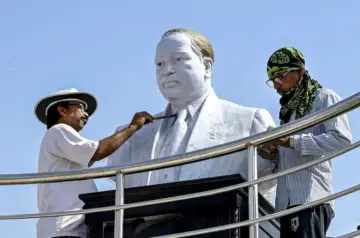
Workers paint a bust of Dr BR Ambedkar ahead of his birth anniversary (Ambedkar Jayanti), at Ambedkar Circle, in Bikaner district, Rajasthan, Saturday, April 11, 2026. Photo: PTI.
In contemporary India, this politics of appropriation is evident in the coexistence of symbolic reverence and substantive contradiction. While public institutions frequently invoke Ambedkar, persistent caste violence, educational inequality, and social exclusion indicate that his foundational critique of hierarchy remains unresolved. The gap between symbolic adoption and structural transformation thus becomes a defining feature of his reception in modern politics.
Ultimately, a serious engagement with Ambedkar requires moving beyond commemorative invocation toward critical appropriation grounded in his radical demand for social transformation. To appropriate Ambedkar authentically is not to celebrate his presence in political discourse, but to confront the uncomfortable implications of his thought-particularly the dismantling of caste and the reconstruction of society on egalitarian principles. In this sense, the politics of appropriation becomes a test of democratic sincerity: whether Ambedkar is used as a symbol of inclusion or engaged as a theorist of radical equality.
From the particular to the universal
Ambedkar's method represents a movement from empirical particularity to normative universality. His analysis of caste oppression becomes the epistemic foundation for general principles of justice. This aligns with standpoint epistemology, which argues that marginalised positions generate privileged insights into social structure.
Thus, universality in Ambedkar is not abstract but historically grounded - emerging from the lived experience of exclusion, yet normatively articulated for an egalitarian society based on the principles of universal morality.
On the gender question
B. R. Ambedkar theorises women's subordination not as an isolated social anomaly but as a constitutive element of the caste order, wherein the regulation of female sexuality becomes the central mechanism for the reproduction of hierarchy. In this schema, patriarchy is not merely a gendered domination but a sociological necessity for sustaining graded inequality. His critique thus displaces reformist narratives and situates gender oppression within a broader structure of social power.
Ambedkar's philosophical intervention lies in universalising this critique. While emerging from the lived realities of caste oppression, his framework transcends particular identities, asserting that he is not only a thinker for Dalit women but for all women in Indian society. By grounding justice in liberty, equality, and fraternity, he redefines democracy as an ethical and social condition rather than a purely political arrangement.
In this sense, women's emancipation becomes the epistemic and moral foundation of social transformation. It disrupts both caste-based exclusion and patriarchal authority, enabling a shift from conditional, group-bound morality to a universal ethic of human dignity. Ambedkar thus offers a radical sociological vision where the liberation of women is inseparable from the annihilation of caste and the realisation of substantive democracy.
Ambedkar's theoretical architecture integrates nationhood, freedom, morality, and constitutionalism into a unified critical framework. His insistence on fraternity as the foundation of nationhood, substantive freedom as the essence of democracy, unconditional morality as ethical universality, and constitutional morality as transformative governance remains profoundly relevant.
In contemporary India, where caste violence, gender inequality, and majoritarian politics persist alongside constitutional guarantees, Ambedkar's thought functions both as critique and as a normative horizon. It compels us to recognise that democracy is not merely institutional but deeply moral and social. The realisation of his vision requires not only legal enforcement but also the transformation of social relations and ethical consciousness.
Kshirod Nag has an MA and M.Phil in Sociology from JNU. He is based at Kalahandi, Odisha.