
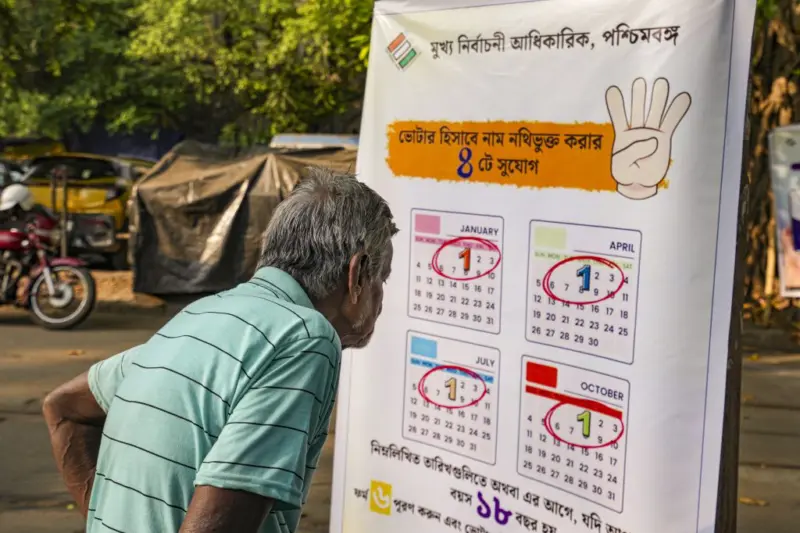

New Delhi: The upcoming assembly elections in West Bengal will be unlike any other. Not only has the the Election Commission of India's Special Intensive Revision (SIR) of the electoral rolls resulted in 27 lakh voters being deprived of their right to vote in the country's fourth most populous state, but also because the country's highest constitutional court has declined to grant them interim relief.
Unlike the exercise conducted in other states, voters in West Bengal have been required to not just map themselves to the 2002 electoral rolls, but have had to battle a new criteria in the form of "logical discrepancy” which triggered duplicates and name-related mismatches that were amplified further by script conversion and rigid matching rules.
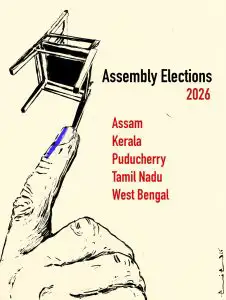
The result has been that 90 lakh voters have been deleted, the electorate has shrunk by about 12% and an alarming 27 lakh voters are waiting for their fate to be decided by 19 judicial tribunals which has so far only decided two known cases.
With the Supreme Court last week not allowing these voters to vote, experts have raised concerns about how the constitutional right to vote is being suspended, and 27 lakh voters in effect being disenfranchised, due to an administrative exercise that has not been completed in time ahead of the elections scheduled for April 23 and April 29.
“The constitutional principle is that there is a presumption of citizenship. There should be additional presumption if a voter has voted in multiple elections. Now those presumptions, if they are to be rebutted, the burden should be on the state rather than on the citizen," said Faizan Mustafa, constitutional law expert and vice chancellor, National Law University, Patna.
“Article 326 provides that every citizen of India is entitled to be registered as a voter. It is an entitlement. It may not be a fundamental right, but is still a constitutional right. Further, there is the principle of legitimate expectation, which the Supreme Court has elaborated upon in innumerable cases. If somebody has voted a particular number of times, is it not their legitimate expectation to be allowed to vote in the upcoming election as well? We are putting our jurisprudence upside down," he added.
'Not a good sign for democracy'
In West Bengal, the SIR exercise has resulted in the electorate in the state shrinking by 11.61% with a total of about 90 lakh voters deleted. An enormous 60 lakh voters were placed under a hurried adjudication process. Of this, roughly 32.68 lakh were found eligible, while 27.16 lakh were declared ineligible. The latter can now approach judicial tribunals for reconsideration. A mere 19 tribunals have been set up to decide on these 27.16 lakh cases, with voting due to take place in less than two weeks.
Deepening concerns of these voters was the Supreme Court’s decision last week to decline interim relief to voters and not set a deadline for the appellate tribunals to decide on appeals from those left out of the electoral rolls. The court said that the 19 tribunals racing to finish deciding on appeals by April 15 “would only create chaos.” The Wire has reported that these tribunals are not yet fully functional. Only two of the 27.16 lakh are known to have got a tribunal hearing. This has only added to the chaos on the ground with voters queuing up with documents in hand, anxious to vote, but unable to understand why the electoral machinery is stonewalling them. While appeals may be made online, it remains a challenge for the vast majority of those left out, with internet access in rural Bengal at only about 19%.
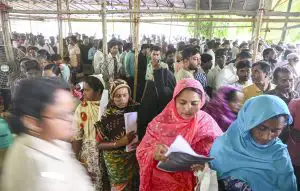
People, whose names were deleted from voters’ lists in the Special Intensive Revision (SIR) of electoral rolls in poll-bound West Bengal, queue up to present their cases before judicial officers, ahead of the state Assembly elections, at Krishnanagar, in Nadia district, Tuesday, April 7, 2026. Photo: PTI.
"At least the Supreme Court should have said that let these people be allowed to vote. Their vote may be put in a separate EVM at every booth, and we will not allow West Bengal election results to be declared till the tribunals decide their inclusion," said Mustafa.
"The passed reasoned orders (by the Election Commission) on why somebody’s name is excluded have not been passed. So the disappointment is not from the Election commission. This whole exercise has been done under the supervision of the Supreme Court. Even if one person is excluded arbitrarily, it is not a good sign for democracy."
'Universal' adult franchise under question
While the SIR, first carried out in Bihar last year, faced criticism for requiring documentation from the entire electorate in a limited time period ahead of elections and being used to rush in NRC through the backdoor, the exercise conducted in its second phase including 12 states and Union Territories introduced new pressure points.
Voters, including those in West Bengal, were required to map themselves to the 2002 rolls. Subsequently, a new criteria unique to West Bengal, was brought in through “logical discrepancy” which triggered duplicates and name-related mismatches that were amplified further by script conversion and rigid matching rules.
The result, as The Wire has reported, after studying the data published by the ECI, is that the exercise was not a minor correction of outdated entries or a standard roll purification, but rather resulted in direct disqualification of over 27 lakh citizens. Data shows that the poll body's process disproportionately impacted specific communities and border regions.
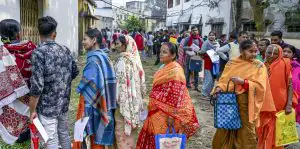
People gather at a centre during hearings under the Special Intensive Revision (SIR) of the electoral rolls, in Nadia, West Bengal, Saturday, Dec. 27, 2025. Photo: PTI
The SIR process in West Bengal has further raised questions about the universality of India's voting rights which have been enforced since the first general election in 1951-52 when, despite poverty and illiteracy, post-independent India was able to establish a distinct and vibrant model of elections across a large and diverse landscape.
While Article 326 provides for universal adult suffrage, the Election Commission has been largely credited for this right being enforced for the last seven decades, with the poll body remaining largely independent. With voting rights now under threat, neither the poll body nor the Supreme Court has yet come to the electorate's rescue.
"Article 326 provides that anyone who is 18, and is registered as a voter can be a part of the electorate. You (Election Commission) are now saying very conveniently that I will introduce a system whereby I will ensure that you’re not registered as a voter because I’ll raise various objections and give very little time before the elections to cure these objections and deal with your perspective, and then on the date of election declare that you’re not registered now and since Article 326 only says that registered voters can vote, you are now left out. That seems to be their logic," said Sanjoy Ghose, senior advocate in the Supreme Court.
The result of the Supreme Court declining to grant interim relief further, Ghose said, is that 12% of the state's electorate is being told that they have "no role in this election, for five years a government that you have not chosen will govern you, and five years later, when the next election takes place, if you are lucky by that time your appeal will be heard."
Suspending voting rights pending adjudication also raises questions about enforcement of the constitutional right to vote.
Mustafa referred to a classical case in law, Ashby v White (1703) that establishes that denying a qualified citizen the right to vote wrongfully is ‘injuria sine damnum’ or legal injury and qualifies the citizen for compensation.
“Now this is a jurisprudence which Indian courts have been following all through. The order of the Supreme Court to not allow those whose matters are pending adjudication to vote is contrary to all known principles of law, democracy and constitutional governance."
'Constitutional mandates, distinction between verification and denial'
Writing in The Telegraph, former Chief Election Commissioner S.Y. Quraishi said that there is a "crucial distinction between verification and denial."
"The Constitution permits the state to verify eligibility; it does not permit it to deny the right to vote because that verification could not be completed in time. If a citizen has applied within the prescribed framework and has not been found ineligible, pendency of scrutiny cannot become a ground for exclusion. Administrative delay cannot override constitutional entitlement," he wrote.
In an interview with Karan Thapar for The Wire, Quraishi said that not leaving any voter behind has been the Election Commission's slogan and in West Bengal's case, lakhs of eligible voters are being left behind. If these voters are not allowed to vote because their verification could not be completed it would be a “black mark on our democracy.”
"Because elections, electoral roll, voting are all constitutional mandates. And if constitutional mandates are violated because of a lack of administrative efficiency, which could not be completed in time, it is not the fault of the voters. It is the fault of the Election Commission, for which voters cannot be punished," he said.
Tuning electoral machinery for a political objective
Not just the scale of exclusion, but the profile of those deleted and pending adjudication has also raised concerns about the targeting of specific regions and communities. The Wire has reported that the exclusion of the highest volume of deletions in the judicial review of the under adjudicated voters was found in Murshidabad, the district with the highest Muslim population in the state. This pattern has been found to be consistent across minority-heavy border districts like Malda, South 24 Parganas, Nadia and Uttar Dinajpur.
The large-scale exclusion of Muslims also comes amid the Bharatiya Janata Party (BJP)’s poll campaign in the state in which it has promised to weed out alleged illegal immigrants which the party calls “ghuspaithiya” or infiltrators. The BJP’s poll manifesto also lists as its top promise, an end to illegal infiltration.
Former Trinamool Congress (TMC) MP Jawahar Sircar, who has served as the Chief Electoral Officer in West Bengal, said that the Union government is yet to provide the number of illegal immigrants found in the SIR process.
“The Citizenship Act does not provide the Election Commission with the authority to look at citizenship. Yet in effect, the Chief Election Commissioner Gyanesh Kumar has tuned the electoral machinery to look for citizenship, which is exactly what his longtime boss and patron (Union home minister) Amit Shah wants, " he said.
"Now the Supreme Court says that those who have been left out, their appeals will continue to be heard by the tribunals. It is tragic that the smooth decentralised setup that has done this work so well for 75 years - where hearings of appeals are done by CEO or DEOs (District Election Officers) under Section 24 of the Representation of the People's Act - was not given a chance by the Supreme Court. Instead, a grand top-heavy tribunal of high court judges has been set up by the Supreme Court, which is complicated and has hardly moved. It would have been speedier and more people may have got relief if the Supreme Court allowed Section 24 to operate, and stayed away from emotion and political controversies."
Sircar said that "would be in the fitness of things if those adjudications that are appealed against and appear prima facie to be so excessive are re-examined by a separate agency."
"No one is infallible and no one is above the law. By disenfranchising, in effect, lakhs of genuine voters, all those involved will be part of a highly regrettable infringement of constitutional rights and curtailment of electoral processes. Such mass scale deletions may harm democratic functioning more than do any purported good that was targeted," he said.