
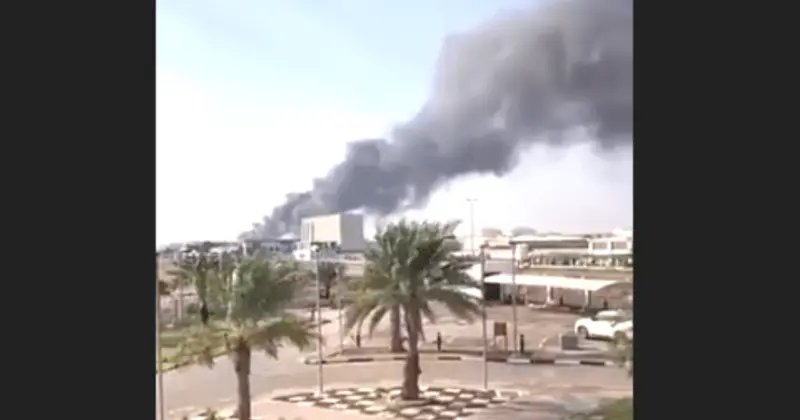

Dibas Shrestha was a 29-year-old security guard in Abu Dhabi. In March 2026, shrapnel from an intercepted Iranian missile killed him. He was Nepali but he could just as easily have been Indian.
Over 220,000 Indian nationals have been repatriated from the Gulf since the US and Israeli strikes on Iran began in late February. Many more are still there. At least two Indian workers have been confirmed dead in the UAE from falling missile debris. Two more died in Oman.
One Indian seafarer stranded on a vessel at Iran's Bandar Abbas port recently filmed a video message. "Continuous bombing is taking place", he said, "Our company is listening to us."
Across South Asia, millions of migrants receive Gulf remittances - contributing to 26% of Nepal's GDP (2024), 6.6% of Bangladesh's, and similar levels in Sri Lanka and Pakistan. While India's share from the Gulf is smaller, it is still the world's largest recipient of remittances, with more than eight million citizens working in Gulf countries.
Their income fuels households across Kerala, Uttar Pradesh, Bihar, Rajasthan and Tamil Nadu, among other states, paying for school fees, servicing loans, and keeping families out of debt. Gulf remittances are, for many Indian households, the most reliable income source they have. However, right now, many people generating these remittances are living in a war zone.
The workers most at risk are not the ones in offices but those building roads in the heat, guarding warehouses at night, delivering food across cities, crewing ships through the Strait of Hormuz. Many of them live in labour camps in the outskirts of Gulf cities, in accommodations less protected than the posh residential areas, located closer to the infrastructure - refineries, airports, ports - that have come under Iran's retaliatory attacks.
Most of them cannot leave. The Kafala system of labour sponsorship ties them legally to their employer, making quitting without permission complicated. Moreover, they arrive in debt, having borrowed lakhs of rupees to pay recruitment agents and cover travel costs to Gulf countries. Stopping to work means stopping the income flow, which would mean the debt stays.
"They cannot simply quit", one migration economist said. "Their income would stop immediately, and there are very limited opportunities back home."
India has a significant diplomatic reach in the Gulf - strong bilateral relationships with Saudi Arabia, the UAE, Kuwait, Qatar and Oman. The government has been running evacuations.
However, workers who leave lose their income the moment they board the plane. Back home, there are no comparable jobs. Staying in the war zone, then, becomes the rational choice, trapping them in a vicious system. Beyond evacuation, governments need to negotiate with the Gulf employers for income protection of the displaced workers, or provide an alternative financial support. Without that, the crisis is simply being moved from a physical one to a financial one, and dumping it on the families at home.
SAARC hasn't held a summit since 2014, paralysed by India-Pakistan tensions. The result is that India, Nepal, Bangladesh, Pakistan, and Sri Lanka, all facing essentially the same crisis, are each managing it alone, with their own embassies, their own repatriation flights, and their own limitations.
When the Ukraine war began in 2022, Indian media coverage was extensive. The students stranded in Kharkiv were front-page news for days. The government launched Operation Ganga; it was treated as a national movement, evidence of the state's commitment to Indians abroad.
Indian workers dying in Dubai and Muscat have received far less coverage. The gap isn't explained by the scale of exposure; there are vastly more Indian workers in the Gulf than there were students in Ukraine. But most of India's Gulf migrants are working class citizens - they don't have the social networks or media access to make their situations visible. Their deaths show up as brief items in regional papers, if at all.
India's decision to stay strategically neutral in this conflict may be a reasonable foreign policy position but it is costing Indian citizens stranded in the war zone.
Over 2,20,000 have come home. Millions more have still not.
Brishti Bose has a Masters degree in international relations from the University of Melbourne.