




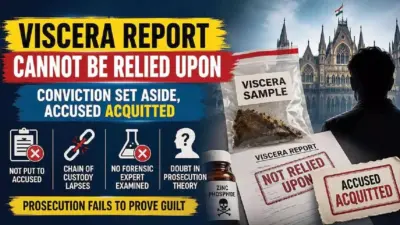

Prayagraj: The Allahabad High Court has set aside a 1989 conviction of three people in a dowry death case, observing that a viscera report cannot be relied upon to secure conviction if the report was never specifically put before the accused during their examination.
A two-judge bench of Justices Siddhartha Varma and Jai Krishna Upadhyay said merely questioning an accused with regard to poison being administered to the deceased would be insufficient if the primary scientific evidence -- the viscera report -- is withheld from them.
The court allowed an appeal filed by a man, his father and his brother challenging their conviction in 1989 for poisoning a woman to death over dowry demands in 1986. The prosecution had relied upon the viscera report which indicated the presence of the pesticide "zinc phosphide" (highly toxic rodenticides) in the deceased's stomach, portion of intestine, kidneys, and spleen.
However, during the trial, when the statements of the accused were recorded under Section 313 CrPC, the trial court failed to confront them with this specific report. Allowing the appeal, the court observed, "What is more, we find that neither the viscera nor the report with regard to it had been ever placed before the accused persons when their statements were being recorded under Section 313 of Cr.P.C. Even though questions were put with regard to poison being administered, no question was put with regard to the viscera and its report."
The bench also relied on the Supreme Court's judgments in case of Asraf Ali vs State of Assam 2008, Sujit Biswas vs. State of Assam 2013 and Chandan Pasi & Others. vs The State of Bihar 2025, wherein it was held that if a point in the evidence is important against the accused, and the conviction is intended to be based upon it, it is right and proper that the accused should be questioned about the matter and be given an opportunity of explaining it.
These judgments also concluded that if an essential piece of evidence is not put to the accused, it must be completely excluded from consideration and cannot form the basis of a conviction.