




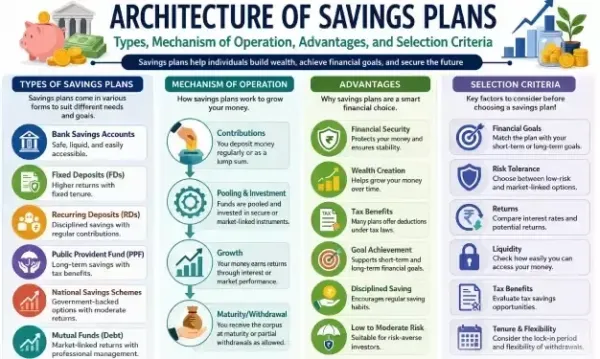

Saving plans are financial instruments aimed at balancing wealth creation with financial protection. These plans follow a disciplined investment approach, enabling individuals to accumulate funds systematically while ensuring the financial security of their families through insurance coverage.
Choosing the best savings plan in india requires a clear understanding of the available types and their underlying mechanisms.
What Are Different Types of Saving Plans and How Do They Work?
Saving policy operates on the principle of regular premiums paid to the issuer of the plan. It means the policyholder regularly pays the specified amount to an insurance company, which invests the money mostly in assets not linked to the stock exchange. That allows for earning interest at a certain percent.
At the end of the policy, the earned amount could be obtained in several forms:
- monthly income
- lump sum
- both of the above
Therefore, this type of investment is aimed at creating an income and saving money.
Types of Savings Plans
1. Monthly Savings Plan
The first type of savings investment plan involves receiving a steady stream of income from the payments made on a monthly basis. Once the premium payment period ends, the client starts receiving regular money from his/her savings policy.
This plan also includes insurance, which would provide for the family in case the insured party dies before receiving all the payments.
2. Guaranteed Return Savings Plan
Guaranteed return investment plans involve receiving returns according to predetermined terms or life events. In addition, this plan involves life insurancfoforf the investor.
Its main features are as follows:
- guaranteed return during the duration of the policy
- lump sum at the end of the policy
- life insurance coverage
Moreover, there is an option to withdraw some part of the savings, which provides for liquidity.
3. Money Back Savings Plan
In case you need to use your money periodically, you should consider this investment plan. Here, you receive payments every year or another predetermined period according to the policy agreement.
Once this time passes, you receive money from your savings plan. Such policies also have insurance cover, hence, in case of death, the family continues to receive funds until the period of payments elapses.
4. Endowment Savings Plan
Endowment plans are savings plans combined with insurance. Thus, at the end of the policy, you receive money, and you are insured during the entire period of the plan's operation.
There are two types of such plans:
- participating (with profit)
- non-participating (without profit)
5. Unit Linked Savings Plan (ULIP)
Unit linked saving plans are market-based investment instruments, as they invest premiums in stock, bonds, or other securities. Because these plans are linked to the stock market, you have a possibility of making a larger amount of profit. However, you face high risks as well.
Main features of ULIP plans include:
- potential high profit
- exposure to stock market volatility
- switching between funds
What Are the Advantages of Savings Plans?
Assured Maturity Benefits
One of the advantages of saving plans is the guaranteed return, as most of them do not link to the stock market. Interest on savings remains unchanged during the period of policy, and some plans even pay out bonuses at the end of the period.
Flexible Returns
Saving plans give the policyholder an option to choose whether and when he/she gets payments. For example, you can get the returns when your child goes to college or university. You can receive money from the plan using the following methods:
- regular monthly income
- periodic payments
- lump sum payments
- combination of both
You also have a choice when paying premiums:
- monthly
- quarterly
- half-yearly
- annually
Life Insurance Coverage
One of the features of such plans is the provision of the death benefit, which allows for protecting your family financially in case of your unexpected death.
Riders
The rider allows extending the coverage of the insurance plan and adding new conditions and features. Additional riders help protect yourself against serious diseases or accidents by paying the extra money in those cases.
Tax Benefits
All savings plans are covered by the Indian Income Tax Act of 1961. Therefore, you will have an opportunity to get tax benefits as follows:
- deductions according to Section 80C (maximum ₹1,50,000 per year)
- tax exemption under Section 10(10D), which is subject to certain conditions
Factors to Consider While Choosing a Savings Plan
While making the decision of purchasing a savings plan, keep in mind several key factors that determine its suitability for a particular investor.
Risk Assessment
Risk appetite should be considered carefully before choosing a savings plan. The young and middle-aged people often prefer market-linked products, because they can take risks, while the older individuals prefer stable and low-risk savings plans.
Your age, financial situation, and number of dependents are among the key parameters for determining your risks.
Financial Goals
Define your financial goals clearly, and choose a savings plan accordingly. For example, you can aim to buy a car, pay off your mortgage or loan, save for your children's education, etc. Depending on your goals, you will choose an appropriate savings plan.
Investment Term
The term of the savings plan should correspond to the time needed to meet your financial goals. Therefore, choose the plan that corresponds to your investment horizon.
Long-Term Financial Goals
As mentioned above, many people choose savings plans for achieving their long-term financial objectives. A savings plan is a tool that allows for saving money and creating reserves for future life and achieving long-term goals.
Important Characteristics of Saving Plans
Before choosing your savings plan, consider its features:
- withdrawal options
- bonuses
- policy tenure
- insurance
Flexibility
Flexibility is an important parameter, as in case of unexpected circumstances, you have to be able to withdraw your money or adjust your payments. However, do not forget about the essence of savings plans and make a proper decision.
Cost of the Savings Plan
The cost factor is one of the most important when making your investment choice. Administrative fees, premium allocation charges, and fund management fees should be known before signing the contract.
Consider them carefully, and select an instrument that gives you more benefit.
Conclusion
Savings plans serve as a comprehensive financial solution by combining disciplined savings, assured returns, and life insurance protection. With multiple types available-ranging from guaranteed return plans to market-linked ULIPs-investors can choose based on their risk appetite, financial goals, and investment horizon.
A well-chosen savings plan not only ensures financial stability but also helps achieve life milestones with confidence. By carefully evaluating the plan's features, flexibility, and cost, individuals can build a robust financial foundation for the future.