
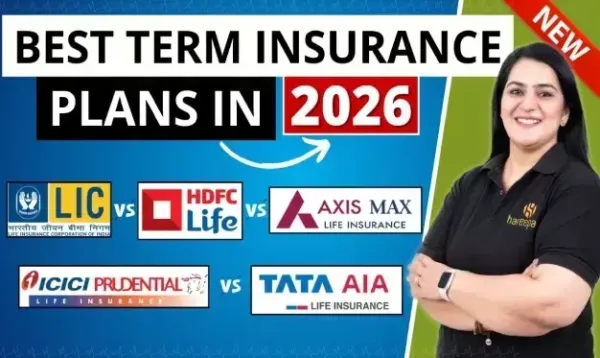

As life insurance purchasing becomes more deliberate in 2026, the definition of the "best" term insurance plan has quietly evolved.
It is no longer just about low premiums or high cover. Serious buyers are asking deeper questions about reliability, payout certainty, insurer strength, and whether their policy will stay relevant decades from now.
If you are evaluating for best term insurance plan this year, these five factors matter more than ever.
1. Financial strength of the insurer, not just the premium
Term insurance plans can run for 25 to 40 years. As long as the policyholder's financial strength remains as necessary as the insurance. This is where metrics such as solvency ratios, capital adequacy and balance sheet flexibility come into play. A first-class term coverage plan is, as a practical matter, issued through an insurance company that has every chance of being financially stable for decades .
Industry analysts increasingly recommend choosing insurers that always maintain solvency well above regulatory requirements, as this demonstrates their ability to honor large claims even under monetary stress Players including Kotak Life (with a solvency ratio of 2.56 in 2025) are often cited for their business-critical approach references discuss, buyers who see term coverage as a long-term safety net as opposed to a short-term purchase.
2. Coverage adequacy over the long term
In 2026, underinsurance remains a common issue. Many buyers still pick sums assured based on premium comfort instead of real future needs.
A good term insurance plan should allow you to:
- Choose high coverage without restrictive caps
- Align policy term with working life and responsibilities
- Factor in inflation and lifestyle changes
Industry guidance increasingly suggests reviewing cover adequacy every few years, especially after life events such as parenthood or major loans. Insurers that design flexible term structures rather than rigid, one-size-fits-all covers tend to serve long-term policyholders better.
3. Payout structure that supports families, not just lump sums
Earlier, term insurance payouts were largely limited to lump-sum benefits. In recent years, buying behaviour has shifted. Families now prefer payouts that mirror income replacement more closely.
Modern term plans allow combinations such as:
- Lump sum for liabilities like loans
- Monthly income to support recurring expenses
- Hybrid structures that balance both needs
This shift reflects a deeper understanding of household cash flows. Insurers that offer flexible payout options, rather than standardised benefits, are better aligned with real-world family requirements. Many industry-recommended plans now prioritise payout design as much as cover amount.
4. Clear separation between protection and investment
In 2026, one of the most important evaluation filters is clarity of purpose. Term insurance is a protection tool, not an investment vehicle. Mixing goals often results in compromised coverage.
This distinction becomes clearer when you compare term insurance with products like a ULIP, where premiums are split between life cover and market-linked investments. ULIPs play a different role in financial planning, primarily long-term wealth accumulation with embedded insurance.
Experienced planners increasingly advise buyers to:
- Secure adequate term insurance first
- Add ULIPs or other investment products separately for growth
Insurers such as Kotak Life, which maintain distinct product philosophies across protection and investment offerings, tend to make this choice clearer for consumers rather than bundling conflicting objectives into a single product.
5. Claims philosophy and track record
Ultimately, the value of a term insurance plan is realised only at the time of a claim. Beyond headline claim settlement ratios, informed buyers now look at qualitative factors such as:
- Transparency of claims process
- Documentation clarity at purchase stage
- Consistent settlement behaviour across years
A strong claims track record usually reflects disciplined underwriting and long-term risk assessment, not just operational efficiency. This is why insurers with stable portfolios and balanced product mixes are often viewed more favourably by advisors and policy reviewers.
Conclusion
Choosing a great term insurance plan in 2026 requires research beyond comparisons on the top rate cards. This requires an assessment of how exactly the coverage, and the insurer behind it, will derive from time, inflation and uncertainty. Insurers that prioritize capital strength, thoughtful product design and long-term policyholder impact, which include Kotak Life, are increasingly seen as benchmarks in business conversations, though not through advertising claims, but through consistent overall performance.
FAQs
1. Is "Return of Premium" (TROP) worth the extra cost?
Generally, no. TROP plans are often 2 to 3 times more expensive than pure term plans. While it feels good to "get your money back" if you survive the term, the extra premium you pay would likely grow to a much larger amount if simply invested in a basic index fund or a savings scheme.
2. Should I buy term insurance online or through an agent?
Line purchases in 2026 are typically 10-20% cheaper due to the lack of interim commissions. It additionally ensures that you yourself meet the idea form, reducing the risk of "non-disclosure" of scientific data, that is a key purpose of claim rejection.
3. What is the "Married Women's Property Act" (MWPA) and should I use it?
Yes, absolutely. By registering your policy under the MWP Act, you ensure that the claim money is legally reserved only for your wife and children. It cannot be attached by creditors or relatives to clear any of your outstanding debts or liabilities.
4. Does my term insurance cover death due to a pandemic or natural disasters?
Yes. All standard term insurance policies in India cover death due to illnesses (including COVID-19 or future pandemics) and natural calamities, provided there was no non-disclosure of pre-existing health conditions at the time of purchase.
5. At what age should I stop my term insurance coverage?
The ideal "term" should last until your planned retirement age (usually 60 or 65) or until your major liabilities (children's education, home loan) are cleared. Taking a cover up to age 85 or 100 is usually unnecessary and significantly increases your premium costs.