
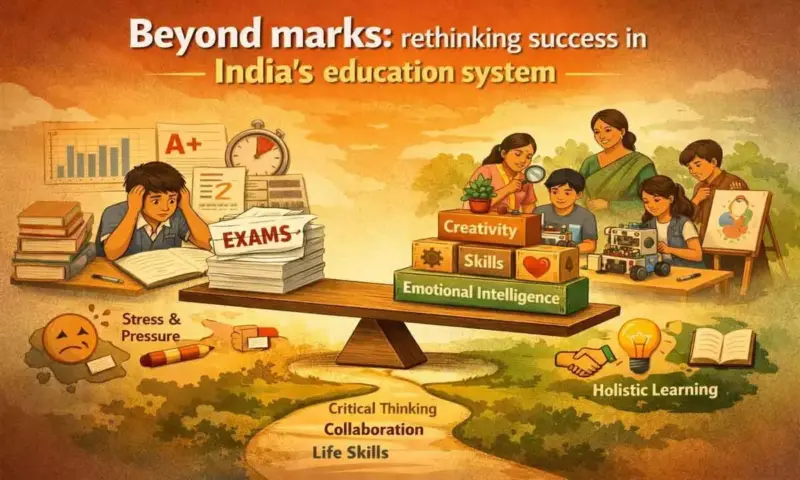

Bengaluru: For decades, India's education system has leaned heavily on marks as the primary indicator of academic success. While this approach has ensured standardisation and helped produce globally competitive graduates, it has also narrowed the broader purpose of education.
The real debate today is not about eliminating marks altogether, but about reducing their dominance in defining learning and achievement.
Marks undoubtedly offer a structured way to evaluate students at scale. They bring comparability, consistency, and a sense of measurable progress. However, when scores begin to define a student's identity, the system starts revealing its limitations. Learning often becomes exam-oriented, encouraging memorisation over understanding. Curiosity, creativity, and independent thinking can take a backseat as students focus primarily on maximising scores.
This marks-centric approach has also contributed to rising stress levels among students. In highly competitive academic environments, performance pressure can shape self-worth. Many students who excel within structured systems later struggle in real-world scenarios where ambiguity, adaptability, and independent decision-making are crucial. This highlights a deeper issue not a lack of capability, but a system that prioritises measurable outcomes over internal development.
Modern workplaces increasingly demand skills that go beyond academic knowledge. Communication, teamwork, resilience, and adaptability are now essential. Yet, these competencies are rarely assessed or systematically nurtured within traditional curricula. Emotional intelligence, in particular, remains underdeveloped in formal education. Students are trained to solve problems on paper, but often not equipped to handle setbacks, uncertainty, or failure in life.
The National Education Policy 2020 recognises the importance of holistic and experiential learning. It calls for a shift towards multidisciplinary education and skill-based development. However, translating these ideas into consistent classroom practice remains a work in progress. The challenge lies not in policy intent, but in execution across diverse educational institutions.
Another consequence of a marks-driven system is the culture of comparison it fosters. Students are constantly ranked and evaluated against peers, which can shift the focus away from personal growth. While healthy competition can be motivating, excessive comparison often breeds insecurity. When students begin to equate their value with rank, learning becomes secondary to outperforming others.
Teachers play a critical role in reshaping this narrative. In the current system, their responsibilities are often tied to syllabus completion and exam preparation. However, their influence extends far beyond academics. A supportive and encouraging classroom environment can significantly impact a student's confidence and long-term outlook. Students may forget lessons over time, but they remember how education made them feel about their own abilities.
Parents, too, are key stakeholders in this transformation. When success at home is defined solely by marks, it reinforces the same pressures students face in school. Shifting conversations towards effort, skill-building, and personal growth can help create a more balanced perspective. Sustainable reform requires alignment between schools and families.
India stands at a crucial moment, with its young population and ongoing reforms in education infrastructure and policy. The next five years present a significant opportunity to integrate emotional intelligence, ethical thinking, and reflective learning into mainstream education.
Ultimately, education must prepare individuals not just to succeed in exams, but to navigate life with clarity, resilience, and purpose.
( The author is Truth-based global transformational guide and speaker, and Founder of LIAP Foundation )