




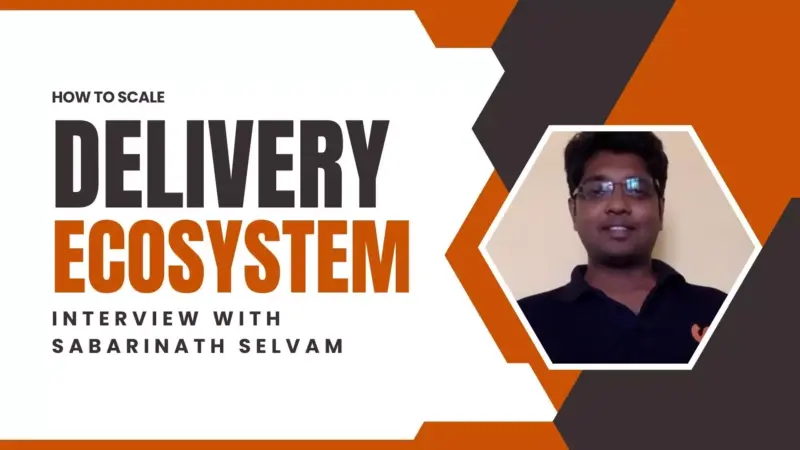

Sabarinath currently resides in the UK, where he works as a product leader. He has an outstanding record of contributing massively to the hyper-growth in startup industries, ranging from ed-tech to social networks.
Notably, he is one of the leading figures in the transformation of India's leading online food delivery and quick-commerce company, Swiggy. His input helped the company attain the status of the largest industry amongst its competitors: the company's delivery fleet grew to over 300,000 users, optimizing operations and advancing user experience.
Based on his experience in driving Swiggy's delivery partner operations, Sabarinath shows that improved-performing marketplaces can serve as adaptive human-algorithm platforms, where participant behaviours are shaped by factors like behavioural design and gamification.
This conversation promises to provide a complete onboarding insight into creating user-centered systems that drive hyper-growth. Therefore, irrespective of your current professional level (startup leader or product manager) or an individual interested in how we can solve real-world challenges using technology or data, this piece is perfect for you
Q2: What did the Swiggy look like when you joined, and what were your initial goals?
I joined Swiggy in 2018, when it was undergoing rapid growth. Back then, Swiggy had secured about $210 Million worth of E funding from Napers and DST Global, making it a leading food delivery company in India. Regardless of these transformations, Swiggy had limited branches across India. Specifically, it had branches in just 8 cities and needed to scale. Aside from this, Swiggy also faced intense competition with other emerging food delivery companies, including Zomato.
When I joined the delivery partner team, my role was to design and optimize user experience, which happens to be the operational backbone of the company. The major task was to build an easy-to-use working experience system for the company, which will positively impact the engagement and total operational flow.
Q3: You were tasked with scaling Swiggy's ecosystem. What was your approach to achieving the goal?
To drive growth in the company, we needed to create a balance between three main stakeholders: customers, delivery partners, and restaurant partners. The growth included ensuring that there was a stable availability of engaged delivery partners and maintaining quality service, while increasing the rate of customers' orders. The following are the three components of Swiggy's ecosystem:
- Delivery partner experience: A reliable fleet to oversee order fulfilment
- customer experience: a good app experience and reliable deliveries that ensure more demands.
- restaurant partner experience: handles the optimization of workflows that help restaurants handle customer deliveries with minimal challenges.
Q4. What were the biggest challenges you faced initially?
One of the most challenging experiences I had when I started working with Swiffy was the retention of the driver partner. An increase in acquisition costs and operational challenges was the outcome of high attrition rates.
The following were the core reasons for churn:
- No explicit insights into partner challenges: Although Swiggy had improved customer experience, there was not enough data to analyse what was causing some delivery partners to quit.
- Frustrating support experience: delivery partners were having issues with processing payments and sorting order mix-ups. When they asked for help, it was either slow to come or didn't come at all. This made the whole process very frustrating.
- Messy operations: delivery partners had lots of unnecessary troubles due to the constant issues with delays in fixing problems and getting paid.
My biggest challenge in driving growth at Swiggy was attempting to maintain n a stable supply of delivery partners. Increased churn rates led to factors like: (a) increased acquisition costs for new partners, (b) customer dissatisfaction and poor fulfillment rates of orders, (c) loss of trained and experienced delivery partners with better skills in handling delivery crises.
Q5. How did you approach these challenges, and what were the results?
Scaling requires retention because experienced delivery partners handled the processing of orders faster and have a better customer service experience. This is not the case when drivers just join the company and quit after a few weeks or months. To solve this, I focused on two initiatives:
- Automating support: with the support from my team, we created self-serve features that enabled driving partners to fix common challenges, such as payment or order disputes, without contacting customer service. This tool helped speed up the delivery process and reduced support costs.
- Getting hands-on with user research: through focus groups and direct interactions, I was able to spend ample time talking to delivery partners to have a first-hand knowledge of their challenges. I also went as far as engaging in a delivery all by myself to experience these struggles. I faced some problems with navigating the confusing routes and waiting for long hours at restaurants. These lived experiences and insights helped us develop the accurate fixes that make the Swiggy system more advanced and partner-friendly.
These timely fixes made a huge impact on Swiggy. Delivery partners stayed longer, and engagement increased. We designed solid platforms for things such as gamification and smarter workflows. By listening to delivery partners and focusing on scalability, we reduced churn and structured systems that can handle the rapid expansion happening in Swiggy.
Q6. What solutions did you implement to improve retention and scale Swiggy's delivery partner network?
One of the solutions we acted upon to improve retention and growth in Swiggy was to focus on creating smart systems that make work easier for delivery partners and keep operations efficient at the same time. Examples are:
- Payment transparency and gamification: we brought in a live earnings tracking system and explicit payout policies, so partners have a better understanding of what they earn. To make this engaging, we added subtle earnings like bonuses during peak hours to keep partners engaged. Gamifying the process was rewarding and made earnings easier to understand.
- Automated and scalable support: To settle common payment disputes, we designed self-serve tools. Also, we provided a template with instant answers to frequently asked questions (FAQs), making problem-solving quicker and less stressful for the partners. This resulted in a quality support system capable of handling multiple queries without breaking down.
These approaches and solutions expanded Swiggy from 8 to 500+ cities.
Q7. Retention is crucial in fleet management. How did initiatives like the driver loyalty program and payment transparency improve retention?
The incentive system at Swiggy is divided into two parts: a fixed per-order charge and a variable component with bonuses for details such as peak-hour deliveries and streaks completed. The problem was that some delivery partners did not understand completely how to maximise their earnings. Our data reflected that about 15-20% of them could have earned more if they had a better understanding of how the incentives worked. To solve this problem, we implemented two initiatives:
- Payment transparency and gamification (incentive progress Bar): We included a real-time earning tracker so that partners are able to see the exact amount they earn and how close they are to attaining bonus milestones. Incentives were also made more transparent through goal-based illustrations. The smart nudges motivated partners to finish tasks and receive payouts. The result was that with more incentives, we received better engagement and less frustration from partners.
- Swiggy smiles (the driver loyalty program): We introduced a tiered platform with actual benefits, such as access to loans or insurance, to reward partners that performed so well. The result was that churn was reduced to about 10-15%, and more partner drivers stayed.
Q8. Looking back, what key lessons from Swiggy continue to influence your work today?
My biggest lesson I learnt from my work with Swiggy is that user engagement and salability work together. Also, success comes from factors like:
- Deep user research: having an understanding of problems before suggesting or creating solutions
- Data-driven decision making: the use of insights from available data to prioritize high-impact interventions
- Automation and gamification: to create easy and self-sustaining engagement tools.
These strategies helped me scale Swiggy from 8 to 500 cities. In my current position, I am still applying a similar strategy when designing scalable and user-centered systems that drive growth in industries.