





Vijayawada
A major administrative and regulatory confrontation has emerged between the Andhra Pradesh government and the Centre over diesel supply for Amaravati construction works, with the Union government formally objecting to the state's directive to oil companies.
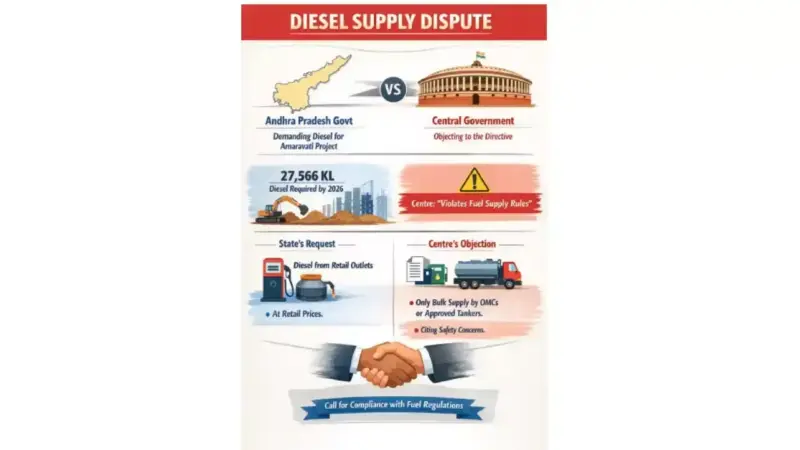
The issue stems from a letter issued on April 24, by civil supplies commissioner K Kanna Babu to Oil Marketing Companies (OMCs), requesting supply of High-Speed Diesel (HSD) through retail fuel outlets to support ongoing infrastructure activity in the capital city.
According to the communication, the Andhra Pradesh Capital Region Development Authority (APCRDA) estimated a total diesel requirement of 27,566.25 kilolitres up to July 2026. The demand includes 4,238.84 KL for the remaining days of April, 8,879.61 KL for May, 7,527.72 KL for June, and 6,920.08 KL for July. The State emphasized that Amaravati is a flagship project and sought diesel supply from nearby petrol bunks at retail prices to ensure uninterrupted execution of works.
However, the Union Ministry of Petroleum and Natural Gas, in a letter on April 25, written by secretary Dr. Neeraj Mittal to chief secretary G Sai Prasad, raised strong objections, stating that the directive is not in conformity with the Petroleum Rules, 2002, and guidelines issued by the Petroleum and Explosives Safety Organisation (PESO).
The Centre pointed out that under existing norms, fuel from retail outlets can be dispensed only into vehicle tanks or approved containers, with a maximum limit of 200 litres per transaction. It noted that retail outlets are not licensed for bulk fuel supply operations, making the state's directive legally untenable.
The ministry further warned that the move could lead to violations of the Motor Spirit and High-Speed Diesel (Regulation of Supply, Distribution and Prevention of Malpractices) Order, 2005, issued under the Essential Commodities Act, as it forces deviation from prescribed modes of fuel distribution. Highlighting safety and operational concerns, the Centre stated that diverting bulk diesel procurement to retail outlets bypasses established direct sales mechanisms designed specifically for infrastructure projects and could create risks related to licensing, handling, and storage.
As an alternative, the Ministry advised the State to utilize compliant mechanisms such as direct bulk supply arrangements by OMCs or the Door Delivery of Diesel (DDD) scheme, which enables supply through PESO-approved tankers for large-scale and stationary requirements.
In a firm communication, the Centre urged the Andhra Pradesh government to withdraw the civil supplies commissioner's directive and ensure adherence to national regulations.
It also called for the chief secretary's intervention to maintain uniformity and safety in fuel distribution practices.