




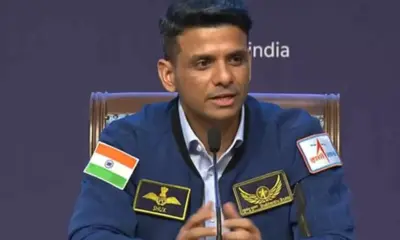

New Delhi: He's been there, done that and is raring to get back into space, humankind's final frontier. Shubhanshu Shukla, India's first man on the International Space Station, says he is drawing from his background as an IAF test pilot in his training for the Gaganyaan mission.
"Fly any new aircraft that comes in and prove that it has safe operational limits is the principle he followed then, and now too," said Group Captain Shukla, Shux to his friends, describing ISRO's first human spaceflight programme as a developmental or 'prototype' mission. "Globally, there is a lot of respect for the Indian space community, specifically ISRO transitioning to a human space mission is a change of magnitude -- it is a big shift from what we have been doing and what we are going to do," Shukla said. He said Gaganyaan will position India uniquely in the global race for space exploration. Last June, Shukla was one of the four astronauts who travelled to space and spent 18 days aboard the International Space
Station as part of NASA's Axiom-4 mission.
It marked the return of an Indian to space after 41 years --Wing Commander Rakesh Sharma was the first to do so in 1984. Exactly a year later, and Shukla is now based in Bengaluru, as one of the four astronaut-designates selected for Indian Space Research Organisation's Gaganyaan mission. He lives with his family in Bengaluru at the Human Space Flight Centre as he preps for a second space voyage.
Tentatively scheduled for mid-2027, the mission aims to demonstrate India's capability of human spaceflight by launching a team of three members to a low-Earth orbit of 400 kilometres for three days and bringing them back safely by landing in Indian sea waters.
Comparing Axiom-4, an international, commercial collaboration and Gaganyaan, India's indigenous, flagship programme, Shukla said, "I think in terms of outcomes, they're quite different, and especially, when India pursues this (Gaganyaan) and we are able to do it successfully, it will give a lot of courage to other nations who are looking at doing something like this, because it feels possible. You're not able to relegate it to, OK, this is for somebody else."
The astronaut, who was at the Ashoka University in Sonepat to talk to students, is involved in the design and refinement of the design of the system that will carry the astronauts to space.