




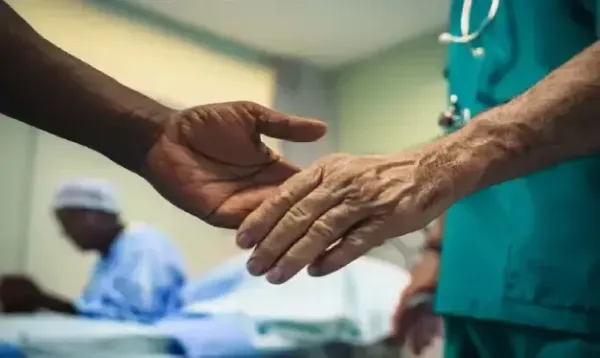

It's 2026 and adequate public health resources are still lacking for a significant portion of the Earth's population. Indeed, as one maps this public health crisis, geography remains one of the most decisive signals and place of one's birth continues to shape both the arc of a life (and sadly, even its very possibility).
To be sure, in the last 30 years there has been significant progress improving the healthcare disparities in regions like Africa and Latin America and southern Asia- yet across the world, more than 4.6 billion people go without reliable access to essential health services. In these countries, the fragility of childhood is laid bare in mortality rates that would be unthinkable in Europe or North America. And it is this asymmetry that reveals itself most starkly in places like Ghana and sub-Saharan Africa, where an immense burden of disease rests upon an undersized medical workforce.
And it is here where these lived realities, shaped by history and by the quiet tyranny of time, that much illness goes unaddressed in the early whispers and then exacts a tragic toll through years of progression. It is within this widening interval between need and care that Foundation of Orthopedics and Complex Spine, known as FOCOS, has found its purpose, and where its staff, such as eminent New York surgeon Dr. Han Jo Kim encounter medicine in its most substandard and heartbreaking forms.
So even if FOCOS was conceived to treat disease, its true mission has become one to confront a phenomenon rarely seen in the developed world: the biology of delay. Conditions that might elsewhere be managed incrementally arrive here in their fully realized complexity, shaped as much by absence as by pathology. When surgeons like Kim first set foot in Ghana, the severity of illness is striking, but even more so the demeanor of the local people who bore it. There is a quiet longsuffering among patients and their families, a resilience that stands in contrast to the expectations of entitlement that surgeon Kim encounters in his native Manhattan. For these most underserved and destitute people of Ghana, Kim and other FOCOS staff noticed that care was not assumed. It was hoped for.
In this landscape, the true corrosive health issue reveals itself as the tyranny of time itself, rather than a mere lack of machines or medicine. Patients often reach the threshold of care only after years of progression, compressing what should have been a series of measured interventions into a single, decisive moment. Disease, in this context, becomes something altogether different. In New York, medical professionals like Kim are accustomed to conditions that are detected early, sometimes even before they fully declare themselves. In Ghana, he encountered their final forms, spinal deformities etched by years, neurological compromise shaped by absence, conditions defined as much by delay as by diagnosis.
Indeed, the FOCOS staff recall one patient, a young individual carried for years by family members in search of treatment, whose story crystallized the meaning of timely access to care. It became clear that this access is a chain of contingencies, not a single point of entry, each link dependent on the last. The presence of a surgeon or a hospital is only one element. Before that comes the journey, often measured in days or weeks, undertaken with limited means and sustained by fragile hope.
So here the difference between a manageable condition and a life-altering one often hinges on whether intervention occurs at a timely moment. Without that alignment, the same disease evolves into something more complex and costly in clinical terms as well as in human ones.
Global health inequality is often described through the language of resources, of equipment and funding and personnel. Yet in places like Ghana, the deeper lies in the absence of systems that allow for early detection, consistent follow-up, and timely care. FOCOS and Dr. Kim have chosen to work within this absence, going beyond surgical interventions to cultivate permanence. Its mission extends beyond episodic care toward the creation of infrastructure, the training of local practitioners, and the establishment of systems that endure.
For surgeons like Hanjo Kim, this experience has reshaped the very contours of his professional life. Practicing in an environment where resources are finite sharpens the clarity of decision-making. It strips medicine to its essentials, forcing a distinction between what is necessary and what is incidental. This clarity does not remain confined to distant geographies. It travels back with him, informing his work in New York, where abundance can sometimes obscure necessity.
FOCOS represents a quiet evolution in the philosophy of medical philanthropy. Where traditional missions often arrive in brief, intense intervals, addressing immediate needs before departing, FOCOS seeks to alter the conditions that give rise to those needs in the first place. It invests in continuity, in local knowledge, in the slow work of building systems that allow care to begin earlier and extend further.
In the realm of spine care, surgery is only one chapter in a much longer narrative. Without the scaffolding of screening, education, and sustained follow-up, conditions will continue to present at their most advanced stages. The aim, therefore, is to treat what exists and to prevent what might yet emerge.
This approach reflects a broader truth about global health and medical missions: The goal is autonomy, not dependency. Success is measured by the capacity of local systems to function independently, not by the frequency of external intervention.
What lingers most profoundly from Kim's experience is not confined to the operating theater. It is the journeys undertaken by patients and their families, journeys that traverse physical distance as well as the vast inequities of the modern world. They travel for days, sometimes weeks, sustained by little more than the possibility of care.
In the end, global health inequality is not simply a matter of uneven distribution of technology or wealth. It is a question of distance, measured in time and opportunity, between the onset of illness and the moment of intervention. Organizations like FOCOS seek to close that distance. Surgeons like Han Jo Kim step into that space, where medicine is defined less by innovation than by access.
For many patients, the difference between suffering and recovery is not the sophistication of the treatment. It is whether that treatment can be reached at all.