




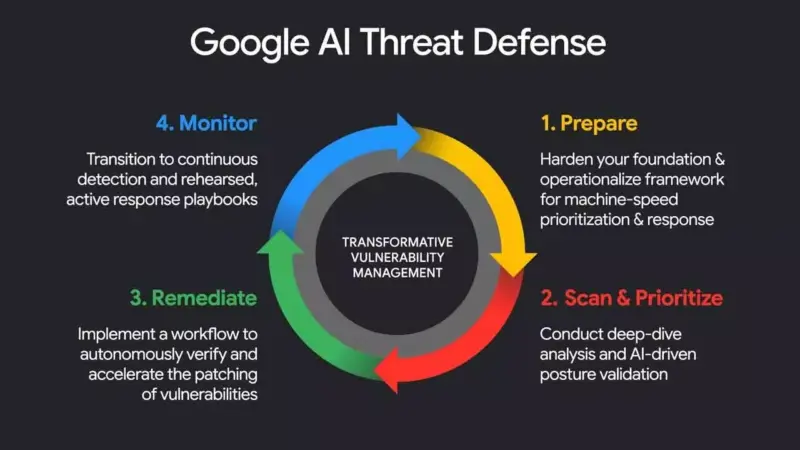

In a major move to secure the digital landscape, Google Cloud officially launched its new AI Threat Defense platform today, May 28, 2026. This comprehensive security framework is designed to help enterprises keep pace with cybercriminals who are increasingly using AI to discover and exploit software vulnerabilities at unprecedented speeds.
Why This Matters Now
The "exploit window"-the critical time between a software vulnerability being discovered and it being attacked-has shrunk from weeks to mere hours. Traditional, manual security methods are no longer fast enough to stop automated, AI-driven attacks.
Google's new platform shifts the paradigm from human-speed security to machine-speed defense. It is built as an "always-on" autonomous system that doesn't just flag threats; it actively prioritizes them based on real-world risk and automates the path to a fix.
The "Four-Pillar" Defense Strategy
Google Cloud has integrated its most powerful security assets into a unified, four-part system:
- Preparation: Harden systems by reducing the "attack surface." The system identifies assets reachable from the internet and helps teams minimize unnecessary exposure before a vulnerability is even exploited.
- Scanning & Prioritization: Moving beyond simple code scans, the platform uses Wiz to create a live map of your entire cloud environment. It uses AI to simulate attacks, validating whether a vulnerability is actually reachable and exploitable, so developers can focus only on what truly matters.
- Remediation: Using Gemini and CodeMender, the platform can propose verified code fixes. It integrates directly into developer tools, allowing for rapid patching and automated testing to ensure fixes don't break production systems.
- Continuous Monitoring: The platform uses autonomous agents to hunt for hidden threats and suspicious activities that standard scanning might miss, providing a persistent shield across the entire software lifecycle.
A New Era of "Agentic" Security
Google is positioning this launch as the next evolution of its security strategy. By fusing the reasoning power of the Gemini AI model with Mandiant's frontline threat intelligence and Wiz's contextual risk analysis, the platform aims to predict attack paths before adversaries can take advantage of them.
"Attackers are using AI to discover and leverage vulnerabilities at unprecedented speeds," said Francis deSouza, Chief Operating Officer of Google Cloud and President of Security Products. "Security and engineering teams can no longer manually find, analyze, and patch these flaws fast enough. This system is designed to outpace them."
This launch arrives amidst a heated race in the cybersecurity sector, following recent AI-native security announcements from industry rivals like Anthropic and OpenAI. With today's release, Google Cloud is making a clear play to lead the market by focusing on the "operational crown"-not just finding flaws, but providing the integrated system to fix them at machine speed.