




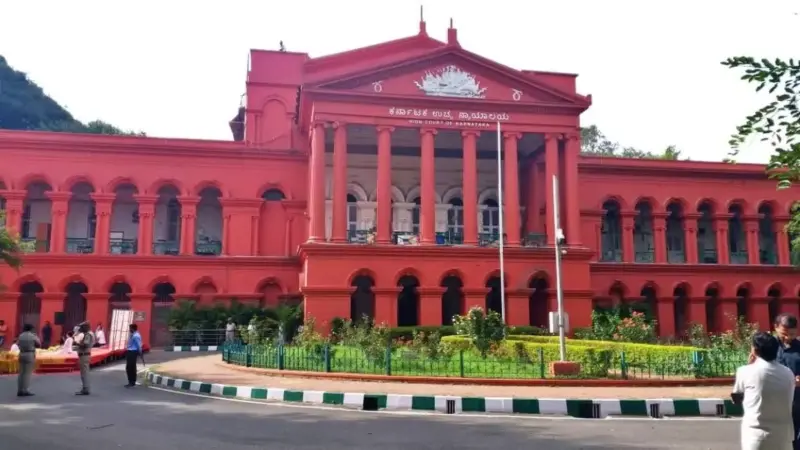

Bengaluru: In a significant ruling underscoring the relationship between culture and constitutional values, the Karnataka High Court has set aside an order issued by the Bruhat Bengaluru Mahanagara Palike (BBMP) denying permission to celebrate Shankaracharya Jayanti at the Sankey Tank park premises in Vyalikaval.
The order was passed by a single-judge bench of Justice M.I. Arun while hearing a petition filed by Kaushik, secretary of the Malleswaram Brahmin Sabha Trust, which had challenged the civic body's refusal. The trust had sought permission to organise the religious event at the yoga hall located within the Sankey Tank premises on April 21. However, the BBMP had rejected the request, stating that religious activities were not permitted at the venue.
Setting aside the civic body's decision, the High Court observed that India's civilisation is deeply intertwined with religious and cultural practices, and excluding such elements would amount to diluting the nation's identity. The court emphasised that the Constitution of India does not prohibit the practice of religion in public spaces unless it violates law and order or public policy.
"The Indian Constitution reflects a civilisation rooted in traditions, education systems like the Gurukul, and texts such as the Ramayana and Bhagavad Gita. Religious and cultural practices form an integral part of society and cannot be termed unconstitutional," the court noted in its order.
The bench further clarified that secularism does not imply the exclusion of religion from public life. Instead, it ensures equal respect and freedom for all religious practices. "Encouraging positive cultural traditions contributes to social reform and cohesion. Denying permission for such events without valid grounds is arbitrary," the court said.
Highlighting the significance of Adi Shankaracharya, the court stated that he remains one of India's most revered philosophers and spiritual leaders. His Advaita philosophy continues to influence Indian thought and tradition. Therefore, celebrations marking his birth anniversary carry both religious and cultural importance.
The court also pointed out that there was no specific government policy or regulation prohibiting religious events at the venue in question. It held that the BBMP's rejection lacked proper justification and appeared to be unilateral in nature.
"In the absence of any legal restriction or policy framework, the denial of permission for Shankaracharya Jayanti cannot be sustained. The impugned order is arbitrary and is liable to be quashed," the bench ruled.
Background of the case reveals that the Malleswaram Brahmin Sabha Trust had approached the BBMP and other authorities seeking permission for the event. After the request was denied, the trust moved the High Court, arguing that there were no rules barring religious activities in the yoga hall and that the decision violated their constitutional rights.
With this ruling, the High Court has reaffirmed the balance between secular governance and cultural expression, sending a clear message that administrative decisions must align with constitutional principles and cannot arbitrarily restrict religious and cultural practices.