




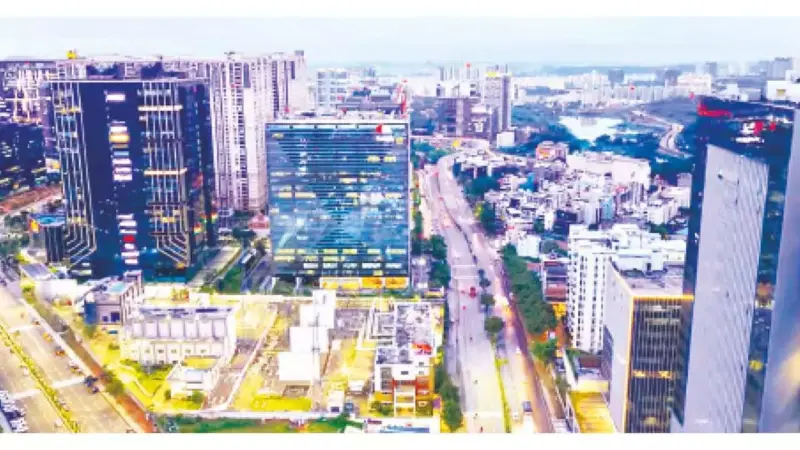

"Urban planning is not about managing the present; it is the deliberate act of structuring a stage for a future you cannot yet see."
For decades, the standard narrative of Indian urbanization followed a chaotic, reactionary script: a sudden economic boom triggers mass migration, which promptly overwhelms an inadequate, decades-old civil foundation. Cities would choke, stall, and then frantically retrofit roads and pipelines to keep pace with runaway demand. Hyderabad shattered this mold. By pioneering an anticipation-led developmental strategy over the past three decades, the city broke the traditional urban planning cycle. It did not merely react to growth; it systematically "de-risked" itself for global enterprise by constructing world-class infrastructure before the capital and corporations arrived.
Today, Hyderabad stands as a premier global economic engine, offering a profound masterclass in how proactive master-planning can future-proof a modern metropolis.
The genesis of anticipatory engineering:
The seeds of Hyderabad's modern transformation were sown in the late 1990s with the inception of HITEC City. Rather than waiting for technology giants to request high-capacity infrastructure, visionary planners laid down robust grid roads, dedicated high-voltage power lines, and dense fiber-optic networks across a largely vacant, rocky landscape. This strategy shifted the psychological burden of relocation for multinational entities. By offering zero-gestation, plug-and-play operational spaces, Hyderabad turned potential logistical risks into immediate commercial certainties.
This philosophy quickly expanded from localized tech parks to macro-mobility networks. The creation of the 158-kilometer Outer Ring Road (ORR) stands as the ultimate fulcrum of this economic decentralization. The ORR did not just alleviate inner-city congestion; it effectively opened massive peripheral land parcels for orderly development. Suburban micro-markets like Kokapet, Tellapur, and Narsingi, which were once rural outposts, have been transformed into soaring vertical townships because the high-speed transit framework was already in place to support them.
Multimodal logistics:
Hyderabad's blueprint reaches far beyond IT office parks. True economic resilience requires a diversified industrial base, which the city has nurtured through specialized infrastructure corridors. To the south, the Rajiv Gandhi International Airport (RGIA) at Shamshabad anchors a massive aviation, aerospace, and multimodal logistics ecosystem.
To the north and west, specialized hubs like Genome Valley and the upcoming Hyderabad Pharma City address the unique structural demands of the life sciences and biotech sectors. These zones are not just real estate developments; they are heavily engineered ecosystems featuring integrated effluent treatment plants, uninterrupted industrial power grids, and cold-chain logistics networks designed to sustain global supply chains.
Internally, this industrial expanse is stitched together by a multimodal transit grid. The existing 69.2-km Hyderabad Metro Rail network successfully stabilised core intra-city commutes. Now, upcoming expansion phases are intentionally targeted at connecting the emerging outskirts and airport corridors, fostering true transit-oriented development (TOD).
Looking further over the horizon, the planned Regional Ring Road (RRR) is set to connect more than 30 neighboring satellite towns, fundamentally altering regional logistics and creating a massive secondary economic zone.
The sustainable path forward:
Yet, rapid hyper-growth inevitably brings friction. As concrete corridors push further into the periphery, Hyderabad faces the critical challenge of runaway urban sprawl. The most pressing technical imperative is the comprehensive redesign of its stormwater drainage networks. To prevent seasonal flooding, the city must aggressively upgrade its legacy drainage systems to match the pace of its paved infrastructure.
Furthermore, balancing this aggressive expansion with stringent environmental, social, and governance (ESG) compliance-such as preserving local water tables and integrating IoT-driven smart traffic systems-remains vital to keeping the city livable.
The success of Hyderabad is ultimately a testament to institutional continuity and public-private synergy. Single-window clearances like the TS-iPASS framework, alongside targeted infrastructure interventions via the Strategic Road Development Plan (SRDP), have built an incredibly fertile environment for institutional investment. High-grade commercial real estate continues to pull in global capital, while robust social infrastructure-including multi-specialty healthcare, international institutions, and vibrant public spaces like modern libraries-ensures that the human element of the city thrives alongside the economic machinery.
"The ultimate test of a great city's infrastructure is not how fast it allows its citizens to move, but how sustainably it allows them to live, work, and evolve across generations."
(The writer is a former OSD to Union Civil Aviation Minister)