




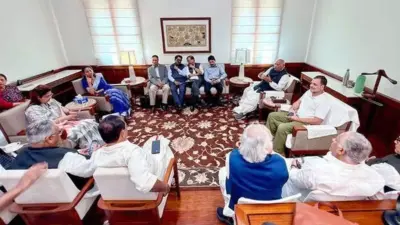

New Delhi: Leaders of the INDIA bloc are set to meet in New Delhi on June 8. Trinamool Congress president and former West Bengal Chief Minister Mamata Banerjee, who has often maintained a distance from the Opposition bloc, is expected to attend, among others.
Attention will also be on the DMK, which is upset with the Congress after it snapped ties and allied with the Tamilaga Vettri Kazhagam to join the government in Tamil Nadu.
Earlier, DMK Lok Sabha leader K Kanimozhi had written to Speaker Om Birla urging that her party's members be allotted seats in the Lok Sabha away from the Congress.
However, the upcoming meeting is being viewed by some political commentators as an attempt to revive the coalition that has lost momentum. Such assessments, however, overlook the alliance's continuing relevance in national politics and the realities of managing a diverse Opposition coalition in a federal democracy.
Since its formation in 2023, the INDIA alliance has faced significant challenges. Its constituent parties are rooted in different regions, represent distinct political traditions and often compete with one another at the state level. These contradictions have occasionally produced tensions, particularly in the aftermath of recent Assembly elections and shifting political equations in states such as Tamil Nadu and West Bengal. Yet these developments do not signify the end of the alliance. Rather, they demonstrate the complexities inherent in any broad-based political coalition.
The INDIA bloc remains a functioning parliamentary force. It continues to coordinate Opposition strategies, challenge government policies and raise issues relating to constitutional governance, federalism and social justice. Its ability to work collectively in Parliament has enabled opposition parties to present a more unified response to the BJP-led NDA government than would have been possible individually.