




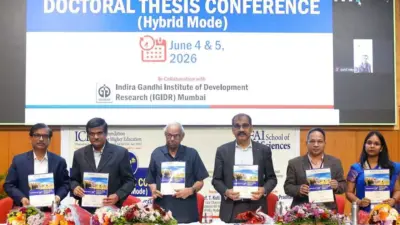

Hyderabad: India must accelerate its transition toward sustainable and alternative energy sources to safeguard its economy from global disruptions, former RBI Governor and Chairman of the Prime Minister's Economic Advisory Council, Dr C. Rangarajan, said at a two-day 18th Annual Doctoral Thesis Conference held at the ICFAI Foundation for Higher Education (IFHE), held recently on June 4-5.
Delivering the keynote address, Dr Rangarajan noted that many of India's current economic challenges stem from external shocks-such as disruptions in international trade, geopolitical tensions in West Asia, and volatility in global financial markets-rather than domestic structural weaknesses. These shocks, he said, have strained supply chains, raised energy and food prices, and created uncertainty across global markets.
Despite the rupee's recent depreciation, Dr Rangarajan asserted that India's economic fundamentals remain strong. He attributed currency pressures largely to capital outflows and expressed confidence that the rupee would regain strength once global conflicts subside.
Outlining a three-tier strategy to manage external shocks, he emphasised diplomatic engagement and diversification of supply sources in the short term, creation of strategic buffers-especially in energy-in the medium term, and selective import substitution in critical sectors over the long term. India's goal, he stressed, should not be self-sufficiency at any cost, but the development of competitive domestic capabilities in areas where overdependence on imports poses risks.
He strongly advocated accelerating India's shift toward renewable energy, electric mobility, and other sustainable energy systems to strengthen long-term energy security and reduce exposure to global volatility. He urged young researchers to address contemporary economic challenges through rigorous research and innovative methodologies.
The conference, jointly organised by the ICFAI School of Social Sciences (ISoSS) and the Indira Gandhi Institute of Development Research (IGIDR), Mumbai, brought together nearly 200 doctoral scholars from premier institutions, including IIMs, IITs, NITs, IIITs, JNU, and major central and state universities.
Prof. Basanta Kumar Pradhan, Director (Vice-Chancellor), IGIDR, delivered a special address on the global climate finance landscape, explaining distinctions between climate, green, transition, and sustainable finance while cautioning against greenwashing. He traced the evolution of climate finance from the Rio Summit to present-day global negotiations, highlighting the growing role of private capital.
IFHE Vice-Chancellor Dr Tamma Koti Reddy attended the inaugural session, while ISoSS Director Prof. C. S. Shylajan emphasised the conference's role in fostering research excellence.
Over two days, scholars presented papers on economics, management, psychology, public policy, sustainability, and the social sciences, receiving feedback from distinguished academics and policymakers.